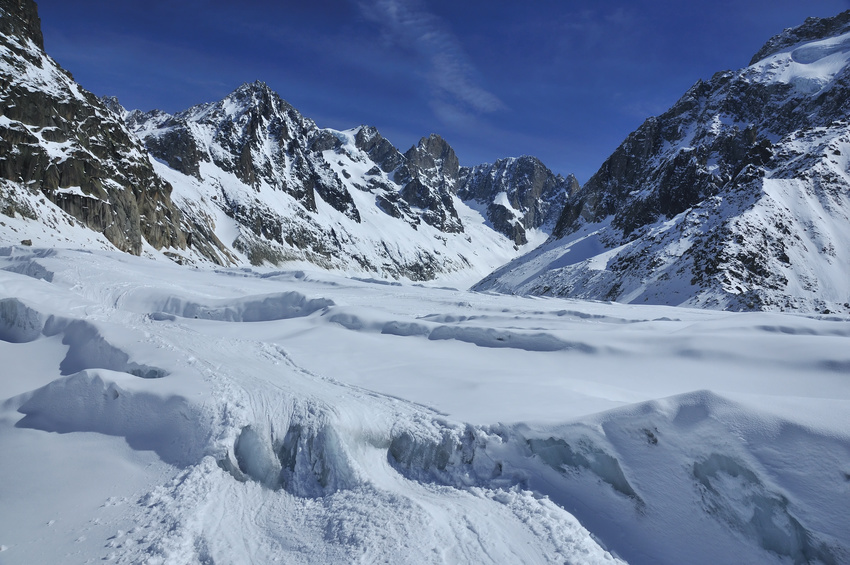
 Mer de Glace is well worth a visit for visitors of all ages. It is the second largest glacier in the Alps – approximately 9 miles long, almost a mile wide, and about 1200 feet in its deepest places. It moves more than 100 feet every year and is currently retreating.
There are several ways to reach the glacier; for those who enjoy hiking, we highly recommend walking from the middle stop on the Aiguille du Midi.
This hike works for those who take the Aiguille du Midi tramway. On the way down from the tram, stop at the first stop (which is about 1/2 way down the tram. The Grand Balcon Nord Trail leads to a small restaurant (about a 10 or 15 minute hike from the tram stop). From the restaurant, it is about a 1.5 hour hike to the Mer de Glace lookout. However, one will have views of the glacier before arriving at lookout.
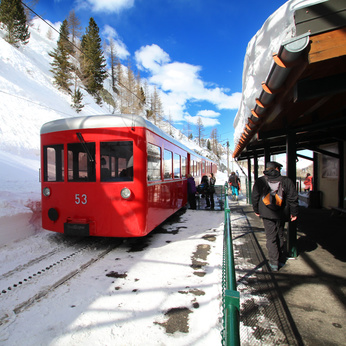
Another less taxing way to reach the glacier is to take the steep cog railway which leaves from the valley floor in Chamonix. This train leaves every half an hour and reaches a maximum elevation of about 6000 feet. The train ride from the valley floor to the glacier takes about 20 minutes and passes through some spectacular scenery. It is amazing how steep the tracks are. As you ride the train you can’t help but feel that the train is about to slip backwards or slide down the track. Before you depart make sure to look at the display of the train tracks at the station in the valley floor. Look closely at the large teeth in the middle of the tracks, and you might feel a little safer on your journey!
The train ride from Chamonix to the glacier round trip costs about 35 euros. From May through June the train runs daily from 8:30am until 5:30pm and departs every half an hour. During July and August the train runs daily from 8am until 6pm and departs every 20 minutes after 10am. Note: from July 15th to August 20th there is a special departure that leaves at 7 in the morning for mountaineers and glacier climbers. Lastly, from September through April the trains run daily from 10am until 4pm.
Several hiking trails cross the train tracks at particular points along the track. The conductor will always honk their horn when approaching these trails. The scenery is fantastic from the train. On a clear or partly cloudy day one will have excellent views of the valley floor and the mountain range opposite the train tracks.
One of the highlights of the glacier is the Grotte de la Mer de Glace. This is an ice cave that is carved into the glacier annually. As you walk down the several switchbacks of steps towards the glacier you will notice old tunnels, left over from previous years. Some will be almost caved in, and some will still have characteristics of their original shape. These old tunnels are a testament to the power and movement of this glacier. The cave has been carved every year since 1946. Tunneling work is started in mid February and continues for about three months.
 The cost to enter the glacier is 15euro and this includes a short gondola ride to and from the glacier. A large carpet is laid on the walkway providing traction on the slippery ice. The tunnel is carved several hundred feet into the glacier. Bring some warmth and a flash camera. Several ice sculptures are inside which make a great backdrop for selfies and other Instagram ready photos.
Beware about stepping off of the carpet outside of the tunnel. Usually there will be a plastic fence preventing curious visitors from walking on the glacier. If you leave the carpet you will be in a very dangerous part of the glacier. There are rocks constantly falling and sliding down the ice and the outside walls of the glacier are quite steep so the falling rocks move at a rapid rate of speed. I stood on the carpet and looked up the glacier and saw many rocks of all sizes falling down over the ice.
For those agile and wanting to climb on the glacier there is a place on La Mer de Glace just for you. I should first mention that you can take glacier climbing and hiking classes from local companies. You can also rent equipment from local stores in Chamonix, such as ice axes, crampons, boots, ect… See Our Equipment Rental/Purchase notes for more information. From the ice cave, walk up towards the first tram and then catch the trail that leads towards the start of the glacier, towards the mountains. This trail leads to a glaciology and crystal exhibit which displays a number of impressive crystals found in and near Chamonix. Our favorites are the large brown smoky quartz crystals. This exhibit is displayed inside a winding tunnel several hundred feet in length carved through solid rock, located on the right side of the path. I found that 10 minutes was a sufficient amount of time to see all that was displayed.
Continuing straight past the geology exhibit one will soon leave the paved path and enter a dirt trail. Depending on the weather and time of year you may pass people coming back from the glacier wearing crampons and holding ice axes. This dirt trail is about 1/4 a mile and ends on the edge of a sheer cliff. The glacier sits about 300 to 400 feet below the top of the cliff. Those comfortable descending to the glacier can do use using metal ladders with rods cemented into the cliff. The total length of these ladders is approximately 300 feet. Several sets of ladders are located here. For example, one ladder will drop down the cliff about 100 feet and then end on a small platform carved into rock, and then the next ladder begins and descends another 100 feet. If you are here in the summer time you may have to wait on these platforms for descending or ascending climbers. I do not recommend climbing these ladders if you are afraid of heights. The metal grips on the ladders can be quite slippery especially in the early morning and late afternoon so be very careful. If you choose to climb down you will eventually reach the bottom of the canyon carved out by the glacier.
Notice all the huge rocks along the side of the glacier. These have all been deposited by the glacier. The trail ends on a small plateau on the side of the glacier. Chances are you will see people putting on crampons and getting ready to ascend the glacier. When I climbed the glacier I did not have crampons, I just had an ice ax. This is all you need if you plan on staying on the dirt and rock that covers the glacier. If you plan on going further up the glacier to the solid ice and deep crevasses you certainly will need previous ice/glacier climbing experience as well as good crampons and an ice ax. You can walk about a 1/4 mile up the glacier and still be walking on glacial till (dirt and rocks). The end of the glacial till will depend on what time of year you are visiting the area. Watch out for the crevasses and deep holes in the ice.
If you do visit this area, either from the top of the cliff or from the glacier itself, bring a camera. This region is stunningly beautiful.
Leave a Reply