Part of the experience of staying in Colima City is being able to explore the surrounding regions through a variety of day trips. It is the friendliness and simplicity of the locals that has always attracted me to this part of Mexico – along with the fact this is not a heavily touristed part of the country. I love walking through some of the small villages, where the local people rarely if ever see tourists. On warm days in the afternoon sun, I would stroll by local village elders sitting quietly in the shade, reading, smoking, talking, but most often, napping. Small children play games of kick-ball in the dust of the old cobblestone streets.
On more then one occasion I encountered drunk men, one or two or maybe more. If you do, give them a cautious amount of room, and let the effects of their inebriation wear off as they stumble around talking to no one in particular.
Sometimes one will find a small soda shop on a corner of some street. Elderly men are often sitting in the shade of the store’s roof. Tip your hat, smile and walk in to purchase a refreshing drink, perhaps a Fanta. Walk out of the store slowly – absorb their questioning looks, but don’t ignore them completely. Look their way to, as they have their own story to tell. A simple smile will usually ease any unease. Stop to chat. Practice your Spanish, give them some of your time, take some of theirs. Tell them where you are from.
—
Comala is a small town of about 8000 people, about 7 or 8 miles north of Colima. Comala is known for its fine woodworking artisans who focus on creating hand-carved wood furniture. Visitors here on Sundays or Mondays will find the local markets worth visiting; the vendors are exceptionally friendly. While walking through some of the side streets, several families invited me into their homes, when they saw me admiring their house through their front door.
Most people just leave their front doors open, so as you walk by on the sidewalk you can get glimpses of the inside of the homes. One family invited me in for a drink while they told me about how they built their own house, and then they continued to talk to me about their jobs, and their family.
Like Colima, Comala gets the occasional bus tour from Manzanillo. I say occasional, because Comala isn’t what most people who stay in Manzanillo are looking for. Its a small town, with one central plaza; it does not have the feel of a tourist town. There are not enough shops to support a large tourist industry. Several restaurants in the main plaza offer outdoor seating. I saw one mariachi band playing during lunch time.
A small intriguing church is located in the main plaza or zocalo. A government building is located near this church; I was able to climb on to the roof and get a great view of the surrounding city. Several sidewalk cafes surround the main plaza. Most of them are open from 11am or 12pm to 6pm.
Lastly, when in Comala be sure to check out the small artists’ cooperative located a short walk from the main zocalo. This is where local artists create unique furniture, crafts, ceramics, leather, and other objects.
Suchitlan is a small village located about 5 or 6 miles north east of Comala. This town is famous for its authentic animal masks, however, chances are there won’t be any in stock, or you can’t find the stores where they produce these. I did locate one lady, who was known by all the local villagers. I ended up walking around this small village for almost 1/2 hour before I located a small thatched roof hut, down a thin trail which ended at a creek. I yelled for this lady, and she came out, but told me that she didn’t have any more masks, she had brought all of them to Colima to sell in the central plaza.
Eventually I learned that Sunday would be the best day to visit for purchasing wooden masks as this is the day that they sell masks in the local markets.
Continuing on about 10 miles past Suchitlan one will pass through very pretty countryside. The road will ascend into the hills while the vegetation becomes noticeably greener. Several restaurants are located along this section of the road. One in particular, I highly recommend. Unfortunately it will remain nameless because I forgot to jot it down. If you find it, let me know! Signs for this restaurant are located along the road – after ascending into the hills you will see a small dirt road leading off of the main road. This road ends after several hundred feet at a small parking lot. After climbing a few steps, you arrive at the restaurant.
Located in an incredible location, the restaurant is perched on the edge of a tall peninsula, with stunning views of the volcano from your table. One eats underneath a thatched roof, hopefully sipping on a stimulating alcoholic beverage with a metal or paper straw while a
beautiful and tanned woman across from you stares longingly into your eyes. After the appetizers you have lost yourself in her gaze and the alcohol and the world is just about right.
Photo courtesy of Vincente in Suchitlan
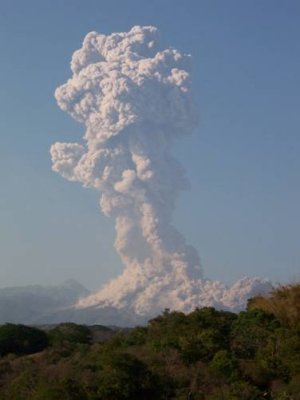 Because you are in a tropical environment at some point you may see leaf cutter ants. On more then one occasion, I watched these ants carry small pieces of leaves to their homes in the ground. Often entire bushes near their homes are completely devastated with very few whole leaves still intact.
Continuing on the road after lunch, you will wind through the hills towards the volcanoes. Eventually you will come upon a level spot in the road (a few clicks south of Suchitlan), which will probably be crowded with parked cars and people wandering around on the sides of the road. This is the “Zona Magica” or Magic Zone. Apparently this section of the road is where cars will ‘magically’ roll up hill. Don’t believe it. It is an optical illusion. I tried this with my rental vehicle. I put the car in neutral and took my foot off the brake and sure enough, the car rolled up hill. Presto!
As you continue driving you will wind further up in the hills towards the volcanoes. The paved road will end about 12 miles north of Comala. At the road’s end one will find a smaller road leading to an elegant hacienda. This hacienda is the site of a former 19th century coffee ranch. It was converted to a hotel several years ago, and all the tour books I have read say that it is open to the public. However, when I tried to drive in, many armed guards ran up to the front and sides of my rental car, and stopped me from entering. I played dumb tourista and pleaded innocence and told them I had come all the way from California to visit – but they still wouldn’t let me in. Even after I tried to slip them some small bills.
The end of the paved road turns to dirt and rubble, but you can continue driving further up the road, if you drive slow. There was one bad section in the road, which requires a little off road driving experience, but for the most part the road was decent. This challening section crossed through the creek. To drive this requires driving very slow, and getting the underside of the car wet. I stopped at the creek and took out a watermelon that I had purchased earlier in the day. I sliced it open with my handy and always-trustworthy Swiss army knife, and let the sweet juice dribble down my throat. I sat on one of the many large rocks overlooking the small stream and watched locals return from a hard days work. Most of the workers I saw did not have cars and they were walking home. They took off their shoes before the stream and waded across. Those workers that did have transportation back to their home villages, were fortunate not to have to walk, but unfortunate in that they were crammed in large open air trucks with lots of other workers.
After eating through the majority of the watermelon, I decided to walk down the road. One nice feature of this area, is that there are large sugar cane trucks hauling the cane out of the fields, down to markets in Colima city and elsewhere. Every time one of these trucks rounded a corner or went over an unusually large bump several pieces of the cane would fall out of the back of the truck and land in the road. This was exciting to the locals, as they would rush over to the fallen piece(s) of cane and begin chewing on the sweet stringy stalks. I found a few that the locals had not discovered. Also excitedly I quickly snatched them up off of the dusty ground and chewed slowly, absorbing the fresh sugar water.
Those who continue on this road, will eventually come to Laguna La Maria, a small lake with a nearby eco lodge and a camping and picnic spot. A few cabins are also located here, each with a small kitchen.
Now, you are now a lot closer to the volcanoes then you were in Colima City. It is possible to climb these mountains for adventurous travelers.
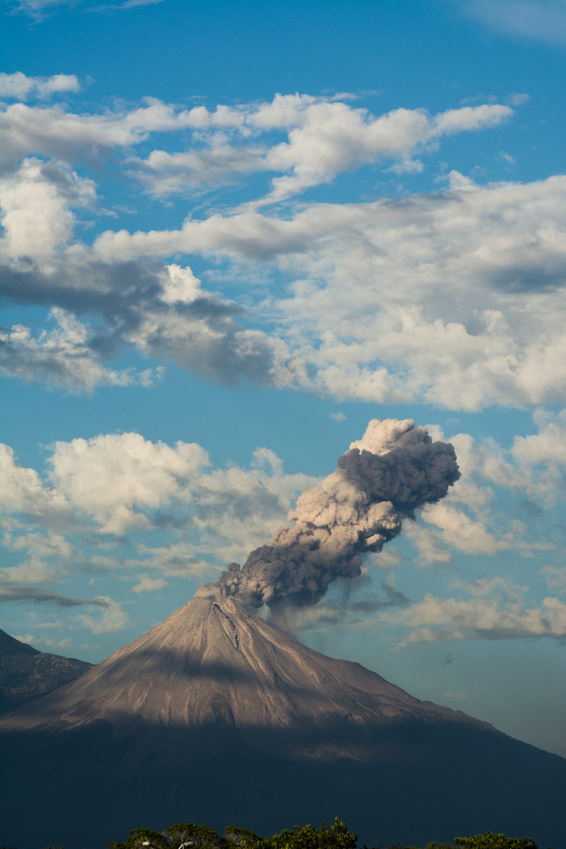 Nevada de Colima is the taller of the two at about 14,202 feet, and the Volcan de Fuego de Colima is about 13,000 feet. These volcanoes usually have snow on their summits from December/January through March or April. During the height of winter each summit may have over 25 feet of snow.
A dirt road leads up the Nevado de Colima. It takes you to within a couple of hours walk of the summit when there isn’t any snow on the mountain. From Colima the drive is about 2.5 to 3 hours one way – which puts you in position of hiking the rest of the way to the top of either mountain. Contact the Colima tourist office for more information about climbing these volcanoes. Another way to access the summits is to contact the Universidad de Colima Vulcanology department, and find out if they are going to be taking research vehicles to the volcanoes. The Universidad de Colima is located about 1.5 miles north east of the main downtown zocalo/plaza.
—
And a final mention:
Tampumacchay is located almost due south of Colima off of Highway 110 (the opposite direction of all the towns mentioned above). Tampumacchay contains shaft tombs that date from 200AD. These tombs are located on the grounds of a small hotel in a tiny suburb of Tampumacchay called Los Ortices. Los Ortices is located about 10 or 11 miles south of Colima city. This small hotel is open to the public and hotel staff will guide you around and through the tombs.
Leave a Reply