I highly recommend hiring a guide for touring Lamu. Visitors probably will only need a guide for no more than 2 days as much of the town can be accessed on your own on foot. However, a guide will point out difficult to find attractions and may introduce you to some of the locals and hidden gems of the town. He can also be a good source of restaurant and lodging recommendations. Lamu is small enough where the guides are aware of most of the restaurants and lodging in town.

Mohamed Mahazi is a licensed tour guide for Lamu. We used his services for several days during our visit.
He is an excellent tour guide who can recommend good restaurants and personally knows a number of fisherman. He speaks decent English and loves showing visitors around his town.


The following are several attractions that I visited and I recommend seeing:
Donkey Sanctuary is located on the harbor front and is run by the International Donkey Protection Trust – of Devon, United Kingdom. Injured donkeys are brought to this small stable for rehabilitation. There isn’t too much to see here except for the donkeys – but its a nice place to stop and relax.
Lamu Fort is located along the seafront and dates from the 1820’s.
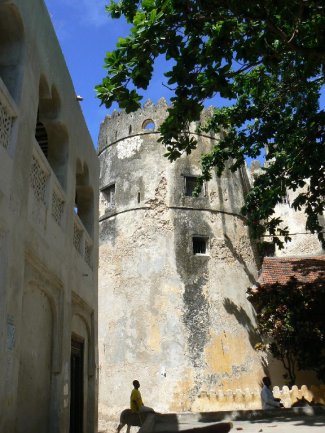
Photo courtesy of Maria Baker
Lamu Museum is located on the waterfront. This museum contains many traditional Swahili items of interest. 45 minutes to 1 hour recommended visit time. Good views from the terrace on the second story.
Lamu Meat Market. This market is enclosed in a long covered building – open at both ends. Much of the fresh fish caught near Lamu seems to be brought here for sale. Visitors are greet with swarming flies and the smell of freshly caught fish.
Dhow Trips. Dhows are wooden boats – often appearing to be crudely constructed. Their appearance can be misleading as they perform wonderfully in the open water. A normal dhow trip can cost around 500KShilling for a couple of hours. Dhows are often seen around Lamu’s harbor front.
Fishing – For a very relaxing excursion hire a local fishing guide to take you out on the water in a dhow. Our guide in Lamu (Mohammed) introduced us to a local fishing guide who owned an ancient looking dhow. The fishing trip lasted about 1/2 the day – we left around 8am and returned around 2pm. The boat was constructed with ancient looking timbers and the sail was a patchwork of many different types of fabric somehow stitched together. The boat sailed a crew of 5, not counting myself – 3 boys ranging in age from 12 to 15, the captain and a grizzled dark old man who looked like he lived at the sea. His beard was almost white which stood out in stark contrast to his dark weather-beaten face.
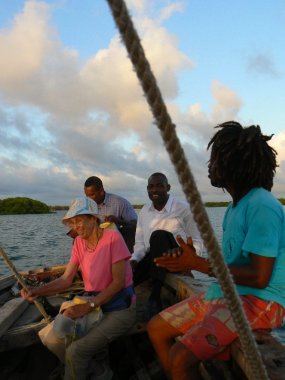
Photo courtesy of Maria Baker
Pieces of cut up fish served as the bait. As soon as I caught a fish from the bottom the captain sliced it up into little pieces for additional bait. We caught many fish over the next hour. After we tired of fishing the captain pulled anchor and took us to another small island where we swam in the warm Indian Ocean and waited to be called to lunch to eat our freshly cooked fish.
We had lunch on this deserted island eating the fish we had caught only hours before. The fish was then washed down with many slices of fresh papaya. There was no one around aside from me and the fisherman. After lunch I spent an hour or so sleeping in the minimal shade of a native thorn tree.
Be sure to bring a wide brimmed hat and suntan lotion. You will be on the water for several hours in the glare of the sun and its easy to get sunburned. If you are sensitive to sea sickness I recommend some Dramamine or equivalent medicine.
Shela Village is located about 10 to 15 minutes via motorboat from Lamu or about 45 minutes via a walkway linking with Lamu. Visitors looking for isolated and picturesque beaches should consider a visit to Shela Village.
Comments or questions about this guide? Post them on Dave’s Africa Forums.
To all my African brother and sisters always strive to be the best at everything explore unknown worlds like finding new dinosaur bones or find a real dinosaur and find a way to bring back a dinosaur alawy remember you are strong and NEVER NEVER NEVER NEVER NEVER NEVER NEVER NEVER NEVER NEVER GIVE UP.
Wolfman – great advice!