 I remember looking out my window on the night flight from Europe to South Africa and seeing nothing but black below. No city lights for hours. Not until the next morning when the plane was over South Africa, were any signs of civilization present. On that flight I tried to imagine what it would be like to actually be in one of those areas that seemed so dark from above. Well, we finally entered this part of Africa when we crossed the “veterinary cordon” in Namibia’s Caprivi Strip. This fence separates the large, white owned commercial cattle ranches of the southern three quarters of the country from the communal and subsistence cattle herds of the north. Its purpose is to keep rinderpest and foot-and-mouth disease away from the southern cattle ranches, but it also effectively marks the boundary between the first world of South Africa and southern Namibia and the third world of the rest of Africa. The flat landscape became noticeably greener and densely wooded. The termite mounds became taller, larger, and sometimes surrounded and virtually consumed whole trees from the ground up. The European colonial influences on towns disappeared as well and we started seeing more and more “rondavels”, traditional round huts made of mud brick and thatch roofs. The air was thick with smoke from individual cooking fires in front of each home and from slash-and-burn agricultural practices. Land cleared by fire can be planted with maize, cassava and vegetables to provide the villagers with food. We constantly observed women doing all the chores from cooking and washing clothes to tilling the fields and harvesting crops. They carried water from the local pump with children tied to their backs. All this intense physical labor endowed the women with burly muscles and the many pregnancies endowed them with rich bosoms. This was contrary to what I expected to see in such a manual lifestyle. I imagined to everyone in these conditions to be very lean. The men, on the other hand, fit my preconceived notion of leanness.
This picture remained with us as we left the Caprivi and entered Botswana. At the border crossing, our milk got taken away from us and dumped into a burning fire pit. We received no explanation, so we assumed that it must have something to do with the cattle diseases. Then our entire bus had to drive through a pit presumably filled with some sort of disinfectant, while all passengers had to get out and walk through a mini pit also filled with the disinfectant. I still felt sweaty and hot but my feet were squeaky clean. Our initial impressions of the country were lush forests and tropically humid weather and many, many donkeys and other farm animals grazing right along the roads. In fact, the roads seemed to be the center of all activity, as children played, people walked, women cooked, men socialized, and animals just blocked them. As expected, the driving was very slow but accepted by everyone as a fact of life. We finally started seeing the true speed at which Africa moved. I didn’t mind at all because the tropical weather had a similar effect on me and all movements slowed down, especially during the heat of the day. We spent some time in a game lodge right on the confluence of the Chobe and Zambezi Rivers not too far from town. Both were slow moving beasts that wound their way lazily through the dense brush and trees. We set our camp up near the Chobe River and slowly a fuzzy feeling of impending animal encounters crept up. But the first animals crept up rather suddenly, as I noticed the white furred, black faced vervet monkeys swarming in the trees above and following my every move in the hopes of scoring something to eat. The first visitors to come after food were not the vervet monkeys, but some warthogs with fearsome tusks and big heads that took up half their body lengths. They sniffed and grunted their way around our camp but showed no interest in me at all. I was happy about that; the last thing I needed was a big dirty tusk up my.uh.behymen. Crocodiles were another matter and a very serious consideration.
With this area being so river laced, Abdul and I decided to hire a pontoon boat and guide in the hopes of seeing some of the wild life of the nearby Chobe National Park. It cost a bloody fortune, but turned out to be worth the money, as we had unparalleled views and very knowledgeable guides. I forget the names of the myriad birds we saw, but will not forget the vast numbers of crocs floating around everywhere. One particularly primitive looking specimen with dinosaur like plates gracing its back and tail happened to be catching the fading sunlight on the shore when our boat floated past. At about 4-5m (12-15 feet) and a belly that could hold a zebra, it didn’t react at all to our presence, but continued to keep its jaws open into the sun. Those were some of the most evil looking slit eyes I have ever gazed on. Further down the river we came upon literally hundreds of elephants grazing and wandering around slowly and gracefully. As big as these beasts are, they moved about in complete silence, even underfoot nothing snapped or rustled. We noticed groups separated according to sex and age; large matriarchs led other, lower ranking females and calves, while young bulls congregated in bachelor herds in the reeds along the river and conducted playful mock fights. Older bulls usually lead solitary lives. Of course, where there is water in this part of Africa, one can be sure to eventually come across the eyes of a hippo floating serenely in the calmer spots. But submerged in water and underneath those two eyes, hide over 2 tons of thick skinned flesh and bone. During those rare occasions, when one of these hippos actually leaves the water in day light, it’s possible to witness the massive rounded features of its body. It seems lazy and slow, but on land these pachyderms can outrun any human and are credited with killing more people than any other animal each year. Such a brutal trampling death usually occurs at night because some hapless person walks into the path the animals use to retreat into the water.
Satisfied with our fill of animals along the Chobe River, we decided to head for the Okavango Delta in the heart of Botswana. To get there we had to opt for the notorious minibuses that we had so desperately tried to avoid in the past. No choice here, though. We were able to flag one overloaded, low riding, tire bulging vehicle down and the driver squeezed us in somewhere in the back row. Unable to move any body part except my eyes, I counted about twenty to twenty two people inside a vehicle the size of a large minivan. Inside, however, everyone seemed happy and the music thumped, as we careened down the highway, swerving around loose donkeys and large potholes. With the vertical noon sun beating down on the roof, the un-air-conditioned interior heated up quite a bit and sweating didn’t help much, it just lubricated our skin as everyone tried to move their limbs around to prevent them from falling asleep in their wedged positions. Besides staying in a small village, a minibus trip with the locals is actually a very African experience that gives a foreigner a very good picture of the life of an average African. We were completely surrounded by the sights, sounds, smells, and textures of African villagers at an African distance: inches from our faces and stuck on our skins. That’s how we got to the Okavango Delta.
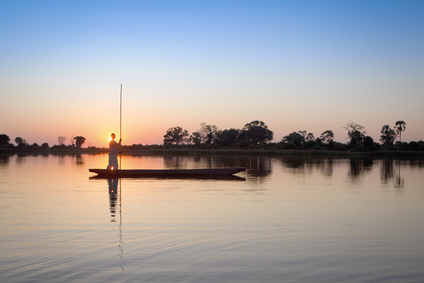
The 1400 km long Okavango River originates in the Angolan Highlands and, unlike most other rivers of the world, flows inland to sprawl in a huge delta and eventually drain into the Kalahari sands or evaporate in the hot air. The delta is laced with a virtually infinite number of channels, lagoons, and islands. This wetland is one of the biggest tourist attractions in Botswana, and accordingly, we ran into plenty of them during our stay there. A highly recommended activity is a trip into the maze of streams in a long pole powered dugout canoe. Known as ‘mokoro’, these canoes are manned by a guide with a long pole, who pushes it slowly and silently through the reeds and papyrus. Due to outrageous prices that these guides demanded and knuckleheaded tourists willing to pay them, we couldn’t afford even a half day on a mokoro. Instead, Abdul and I teamed up with a couple of like minded Kiwis (traveler speak for a New Zealander) and hired some horses and guide for an unforgettable trip into the bush on horseback. To accentuate the possible dangers, my horse had huge scars on its rear end, inflicted by a crocodile. The guide told us that it ventured near the water’s edge a little too long and barely escaped the jaws of a 4m croc. Ay caramba!! We were able to ride through some remote delta villages accessible only by these means. No electricity, no running water, no gas, no mail delivery, no phones, and still around in the twenty first century. Amazing.
As much as we would have liked to stick around Botswana, we had to cut our stay short because of outrageously expensive prices for foreigners. Most of the bush lodges demanded sums that would make a first class weekend in Las Vegas seem like a trip to McDonald’s. It seems as though the Botswana government actively pursues the low volume, high budget kind of tourism. It was too bad, as the people themselves did not seem at all concerned with such issues and just pursued their simple subsistence life styles. So we mini-bussed it in African style and tortuously slow from town to town until we reached the border of Zimbabwe. Here, Abdul and I embarked on a trip through a different side of Africa, one of bureaucracy, corruption, instability, greedy strong-man presidents and utter nonsense. But we also saw one of the absolute top natural wonders of the world. More about that later.
wonderful site, great shape on it , fantastic work guys
There are actually a number of details like that to take into consideration. That is a great level to bring up. I offer the ideas above as common inspiration but clearly there are questions like the one you deliver up the place a very powerful factor shall be working in sincere good faith. I don?t know if finest practices have emerged round things like that, however I’m certain that your job is clearly identified as a good game. Each boys and girls feel the affect of just a second’s pleasure, for the remainder of their lives.