The first time I ever saw elephants in a national park, it was a life-changing experience.
Africa offers some of the best places in the world to encounter these giants up close.
As a travel expert with 10+ years on safari all around Africa, I’ll guide you through where to see elephants in Africa, why these national parks are special, and when to visit them (some times are better than others).
By the end, you’ll know where to find them in Kenya, Botswana, Tanzania, Zimbabwe, and South Africa.
Kenya: Amboseli National Park
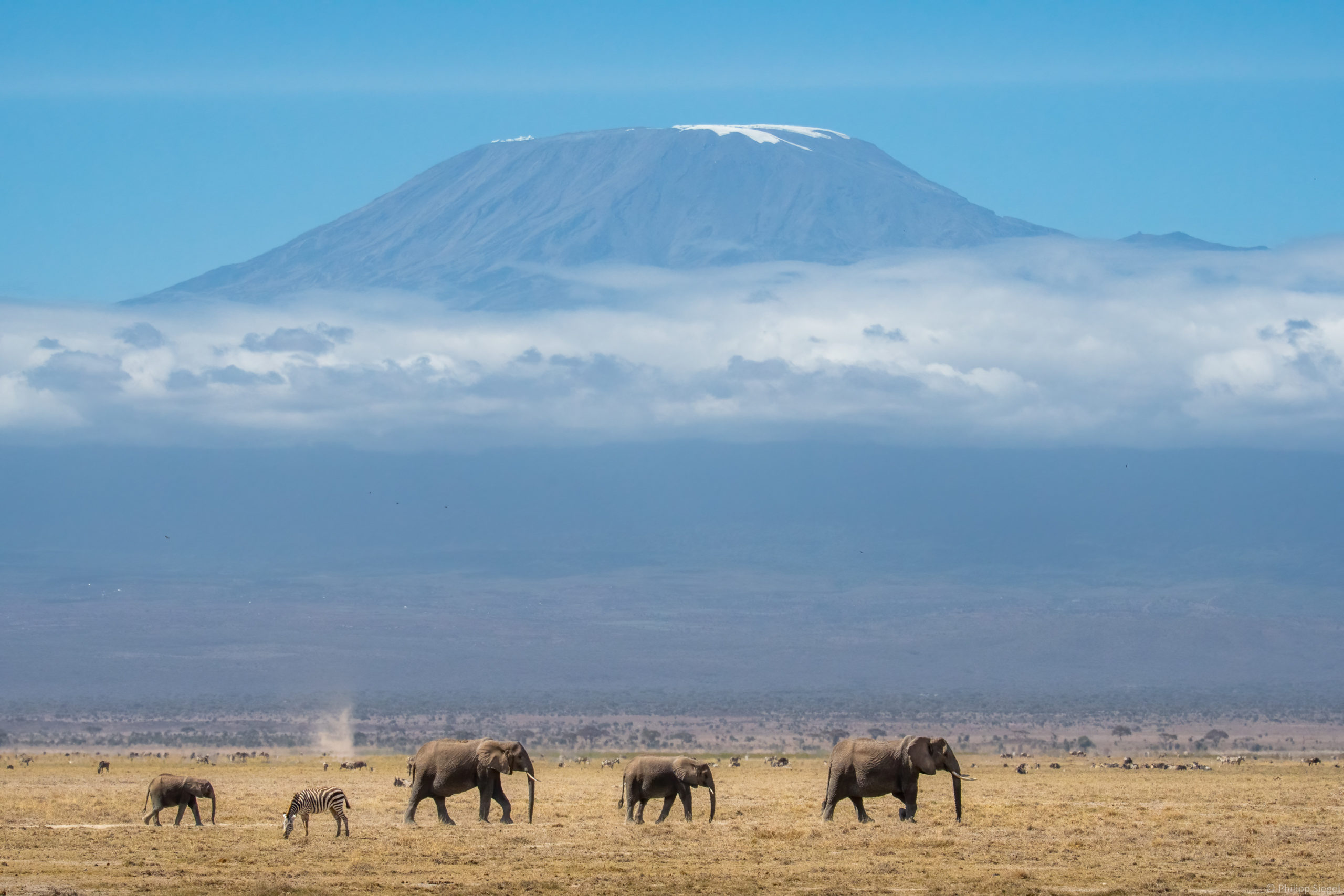
If you’re wondering where to see elephants in Africa first, Kenya should top your list.
Amboseli National Park in southern Kenya is famously called the “HOME OF THE GIANT TUSKERS“, referring to the elephants with their giant tusks.
It’s famous for large elephant herds grazing in open marshes with Mt. Kilimanjaro in the background (I’m sure you’ve already seen these Instagram-famous pictures).
Amboseli hosts around 1,500 – 2,000 elephants.
Last time we went, we saw multiple families at once. We counted almost 50 elephants!

Wildlife experience
Amboseli’s elephants live in its swampy wetlands, especially during the dry season (June–October).
With little rain then, elephants gather at the park’s permanent marshes.
The most special activity in Amboseli is heading out at sunrise and seeing the elephant silhouettes with the golden Kilimanjaro in the background, before the clouds come at around 10 am.
Peak season
Visit Amboseli in the dry months of June to October or January and February for the best elephant viewing.
During these months, rain is rare and elephants concentrate near water, making them very easy to spot.
👉 INSIDER TIP: Amboseli is perfect to mix with a visit to the famous Masai Mara during the popular 7-day Kenya itinerary focused.
Tanzania: Tarangire National Park

Tarangire National Park
Next door to Kenya, Tanzania is another top choice for ‘where to see elephants in Africa’.
While the Serengeti and Ngorongoro Crater are famous for general safaris, Tarangire National Park stands out as THE PLACE TO BE for elephants.
Located in the north, Tarangire is often overlooked by first-timers, which is great for you, because it means fewer crowds and a more personal experience with the wildlife (there won’t be 40 cars gathered around a group of elephants).
Why Tarangire
In the dry season (June to October), Tarangire hosts the LARGEST elephant gatherings in Tanzania.
The park’s lifeline is the Tarangire River; as surrounding areas dry up, elephant herds up to 300 strong converge on the riverbanks.
Imagine dozens of elephant families all coming to drink and play in the mud.
Overall, about 3,000 to 5,000 elephants inhabit Tarangire and its ecosystem, depending on the season.
Beyond the numbers, the landscape is Instagram-perfect: huge baobab trees across the plains.
Best time
Like Kenya, Tanzania’s dry season (June to October) is the best time for elephant safaris.
By August and September, Tarangire’s elephants are practically guaranteed at the river.
You’ll likely see elephant herds every few miles, especially in the afternoons near water.
They are very active. You can expect to observe all sorts of behaviors: mud-bathing, trumpeting, or babies trying to use their trunks to drink water (often soaking themselves in the process!).
Another advantage: Tarangire is a lot more relaxed than the Serengeti, so you can often watch elephants undisturbed by other vehicles.
Note: Tarangire, at 1,100 square miles, is a huge area, so I recommend hiring a good local driver for a private or group safari.
👉 INSIDER TIP: Don’t rush off each day at sunset. I recommend enjoying the famous Tarangire’s sundowners (cocktails in the bush at sunset).
Botswana: Chobe National Park

Chobe National Park
When discussing where to see elephants in Africa, Botswana must be in the conversation.
Chobe National Park, in Botswana’s north, is seen as THE BEST PLACE ON EARTH TO SEE ELEPHANTS.
That’s not me saying that, Chobe has Africa’s largest elephant population, estimated around 120,000 to 130,000 elephants living acriss its 4,500-square-mile area.
What to expect from Chobe National Park
Chobe’s elephants are Kalahari elephants, known to be large in body size.
They migrate seasonally between the park and Zimbabwe and Namibia in search of food and water.
During the dry winter months (May to October), they concentrate by the Chobe River.
Each afternoon, as temperatures peak, elephants emerge from the bush and head to the river to drink, bathe, and play.
It’s not unusual to see big bull elephants SWIMMING ACROSS THE RIVER CHANNELS, trunks snorkeling above water, or lines of mothers and calves crossing shallow spots.
That was one of the craziest things we have ever seen!
Boat cruise safaris are a highlight in Chobe NP. From the deck of a river boat, you might float past a herd of 50 elephants on the shore, and soon after watch a dozen more swimming right in front of you!
Chobe is divided into regions, with the Chobe Riverfront (Serondela) being the most popular for elephants.
Beyond Chobe, the Okavango Delta and Linyanti Reserve also harbor large elephant populations, many of the same elephants move between Chobe and these areas since there are no fences.

Best time
The best time is around July to October for peak elephant concentrations in Chobe.
September tends to be dry, hot, and absolutely packed with elephants (and yes, other wildlife like buffalo and giraffes who also crowd the river).
August is a sweet spot with cooler weather and high elephant numbers.
Just note that peak season is also peak tourist season here so the riverfront can have many safari vehicles and boats.
👉 INSIDER TIP: In Chobe, don’t skip the boat safari. It offers a perspective unlike any other. Some elephants swim to the sedge islands while you watch from a safe distance.
Zimbabwe: Hwange National Park

For travelers looking beyond the usual destination, I recommend Zimbabwe’s Hwange National Park to see elephants in Africa.
Hwange (pronounced “Wang-ee”) is Zimbabwe’s largest park and one of Africa’s great ELEPHANT REFUGES.
It has 44,000 elephants within nearly 14,650 km² of wilderness. In practical terms, that means massive herds. So it’s normal to see hundreds of elephants in a single day during the dry season here.
Wildlife viewing
Hwange has a mix of forests and open plains.
In the dry season (July to October), water is scarce except at the PUMPED WATERHOLES, which the park maintains.
Elephants have learned this and gather at waterholes every day in impressive gatherings.
One famous spot is Nyamandhlovu Platform, where you can watch from an elevated stand as family after family of elephants march in for an evening drink.
Hwange is also rich in other wildlife (lions, buffalo, giraffes, and more), but elephants steal the show.
A special treat in Hwange is the “Tusker” elephants, a few big bulls with impressive tusks (though not as many as in Amboseli National Park in Kenya).
The park’s conservation efforts since the 1920s have made it a safe haven, so elephant numbers have grown significantly.
Access & combo: Hwange is typically accessed via Victoria Falls.
A 2.5-hour drive (around 110 miles / 180 km) or a short charter flight brings you from Victoria Falls town into Hwange Main Camp area.
This makes it easy to combine an adventure: see Victoria Falls (one of the Natural Wonders of the World), then go on safari in Hwange.
Best time
Like other southern African parks, the dry season (Aug to Oct) is best for elephants in Hwange.
If you visit in the green season (December to March), elephants disperse into the teak forests, and sightings are more hit-or-miss (but you’ll see baby animals and lush scenery).
South Africa: Kruger NP & Addo Elephant NP

Kruger National Park
No list of where to see elephants in Africa would be complete without South Africa.
While South Africa’s parks don’t have the absolute largest herds like Chobe, they offer an accessible, well-managed safari experience, which is perfect for first-time visitors.
South Africa offers two parks where you are guaranteed to see elephants.
Kruger National Park

Kruger National Park
South Africa’s flagship park (nearly the size of New Jersey) is home to about 15,000 elephants.
Elephants are plentiful throughout Kruger, so you can expect regular sightings while driving.
The unique aspect here is that you can self-drive. This means you can rent a car and explore at your own pace (Kruger’s roads are well-maintained).
Many elephants in Kruger are accustomed to vehicles, meaning you can often watch them calmly crossing the road just yards in front of you!
Kruger’s elephants tend to roam in smaller family groups (5 to 20), but you might see larger aggregations at rivers in dry months (winter).
Just remember to keep a safe distance (park rules say 20 meters minimum) and never get out of your vehicle except at designated areas.
Addo Elephant National Park
Located in the Eastern Cape (near Port Elizabeth/Gqeberha), Addo is malaria-free and focused on elephants.
It started as a sanctuary for just 11 elephants in 1931, and now over 550 elephants thrive in this 1,640 km² park.
Elephants here often gather at waterholes like Hapoor Dam. At times, you might count 50+ elephants in one view.
The park has viewing hides where you can safely watch elephants at close range as they drink and interact. Because there are no lions in the main section (lions exist in a separate, fenced section of Addo), the elephants can be quite relaxed and sometimes come very near the tourist areas.
👉 INSIDER TIP: When in South Africa, mix wildlife with a bit of local culture. Near Addo, you can also tour a local citrus farm or enjoy a braai (South African barbecue) night under the stars. Some lodges arrange this, giving you a taste of authentic cuisine. And if you’re around Cape Town after Addo, consider a stop at The Oranjezicht Market on a Saturday. It’s a trendy spot where locals and influencers alike brunch with Table Mountain as a backdrop (not safari-related, but a cool experience to round out your trip!).



Leave a Reply