Connecting panels in series raises voltage. Connecting them in parallel raises current. Both arrangements can deliver useful solar power, but only when the array remains inside the solar generator input window for voltage, current, and total wattage.
The better setup therefore depends on the power station, panel specifications, cable run, shading pattern, and weather. A diagram that works for one product can exceed another product’s electrical limits even when the panels share the same rated wattage.
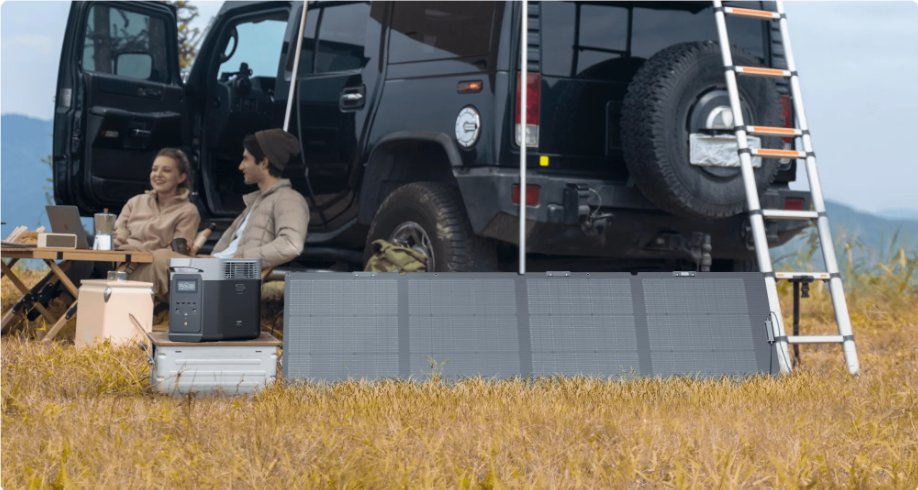
Photo credit: Sabiha
Start With the Power Station, Not the Panels
Read the station’s PV input range before planning an array. The EcoFlow DELTA 3 Plus, for example, provides two DC solar inputs. Each accepts 11–60V and up to 500W, creating separate voltage and power boundaries for each connected string.
A solar generator includes storage, an inverter, a charge controller, and defined DC inputs. The controller cannot make an unsafe array compatible. It can optimize power only after the connected voltage and current fall within the supported operating limits.
Gather these three values from the current manuals before connecting anything. Cold-weather open-circuit voltage deserves special attention because panel voltage may rise as temperature falls and move a series string beyond its planned margin:
- Record each panel’s open-circuit voltage, operating voltage, operating current, and rated power.
- Record the station’s minimum voltage, maximum voltage, maximum current, and wattage limit per input.
- Calculate the complete array at the lowest expected temperature rather than using only a warm-day reading.
Understand What Series Changes
Series wiring connects the positive lead of one panel to the negative lead of the next. The string voltage adds, while current remains near the current of one panel. That pattern can reduce current-related loss on longer cable runs.
Voltage Adds Across the String
Two panels operating near 20V and 5A form an approximately 40V, 5A series string. Rated power remains about 200W because 40V × 5A = 200W. Four identical panels would approach 80V and exceed a 60V input before other margins.
Current Stays at the Weakest Level
The same current passes through every panel in a simple series string. If shade limits one panel, the string may be constrained by that weaker current. Bypass diodes can reduce some loss, but they do not make shading irrelevant.
Higher Voltage Can Help Long Runs
For equal power, higher voltage means lower current. A 400W array at 40V carries about 10A, while 400W at 20V carries about 20A. Lower current may reduce cable voltage drop, provided the station’s voltage limit remains protected.
Cold Conditions Shrink the Safety Margin
Open-circuit voltage is the value to use for the upper-limit check. A string that sits just below the limit on a warm afternoon may rise above it in cold weather. Use the panel’s temperature coefficient or manufacturer guidance when available.
Series Works Best With Consistent Sun
Series can suit an open site where matched panels face the same direction and receive similar light. It may be less forgiving beside trees, roof vents, or vehicles that cast moving shadows across only one module.
| Array example | Approximate voltage | Approximate current | Rated power |
|---|---|---|---|
| Two 100W panels in series | 40V | 5A | 200W |
| Two 100W panels in parallel | 20V | 10A | 200W |
| Four 100W panels, two strings parallel | 40V | 10A | 400W |
| Four 125W, 50V panels in parallel | 50V | 12A | 500W |
Understand What Parallel Changes
Parallel wiring connects positive leads together and negative leads together. Voltage stays near one panel’s voltage, while branch currents add. That structure can preserve output better when one branch is shaded, but the higher current requires suitable connectors and conductors.
Voltage Remains Near One Panel
Two 20V, 5A panels in parallel create approximately 20V and 10A. The solar generator sees a voltage similar to a single panel, which may help when a series string would exceed the DC input’s maximum voltage.
Current Adds at the Combiner
Every parallel branch contributes current. Four branches at 3A each may approach 12A under strong sun. Confirm that the station, branch connectors, combiner, extension cable, and any required overcurrent protection support the calculated total.
Shaded Branches Affect the Array Differently
One shaded parallel branch may lose output without forcing the same current reduction through every unshaded branch. That does not eliminate shade loss. It changes how the loss spreads through the array and may improve production in mixed conditions.
Use this comparison only after the site conditions and equipment limits are known. It is a decision aid for matched panels, not a substitute for the model-specific wiring diagrams and protection requirements:
- Favor series when the voltage margin is ample, panels are matched, and shading is minimal.
- Favor parallel when voltage is already high or separate branches face different shade patterns.
- Use series-parallel when neither one long string nor many high-current branches fit the equipment limits cleanly.
Apply the Limits to a Real Product Example
EcoFlow’s 125W bifacial modular panel is rated at 50V and 3A. The product page describes parallel expansion for 60V-class inputs and series capability for systems designed around 150V. The correct configuration changes with the connected power station.
Compare It With a 60V Input
Two 50V panels in series would create roughly 100V before cold-weather adjustment, so that string would not fit an 11–60V input. Four in parallel remain near 50V, add to about 12A, and provide 500W of rated panel capacity.
That calculation is an electrical-screening example, not installation approval. The exact solar generator input-current limit, connector specification, fusing requirements, panel open-circuit voltage, and environmental adjustment still control the final design. Stop if any required specification is missing.
Verify the Array Before Connection
Write down the proposed solar generator branch and string math before assembling cables. Then measure polarity and open-circuit voltage with appropriate equipment or use a qualified installer. Never connect unmatched plugs by force, reverse polarity, or assume that identical connector shapes prove electrical compatibility.
After connection, compare live PV input with sunlight and array rating. A lower reading may reflect temperature, angle, shading, or charge demand. A zero or unstable reading calls for a shutdown and methodical inspection rather than repeated reconnection under load.
Complete the pre-connection review in order and keep the calculation with the equipment records. That written check reduces the chance that a later panel addition silently changes a safe array into an overvoltage or overcurrent configuration:
- Confirm voltage, current, wattage, polarity, connector type, cable rating, and environmental margin.
- Confirm every panel in a series string is electrically matched and oriented consistently.
- Confirm parallel branches use approved combining hardware and any protection required by the manuals or local rules.
Choose the Arrangement From the Limits
Series is not automatically more efficient, and parallel is not automatically safer. Series raises voltage and can reduce current-related loss. Parallel keeps voltage lower and may isolate shading effects, but it increases the current carried by shared conductors and connectors.
Choose the layout that stays inside every input limit under expected weather, then evaluate shading and cable distance. If the safe margin is unclear, reduce the array or obtain product-specific guidance before energizing it. Correct math comes before convenience.





I appreciated the practical perspective in Solar Panels in Series or Parallel: Which Setup Works Better with a Power Station? – Dave’s Travel Corner.