 Hundreds and hundreds of miles of lush green vegetation lie below me seemingly never changing as we bounce from one cloud to the next in a small 10-seat prop plane – green, so much green covering this vast terrain of eastern Africa. A single strand, so small and barely noticeable comes into view. It reminds me of a dark thread out of place on light colored shirt. A muddy road, unbroken except for the occasional truck, winds its way eastward towards the ocean. We slowly descend onto the dirt airstrip near Lamu, a remote Kenyan town 50 miles south of the Somali border – our final destination.
We land on Manda island just across the dark waters from Lamu. We walk from the plane in the hot humid heat of eastern Africa to a small shelter which is the airline’s official rest area. By this time I had been traveling almost 24 hours straight without sleep and was quite tired. Almost immediately several “tour guides” came up to us and offered to be our “guides.”
I didn’t have the energy to try to look for the “right guide” so fortunately the first guide that approached me turned out to be a blessing for the next several days. Unlike the “old days” the guides that greet you are licensed by the government. Their prices are reasonable and are negotiable. Mohamed Mahazi, a licensed tour guide guided us to a motorized dhow (see attractions) which was operated by several of his friends. They took us into Lamu and found us lodging. Mohamed was an excellent guide as he knew where to find the small eateries that most tourists would never find. He also knew many people in town.
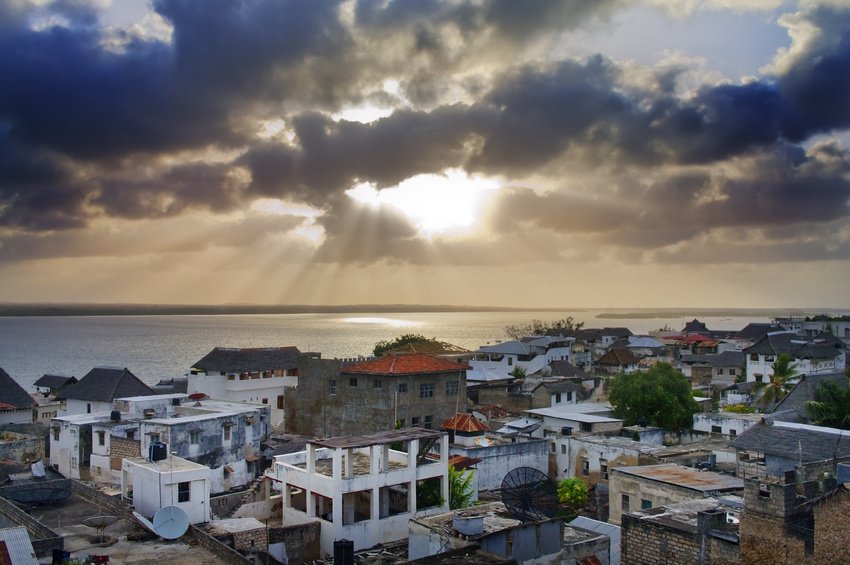
 Lamu is a Kenya’s oldest living town and its population is mainly Muslim. Automobiles are not allowed within its city walls. The primary reason for this is that the dirt streets are extremely narrow and crowded with people. One car is allowed on the island – owned by the District Commissioner.
Pay attention to the dress of of the locals. Most of the men wear full length white robes and distinctive skull type caps. The women wear black wrap around robes, most of them cover their head in black cloth, and a few women cover their entire face except for slits around their eyes.
Lamu is still isolated enough and somewhat difficult to get to that its not yet over run with tourism.
I felt that the interactions received from the local people were still genuine. Shopping can be used as an example of this. In areas that have been over run with tourists no matter where you are in the world – the shop keeper’s time is extremely short, they are often very aggressive, and their interest in only your money is quite apparent. This was not my perception in Lamu.
For example I visited a small artisan shop located under a corrugated steel roof held up by ancient wood stakes. While there I purchased a hand carved local game made out of wood. Three red seeds filled each indentation in the wood – the seeds obviously had something to do with playing the game. The shopkeeper asked me if I would like to learn how to play. He told me to sit down and then for the next 45 minutes taught me strategy and several versions of this particular game.
This was only one example – I felt welcome at most of the shops that I visited. I spent 4 days and 5 nights in Lamu. This was about about the right amount of time to explore the city.
I need to get back to Lamu – thanks for the memories!
Where do you recommend we stay – going to Lamu this June. Thanks – Albert
Did you mean 4 Nights/ 5 days. Lamu shopping experience and the hospitality, I visited during the maulidi cultural festival. I have to say the donkey ride competitions were very fascinating.
Hi, i need the tour guide contacts im interested to go to lamu
Alex – donkey rides eh? I have to try that during my next visit 🙂
John – I would reach out to Mohammed directly.