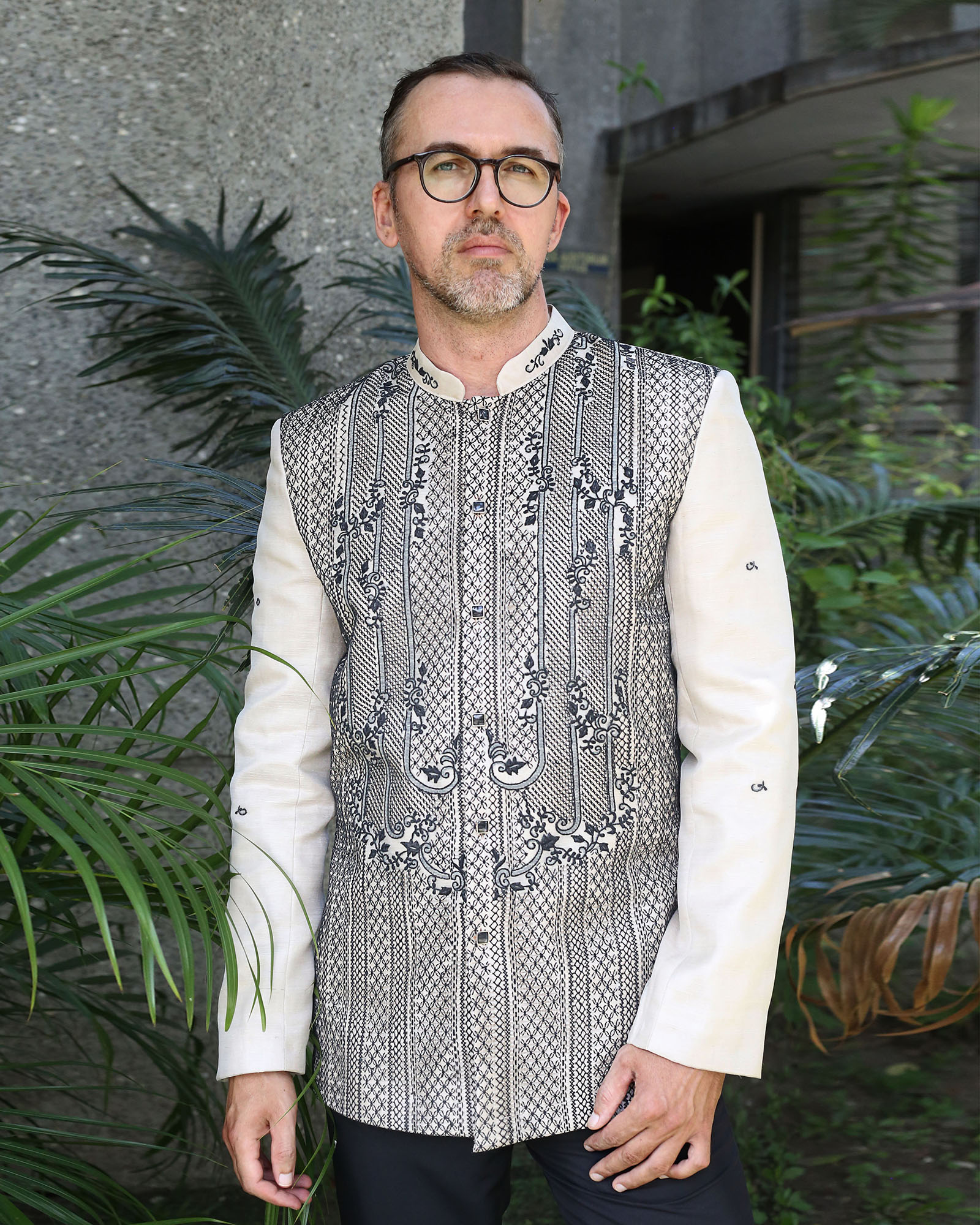
Finished custom Barong Tagalog with black embroidery
First Seeing the Barong Tagalog from the Outside
My name is Anton. I’m from Siberia. In 2022, I moved to the Philippines.
Before that, the Philippines meant sun, sea, and friendly people to me. Nothing unusual — a fairly standard picture for someone looking at a country from the outside.
I had never heard of the Filipino shirt called the Barong Tagalog. It never occurred to me that the Philippines had such a recognizable symbol. That’s how out of the loop I was.
Four to six months after arriving, I met designer Josip Tumapa. She was the first person who told me what the Barong Tagalog was, why people wore it, and why for Filipinos it was more than just a shirt.
The Barong Tagalog is a traditional Filipino formal shirt. It is often worn for official events, weddings, and other important occasions.
But as a foreigner, none of that meant much to me personally at the time. I saw the Barong Tagalog simply as a national shirt — something the Philippines liked to present as a cultural symbol.
More than that, I didn’t like it at first. I thought the barong looked baggy and unattractive. The problem wasn’t the Barong Tagalog itself — it was that I had mostly seen simple mass-market versions made from cheap fabrics. That’s what I based my first, fairly superficial judgment on.
When Fabric and Ornament Changed My View
After some time, I started working in the Filipino fashion world. There, for the first time, I saw the Barong Tagalog not as an ordinary shirt from a shop, but as a garment people genuinely worked on: choosing the fabric, thinking through the fit, the ornament, the embroidery.
That left a completely different impression on me.
Calado, Piña, and the Value of Handwork
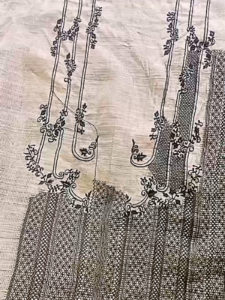
Calado ornament work in progress
First, the fabric. One of the most prized traditional materials for the Barong Tagalog is piña — a textile made from pineapple fibers. Its production takes considerable time: the fibers must be prepared, processed, and woven into a light, semi-transparent cloth.
Second, the ornament. It can be floral, geometric, traditional, or more contemporary. It can be done by machine — but in fine barongs made from fabrics like piña, handwork is what people value most.
Hand embroidery isn’t always perfectly even. There can be small variations in the lines and details. For me, that became the point: those traces show you that this isn’t a mass-produced factory item, but clothing someone made by hand.
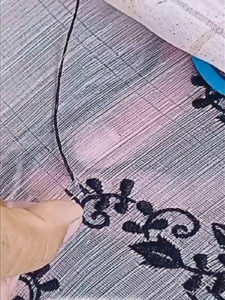
Hand embroidery process on Barong Tagalog fabric.
Calado holds a special place in this. It is an openwork hand technique in which some threads are drawn out or thinned, then secured to create an open pattern in the fabric. In a well-made Barong Tagalog, details like this change everything about how the garment feels.
Some of these techniques are passed down through generations. The process itself takes time. Making a calado ornament by hand, for example, can take around a month — and that is only one part of the work on a Barong Tagalog.
In a time when almost anything can be copied quickly, things like this carry a different kind of weight. What matters isn’t only how something looks, but how much time a person put into the fabric and the ornament.
When I was around eighteen, I got deeply into the Arts and Crafts movement. It stood against impersonal mass production and argued for the value of hand labor, honest materials, and the maker’s genuine effort.
That’s why a custom Barong Tagalog made such a strong impression on me. I’m talking about a garment made for a specific person, a specific fabric, a specific occasion, and a specific set of details.
In that kind of barong, I saw not just a national shirt, but clothing where time, the human hand, and cultural memory all matter.
From that point on, the Barong Tagalog no longer felt like baggy formal wear to me. It started to create something I had not expected: emotion, and real respect.
Why Mass Production Still Worries Me
At the same time, I have concerns. From what I observe, interest in the Barong Tagalog — especially in custom barongs with calado and handwork — is growing.
But things like this can’t be scaled quickly without losing something. A skilled embroiderer, a calado specialist, someone who knows how to prepare the fabric — you can’t train that in a few weeks. It takes years.
So the risk I see isn’t the growing interest in the Barong Tagalog itself. It’s the possible simplification of production to meet mass demand. The history of craft has shown this pattern more than once: when something becomes too sought after, people start making it faster, cheaper, and simpler.
For the Barong Tagalog, that matters especially. Strip away the fabric, the handwork, the fit, the attention to detail — and it becomes an ordinary formal shirt again. And those details are exactly what once changed how I saw it.
Custom Barong Tagalog in the workshop.
Choosing My Own Barong Tagalog
Today I have my own Barong Tagalog. I took the choice seriously: I went through different fabrics, ornaments, and ways of making it.
In the end, I chose piña cocoon silk with added pure piña. For me, it was the right balance: more practical and durable than pure piña, but still connected to the traditional material.
The ornament was easier. I had almost no doubt it would be calado. What took longer was the motif itself — whether it should be floral, geometric, or something else.
I went with floral. It felt the most alive, and the most right for a barong I actually wanted to wear — not just admire as a beautiful object.
Anton Dvoryadkin works with Josip Tumapa Design, a custom fashion atelier in the Philippines.




Leave a Reply