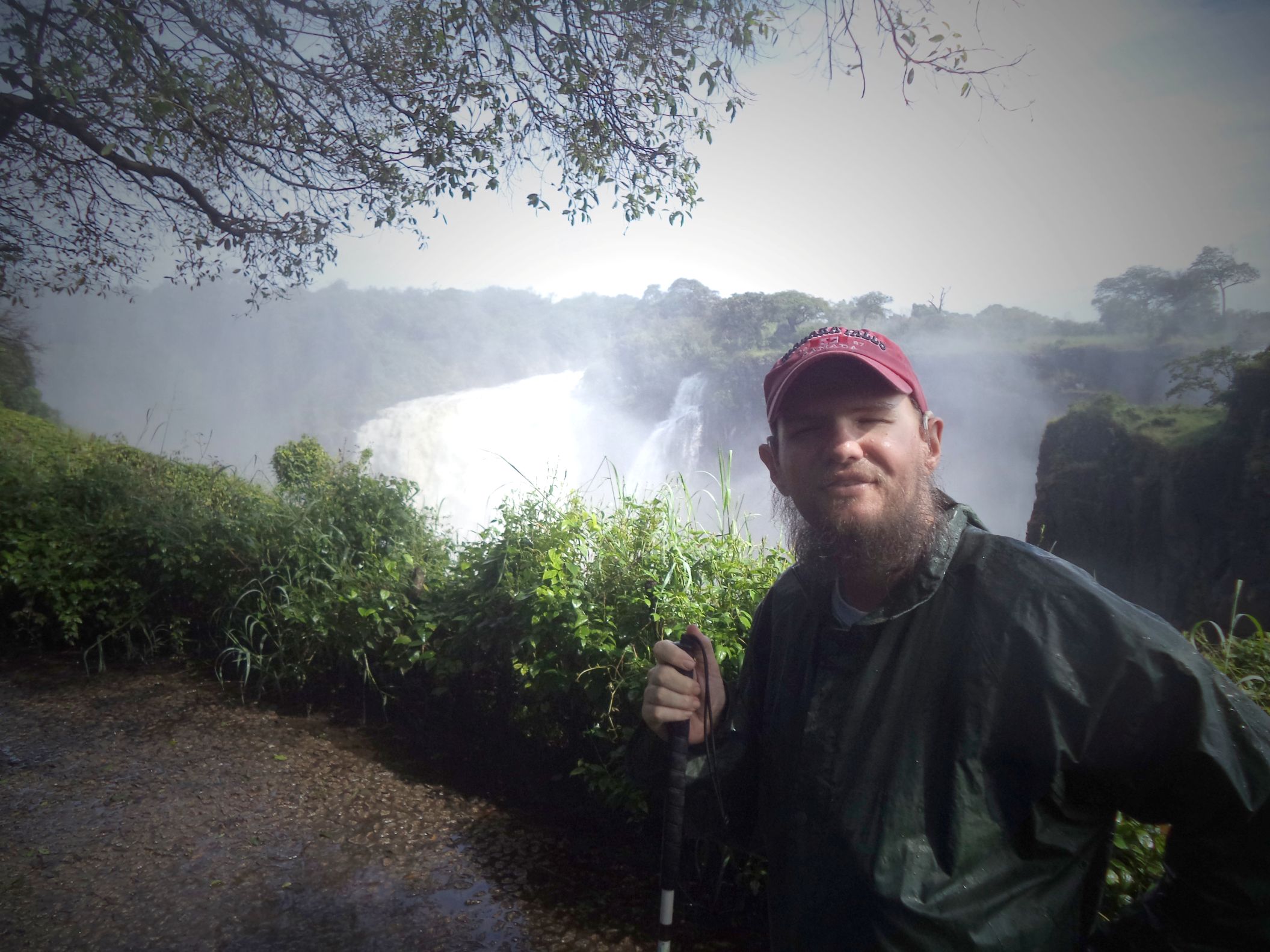
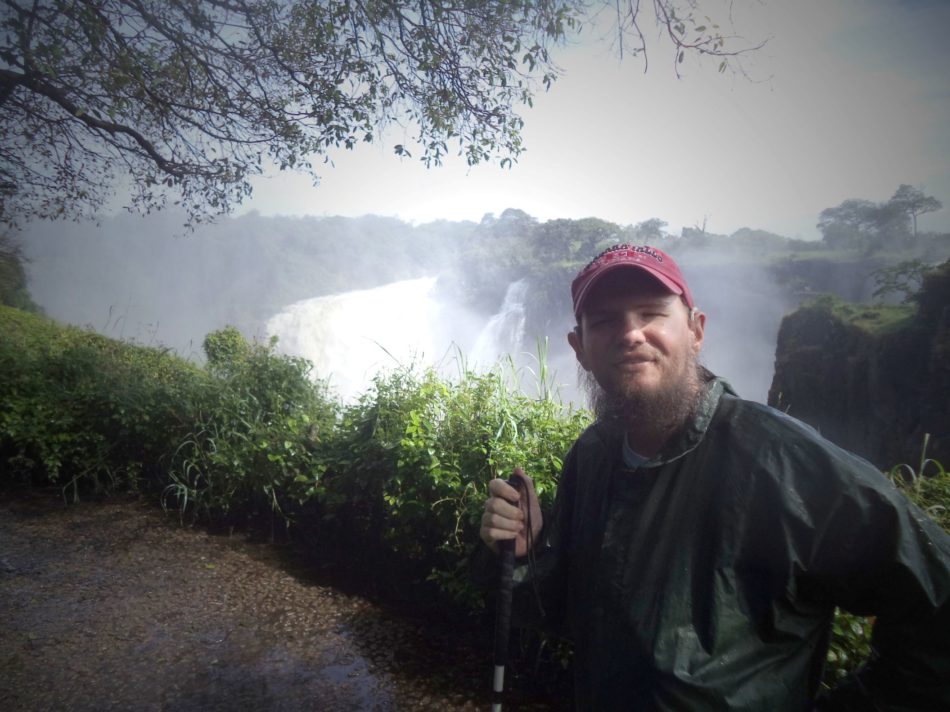
Victoria Falls – Tony with Cataract Island behind and Devil’s Cataract to the left
Tony Giles is a blind and partially deaf adventurer from England who has turned the world into his classroom, He has traveled solo to more than 130 countries across all seven continents, going for everything from bungee jumps to crossing the Arctic Circle and he shares the ride through his ebooks and talks.
Q. Tell us about yourself?
I am Tony Giles. I live in the Southwest part of the UK. Currently 47 years old. Totally blind from birth and partially deaf in both ears from the age of 5 years. Attended specialist schools for blind-visually impaired children. This is where I learned to read and write using Braille, the tactile dot system. I also received mobility instruction, where I was taught to use a long white cane to navigate my surroundings.
I have a BA in American Studies from the University of Northampton, East England and an MA in Transatlantic Studies (History of US Foreign Policy in the Cold War) from the University of Birmingham, England.
Q. Take us to the very first time you decided you wanted to travel solo and where your inspiration came from?
My inspiration for travel came from my dad’s stories of when he was in the Merchant Navy in the 1950s. He told me about crossing Australia from coast to coast by train and it taking over three days. He also described sailing along the Saint Lawrence River in Canada with icebergs floating along the ship’s side. These stories pricked my imagination.
When I was 16, I had the opportunity to visit Boston, USA with my school and loved it. Everything was so different: pavements were huge, I could feel the space through my body, steaks were enormous and people talked with strange accents. I found the US exciting and wanted to experience more. However, it was whilst studying in America in the winter of 2000 that my first solo trip occurred.
All my friends went to Florida for Spring Break, but I wasn’t interested in joining them as I thought they would curve my desire for adventure, so I headed to New Orleans instead. I’d read about this lively city in a novel, which I’d listen too as an audio book.
A university staff member helped me book a flight and find a hostel (cheap shared accommodation) and I went off and had fun.
I still remember that trip now. It was so simple. A friend drove me to the airport near the university I was attending, airport special assistance took me through the airport, through security and escorted me onto the plane. I was met upon landing in New Orleans and taken out of the airport to a taxi that drove me to the city and right to my hostel. Once settled in my dorm room, I asked reception staff walking directions to the main street in New Orleans where I could find food, beer and live music.
I was directed to Bourbon Street and told what areas to avoid. I felt the heat on the street and the electricity in the air. New Orleans was alive with activity. Jazz emanating from almost every bar and cheap beer everywhere. I bumped into people on the streets and engaged in interesting conversations. It was a wonderful experience.
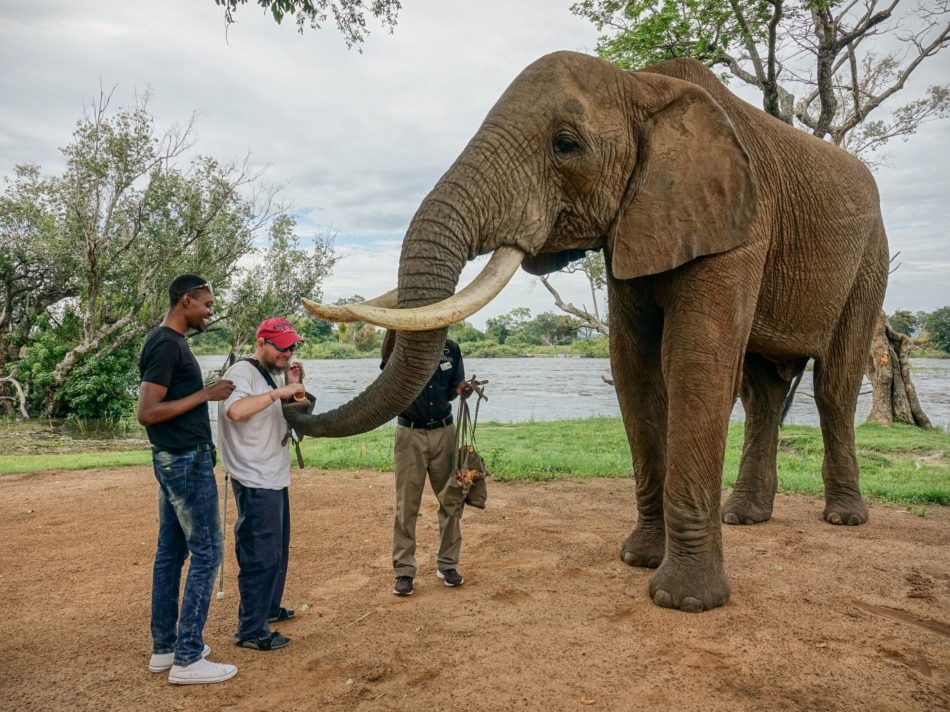
Feeding an elephant at the ElephantCafe, Livingstone, Zambia, March 2020
Q. When you are traveling, how do the sounds you hear, the things you touch, the flavors you taste, and the people you meet all come together in the way you experience a place?
I use sound, smell, touch to give me a sense of my surroundings when travelling alone in a new town, city, country. I also use my memory to get about. For instance, if I walk from my accommodation to a particular landmark, museum, religious building, I try to remember how many streets I’ve crossed how many corners I’ve turn, how many are left or right.
I use my feet to notice the various textures of the ground and add them to my memory. I also look for objects next to my accommodation to find it in case there are no people around to ask. This might be the texture of the entrance gate or a nearby lamppost, streetlight, trash bin, etc. I use my feet to detect if I’m going up or down any gradients and so on. This gives me a mental picture of my surroundings. I use my hearing to follow the sound of traffic to give me a basic direction. I know that if traffic increases I’m probably heading to a city’s center. I also follow the sounds of peoples footsteps and voices. This is useful when crossing roads that don’t have audio traffic lights. When I hear people walking, I know it’s fairly safe to cross and follow.
Tasting various textures and flavors of food gives me an insight of a country’s culture and provides me with a better understanding of peoples customs, especially when dining with a local. The taste of a nation’s cuisine combined with traditional music and interesting conversations allows me to gain a sense of what a country and its culture is really like.
I don’t need any sight to talk, eat, drink and hear music.
It’s the combination of using all my senses that gives me a small idea of what a city or country and its people are really like. I feel the atmosphere in different places and try to connect with local people on a basic level.
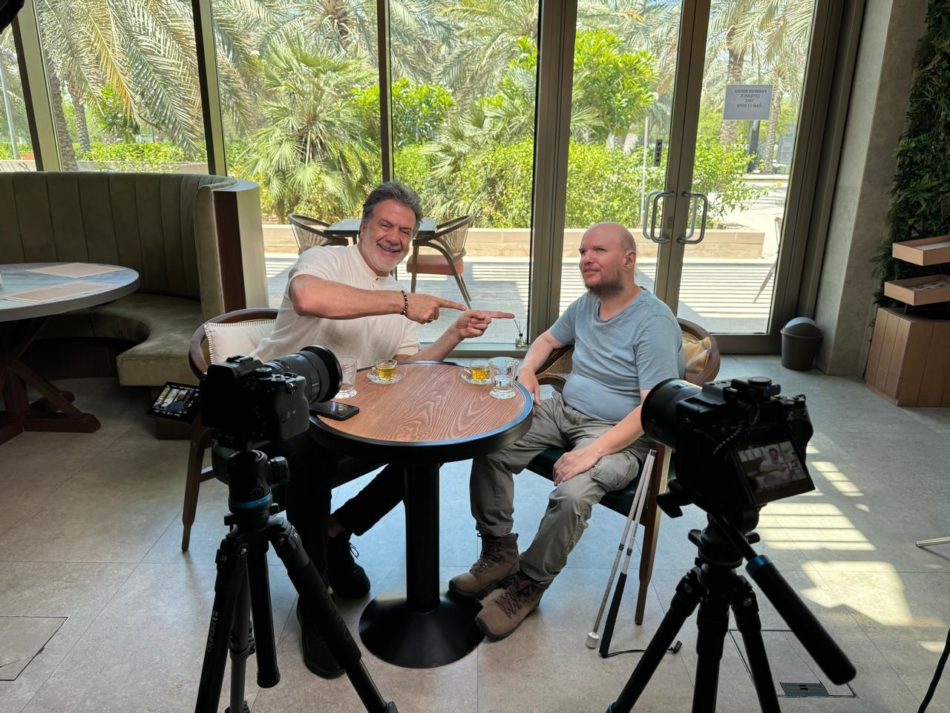
Tony G & Tony B, Interview in Abu Dhabi, 6 June 2024
Q. How do you train yourself to get around the world. Different countries have different systems for the blind, how do you navigate and adjust when you are in a new place?
I travel with a laptop that has specialized speech screen-reading software on it called JAWS. Each time I press a key the laptop speaks. This allows me to navigate the internet using the keyboard’s arrow keys and research the places I want to visit in a particular country/city, etc.
I gather research about a place’s public transport, sights to visit, available activities . These I type into a text document that I can read on my laptop whilst travelling. I discover a country’s national and local dishes and permit them to memory because I can’t read a menu and the majority of people in many countries don’t speak much English.
I also carry a small device similar to a mobile phone called Victor Stream Reader. It has tactile buttons and can store various files on it, including text documents, and both music and photos. The device has speech software, enabling me to listen to the information I’ve gathered as I travel and even listen to it as I walk along a street.
Once at my accommodation in any particular place, I ask the staff to escort me around the building; show me where the toilets, showers and kitchen are located and connect me to the internet, I’m ready to go exploring.
I need to know where I want to visit because I can’t read a map. Unlike many people, sighted or blind, I don’t use a Smart phone. Most don’t have tactile buttons and I don’t like the idea of swiping. Also, due to my deafness, I struggle to hear a mobile phone. Therefore I rely more on the public. I’ll tell a hotel/hostel staff member the place I wish to visit and ask how to get there, either by foot or via public transport. If walking, I ask them to tell me how many streets or blocks I may need to walk, where to turn right or left, etc. When travelling by public transport I want to know what bus number or metro line to take and the name of the stop I require.
I’ll often ask accommodation staff to write down on paper the necessary information in their own language so I can enter cafes, bars, shops etc, show the paper and ask locals for directions. By this method, I often find that many kind people will give me good directions or even accompany me to my destination. It’s a great way to interact with locals.
I take a copy of the accommodations address and phone number so if I get lost or stuck or need help with the local language, I can shout “Taxi”, show them the address and get back to a safe place.
When researching a country’s attractions and places to visit I look for museums that have an audio guide or a guided tour. I often try to join a guided walking tour, especially ones that are free. A walking tour is a good way to get a feel of a city’s/town’s layout, gain some history from a local guide and discover a few “hidden gems” not mentioned in tourist guidebooks.
Readers might like to know that I take my own photos, usually with a little help! Although, often I’ll simply aim and shoot by myself. I find it fun and interesting. I use an app on my laptop called Be My Eyes that describes photos in reasonably accurate detail, allowing me to discover what I’ve photographed. This gives me an added insight to many of the historic buildings and other attractions I visit.
I love hiking to waterfalls, stumbling across unexpected fountains I can listen too, like all over Zurich, Switzerland and statues I can explore with my hands. Wroclaw, Poland has many statues; most on the ground and very small and interesting. Warsaw, Capital of Poland, is also great for tactile objects. There are tactile models outside many of the city’s famous attractions, like the cathedral and castle.
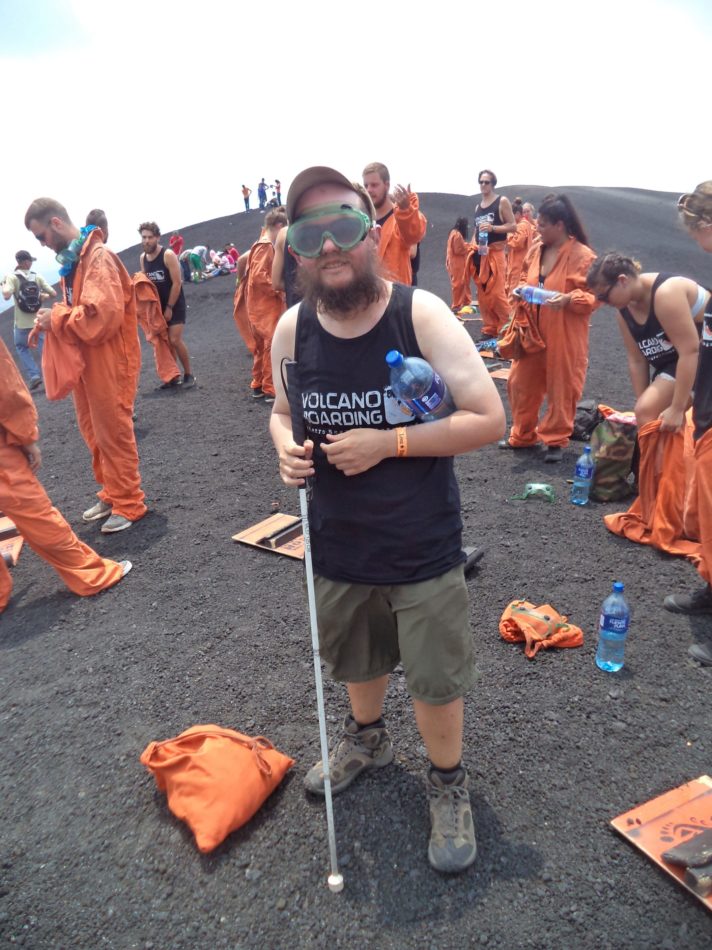
Sand Boarding, Cerro Negro volcano, Nicaragua, April 2016
Q. I know you love extreme adventures. Out of all the wild things you have done, which one gave you the biggest adrenaline rush?
I love undertaking adrenaline activities! I gain such a thrill from a bungy jump, sky dive, rafting trip. It’s because I feel every bump, bounce, splash, crash! it involves all my senses and my entire body. I’ve partaken many such activities multiple times but the one event I remember the most that gave me the biggest thrill was a Rocket Bungy, which I did in New Zealand in 2001.
I was strapped into a plastic seat inside a metal framed ball-shaped apparatus. Then, suddenly, without warning, the ball was tipped backwards and I was on my back, facing the sky. I knew this because I felt the warm sun on my face. Apparently, two bungy chords were stretched up over two tall towers.
Suddenly, the bungy chords were released and the ball, with me inside it, shot into the air with tremendous force and speed. My entire body felt the impact as I shot 229 feet into the air. Bang! What a hell of a shock! I swore loudly enjoyed the forces pummeling my body before crashing back to earth – what a f…ing thrill! One I’ll never ever forget!
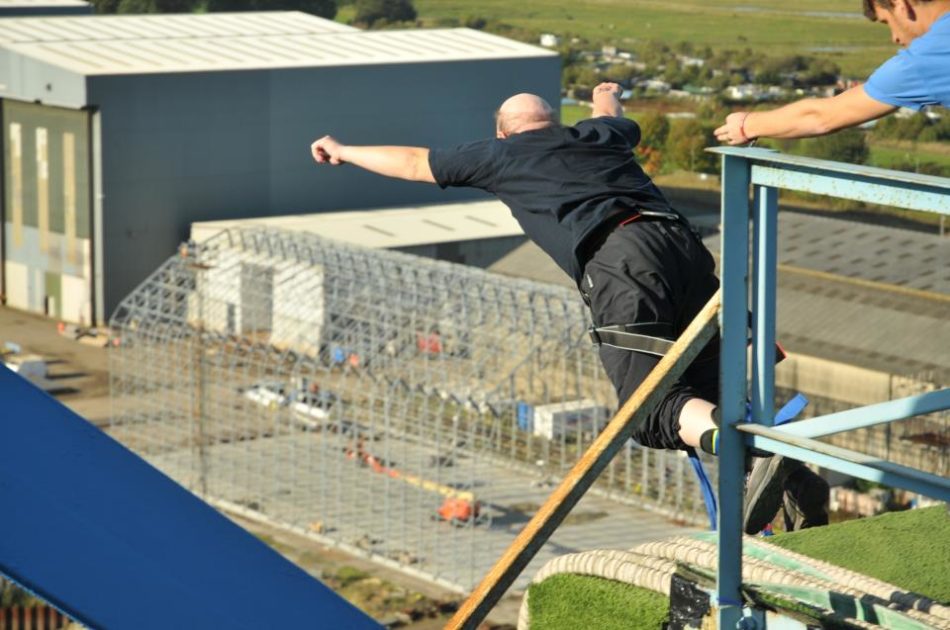
Tony bungee jumping off the Transporter Bridge in Middlesbrough. 7th October 2012
Q. You’ve got 3 eBooks about the way you travel. What made you decide to put those stories down, and what do you hope readers take away from them?
It was my mum who suggested I write a book about my travels back in 2005. I’d undertaken several longish trips and recently returned from a year traveling around the globe. I was a little reluctant at first. But eventually sat down and began thrashing something out, mainly using my memory.
I simply decided to chart everything I’d experienced in my life thus far, thinking it probably would never be published. It became a kind of therapy. I lost both my best friend and my aging dad through illness and was still verry frustrated and angry about being blind and partially deaf. Writing gave me the chance to express my feelings without having to speak them out loud.
I hope the 3 slightly different eBooks give readers a sense of adventure and an insight of travel from a unique perspective. Maybe they provide readers with the notion that being disabled doesn’t have to be a negative and prevent people from living their dreams. But mainly the eBooks say go have fun and try something new, and different. In essence, have a go.
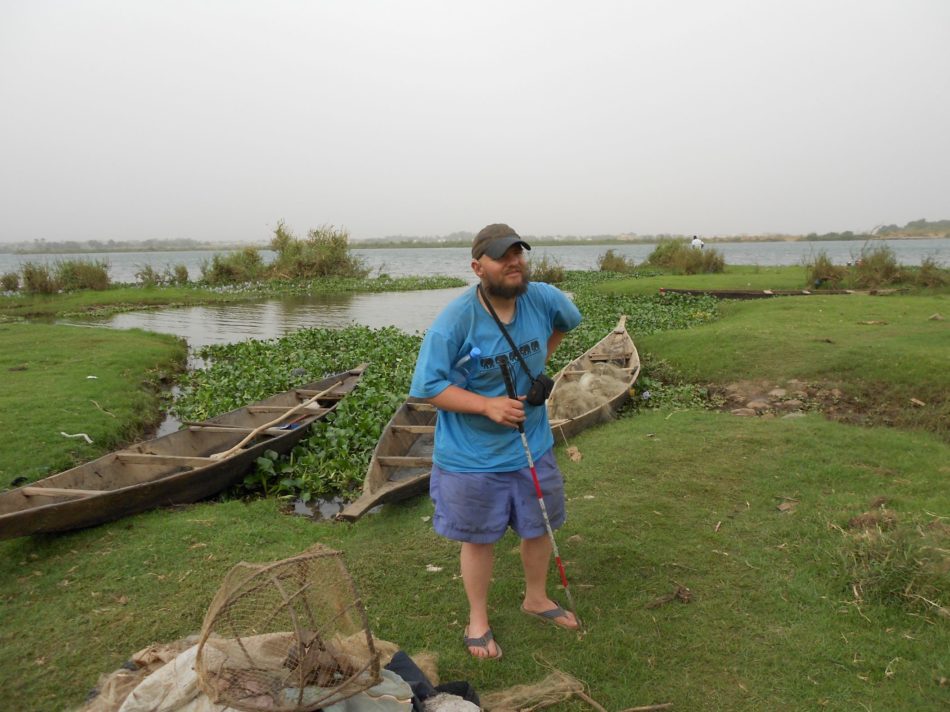
Tony beside Niger River, Bamako, Mali, March 2012
Q. What has been the biggest challenge you have had to deal with while traveling, and how did you get through it?
Having my backpack, tent and sleeping bag taken whilst camping in a field in the Yukon, Canada is probably the most difficult challenge I’ve had whilst traveling!
This story is detailed in my second eBook: Seeing The Americas My Way.
Basically, I arrived into White Horse, far North Canada in the verry early hours of the morning. Learning that all the hostels were full and not wanting to share a hotel with other people off the Greyhound bus, I decided to camp. Someone show me to a field where I could pitch my tent. I put it near to a gravel path in order to re-locate the tent on my return.
Later, I walked into town, found breakfast and undertook a couple of activities. That night I was dropped back at the bus station by a kind local and set off to find my tent. Once on the gravel path, I began swinging my mobility cane in order to hit the tent. After sometime searching, I went to the nearby road, locating it through the sound of traffic, and managed to stop a vehicle. The driver was a young guy delivering pizza! He couldn’t believe or understand why a blind guy was camping all alone in Canada. I explained I was searching for my tent, but couldn’t locate it. He helped me search, but couldn’t see it anywhere. Everything was gone: Tent, large backpack, sleeping bag.
I was in shock and upset. The guy took me to a Salvation Army refuge where I spent the night. He promised to help me search again in the morning. I reported the missing items to the local police, but they weren’t much help. My main concern was the loss of my blood pressure tablets. Fortunately, I managed to buy the medication sometime later. After spending an evening in a bar feeling sorry for myself, I remembered about a guy I’d met in South America who lived in Haines, Alaska – only three hours away by bus and ferry. I still had his number. So I phoned him, explained my predicament and asked to stay. In the end events turned out well, but It was a hell of a shock when it happened.
Q. Your message to our readers?
If you want to travel, go do it. It’s very possible. Live life and try to have fun.
All photographs credit: Tony Giles
Victoria Falls – Tony with Cataract Island behind and Devil’s Cataract to the left



Leave a Reply