Before noon, the colonnade in front of Baden-Baden’s Kurhaus belongs to dog walkers and hotel staff carrying coffee trays. The neoclassical block behind the Corinthian columns was finished in 1824 to a design by Friedrich Weinbrenner, and from the gravel path it reads more like a regional parliament than a gaming floor. The ambiguity was deliberate. In nineteenth-century Europe, the tables paid for the building, and the building supplied the respectability.
Five properties still carry that logic, in five very different forms: a Renaissance palace on the Grand Canal, a Belle Epoque landmark in Monaco, a spa complex in the Black Forest, a modernist hall on the Portuguese coast, and a hotel and conference campus outside Limassol that opened only recently. Together they trace four centuries of one business dressing for its audience.
Venice and a word that travelled
The word arrived long before the building type. In Italian, casino meant a small house, the sort of garden pavilion where Venetian patricians entertained away from the family palazzo. When the Venetian state opened the Ridotto in 1638, it placed a sanctioned gaming room inside a wing of an existing palace rather than building something new, which set the pattern for most of Europe that followed.
The Casino di Venezia now occupies Ca’ Vendramin Calergi, a Renaissance palace attributed to Mauro Codussi, with a water entrance on the Grand Canal and Richard Wagner’s final apartments on the ground floor. Visitors treat it as architecture first and gaming floor second, and anyone who wants the residential city instead can walk out to the quieter end of Venice where the palaces give way to municipal housing and football pitches.
The house that Garnier built
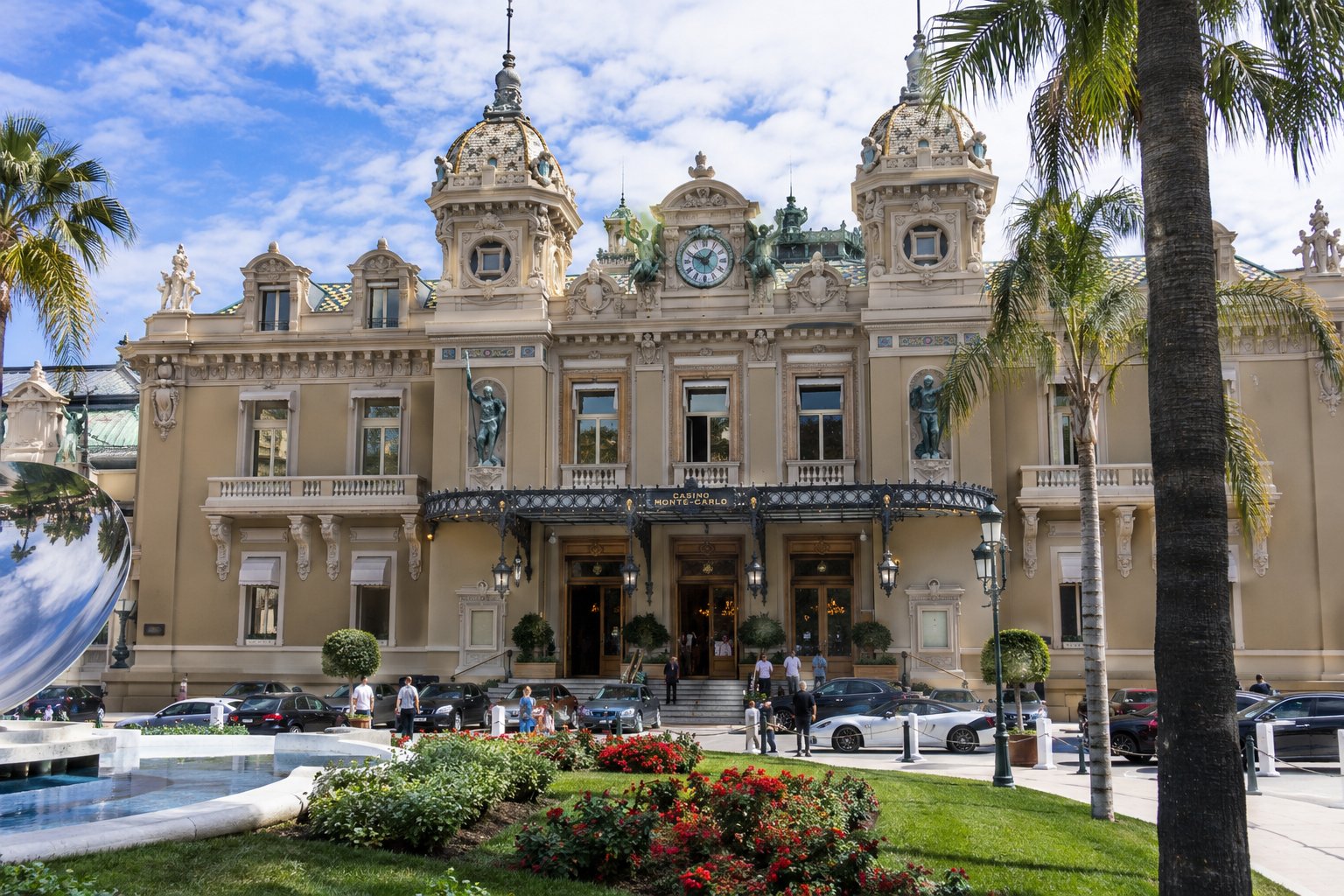
Monaco’s Casino de Monte-Carlo was commissioned when the principality had almost no other source of income, and the design brief was tourism rather than gambling. Charles Garnier, already known for the Paris opera house, added the Salle Garnier in 1879, giving the complex a theatre, a terrace over the Mediterranean and a sequence of gilded rooms that photograph better than they play.
The effect on the surrounding district was permanent. Hotels, gardens and a rail connection followed the casino rather than the other way round, and the Monte-Carlo quarter still organises itself around that single facade and its fountain forecourt.
A spa town’s second trade
Baden-Baden’s Kurhaus grew out of the cure industry rather than beside it. The first building on the site dates from 1766, and the gaming rooms were fitted into a spa complex whose primary purpose was drinking water, bathing and being seen doing both. Nineteenth-century Russian and French visitors arrived for the season, and the Kurhaus functioned as the town’s main social hall, with the tables as one room among many.
That arrangement explains the interiors, which borrow from French palace decoration instead of the enclosed, windowless logic of later gaming halls. The building still hosts concerts and conferences, and the gaming rooms open onto the same park used by spa guests.
Portugal’s Atlantic outlier
Casino Estoril sits at the top of a formal garden facing the Atlantic, twenty minutes by train from Lisbon. Its origins run back to 1916, and successive expansions made it one of the largest gaming venues in Europe by floor area, with a concert hall and exhibition space attached.
Its reputation rests partly on wartime Lisbon, when neutral Portugal filled with exiles, diplomats and intelligence officers who used the same bar. Ian Fleming’s first Bond novel is frequently traced to that period and that building, which has done more for the town’s visitor numbers than any renovation.
Two versions of the same business
Each of these buildings was designed when a casino had to persuade a city to tolerate it. Scale, symmetry and a concert hall next door were part of that argument, and the gaming floor was rarely the first thing a visitor saw. Online operators inherited the business without the architecture, so their reputations are assembled from payout records, bonus conditions and user complaints instead of facades.
That changed how the sector gets compared. Players in markets such as Estonia sort the field through review sites, and a listing on Kasiinoguru ranks online casinos by bonus conditions, game selection and reader ratings, much as a nineteenth-century guidebook once ranked spa hotels by their waters. The historic houses compete on the one variable no ranking table measures, which is the experience of walking in.
Cyprus builds for the whole stay
The newest entry on the list looks nothing like the other four. City of Dreams Mediterranean opened outside Limassol in 2023, built by the Hong Kong group Melco Resorts as an integrated resort in the Asian sense: a five-hundred-room hotel, conference facilities, pools, restaurants and retail, with the gaming floor as one revenue line among several.
The architecture follows that economic model rather than a civic one. Where Garnier faced his building outward to a public square, the Limassol campus turns inward toward its own grounds, because the commercial aim is to keep a guest on site for a week. Cyprus took the model partly to extend a tourist season that used to collapse in November, and the result is the first European casino building in generations that was planned around hotel occupancy figures rather than around a town’s idea of itself.


Leave a Reply