The mist clung to the mountainsides like a reluctant lover as our vehicle navigated the winding road from Baguio City deeper into the heart of Benguet province. I pressed my forehead against the cool glass of the window, watching as the landscape transformed with each passing kilometer. The Philippines has many treasures, but the highlands of the Cordillera region hold a particular mystique that draws travelers seeking respite from the tropical heat of the lowlands and an encounter with cultures that have preserved their heritage despite centuries of outside influence.
The Gateway: Baguio CityInto the Heartland: La Trinidad Valley
With provisions secured, I departed Baguio with Eduardo, heading north to La Trinidad, the capital of Benguet province proper. Just a 30-minute drive from Baguio, La Trinidad reveals itself as a valley nestled between mountain ranges, a stark contrast to the densely packed urban center we left behind.
“This is the salad bowl of the Philippines,” Eduardo explained as we passed terraced farms carved into the hillsides. “Nearly 80% of the country’s temperate vegetables are grown in Benguet.”

La Trinidad’s strawberry fields are its most famous attraction, stretching across the valley floor in neat rows. I joined other visitors in the “pick-and-pay” experience, selecting ripe berries under the watchful eyes of Ibaloi farmers who have cultivated this land for generations.
“The relationship between the people and the land is sacred here,” explained Maria, an Ibaloi woman who had been tending the same plot for over forty years. “We believe the soil has memory—it remembers those who treat it with respect.”
Beyond agriculture, La Trinidad has embraced art as a form of urban renewal. The once-drab houses of Barangay Balili have been transformed into a massive mural known as the “Stobosa Hillside Homes Artwork,” with buildings painted in vibrant patterns inspired by indigenous Cordilleran textiles. Standing at a viewpoint across the valley, I marveled at how this community art project had turned simple dwellings into a collective canvas celebrating local heritage.
Ancient Practices: Kabayan and the Fire Mummies
From La Trinidad, we continued north through increasingly rugged terrain. The road narrowed as we climbed higher, occasionally disappearing entirely behind curtains of mountain fog. Our destination was Kabayan, one of Benguet’s oldest municipalities and home to some of its most sacred sites.
Kabayan is known primarily for its centuries-old practice of mummification. Unlike the chemically preserved mummies of Egypt, the Ibaloi “fire mummies” of Benguet were created through a complex process involving salt and herbs, followed by smoking over a fire. The result preserved not just bodies but, according to local belief, the spirits of the deceased.
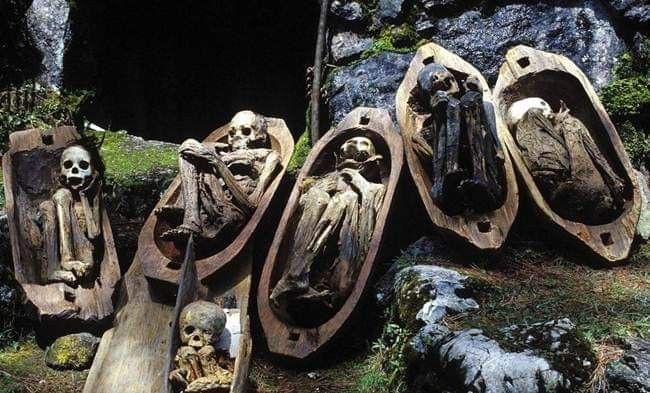
The Kabayan Fire Mummies of the Ibaloi Tribe, existed in Benguet Province for thousands of years endured until the arrival of Spanish colonialists in 1500 and the caves remained untouched until the 19th century (© Author Luna Mayfield).
Obtaining permission to visit the mummy caves requires respect for local protocols and customs. Eduardo had arranged for us to meet with a local elder, who, after determining our intentions were respectful, agreed to guide us to one of the more accessible sites.
“The mummies are not tourist attractions,” the elder, Apo Singan, cautioned as we hiked through pine forests toward the cave. “They are our ancestors who chose to remain physically present in this world.”
The cave itself was unremarkable from the outside—a simple opening in the mountainside partially obscured by vegetation. Inside, however, the atmosphere changed dramatically. The air was cool and dry, perfect for natural preservation. In wooden coffins placed in niches cut into the rock sat several mummies, their skin darkened by the preservation process but their human features still discernible after centuries.
I maintained a respectful distance, observing in silence. The UNESCO-protected mummies represent one of the most tangible connections to Benguet’s pre-colonial past, a reminder of sophisticated indigenous practices that developed in isolation from other mummification traditions worldwide.
Living Heritage: The Ibaloi Communities
Beyond the historical artifacts, Benguet’s greatest treasure is its living cultural heritage. The province is home primarily to the Ibaloi and Kankanaey peoples, two indigenous groups with distinct but related traditions. As we traveled through small communities off the main highways, Eduardo introduced me to families who continue to practice traditional weaving, music, and agricultural methods.
In one village, we were invited to observe a “cañao,” a traditional feast and ceremony. Though once associated primarily with headhunting victories—a practice long abandoned—modern cañao celebrations mark important life events or community milestones.

The Ibaloi Tribe
“The ritual has evolved, but its purpose remains the same—to maintain harmony between people, nature, and the spirit world,” explained the mambunong (ritual specialist) who led the ceremony.
I watched as community members performed the tayaw, a traditional dance where participants move in a circular formation, mimicking the cyclical nature of life that is central to Ibaloi cosmology. The hypnotic rhythm of gongs accompanied the dancers, whose movements told stories of harvest, courtship, and warrior valor.
The Mines of Itogon
The final leg of my Benguet journey took me east to Itogon, a municipality whose history reveals both the wealth and the wounds of the province. Itogon has been a mining center since pre-colonial times, when indigenous peoples extracted gold using simple methods. The American colonial period industrialized this process, establishing massive mining operations that continue to shape the area’s economy and environment.
The Benguet Corporation, established in 1903, was the first formal mining company in the Philippines. Today, its legacy is visible in the town of Itogon—both in the infrastructure developed to support mining and in the environmental challenges left in its wake.

A mining site at Itogon.
“Mining gave us economic opportunities but took something from the mountains,” said Roberto, a former miner who now advocates for sustainable development in the region. “We’re still trying to find the balance between prosperity and preservation.”
We toured abandoned mining tunnels that have become informal tourist attractions, their dark passages echoing with the labor of generations. Outside, small-scale miners continue to pan for gold in streams, using methods similar to those employed by their ancestors centuries ago.
Nature’s Cathedral: Mount Pulag
No journey through Benguet would be complete without acknowledging its highest peak and spiritual center: Mount Pulag. Standing at 2,926 meters, Pulag is the third-highest mountain in the Philippines and is revered by local indigenous groups as the dwelling place of ancestral spirits.

Mount Pulag National Park (© Maryanne Mendoza).
Though a full ascent requires preparation and often camping overnight, Eduardo arranged for us to visit the lower slopes, where the mountain’s unique ecosystem transitions from pine forest to mossy forest and eventually to dwarf bamboo grasslands near the summit.
“The locals say that when you die, your soul passes through Mount Pulag on its journey to the afterlife,” Eduardo told me as we walked through a section of mossy forest, the trees draped in thick carpets of moss and epiphytes. “The mountain stands between worlds.”
Even without reaching the famous “sea of clouds” that makes Pulag’s summit a photographer’s dream, I felt the mountain’s presence as a unifying force in Benguet culture—a natural monument that has witnessed the province’s transformations through time.
Departure: Carrying Benguet Forward
As my week in Benguet drew to a close and we began the journey back to Baguio, I reflected on the layers of experience the province had offered. From agricultural abundance to cultural preservation, from environmental challenges to spiritual traditions, Benguet revealed itself as a place of profound contrasts unified by the strength of its indigenous heritage.
“What you take from Benguet depends on what you bring to it,” Eduardo said as we watched the sun set behind the mountains. “Those who come seeking only photographs leave with images. Those who come seeking understanding leave with wisdom.”
I left with both—memory cards full of Benguet’s visual splendor and a mind enriched by conversations with its people. As our vehicle descended through the evening fog toward the lights of Baguio, I knew that the true souvenir of Benguet was not the strawberries or woven textiles in my bag, but the reminder that some of the world’s most valuable cultural treasures still thrive in places where mountains meet the sky.


Leave a Reply