Trekking to Annapurna Base Camp
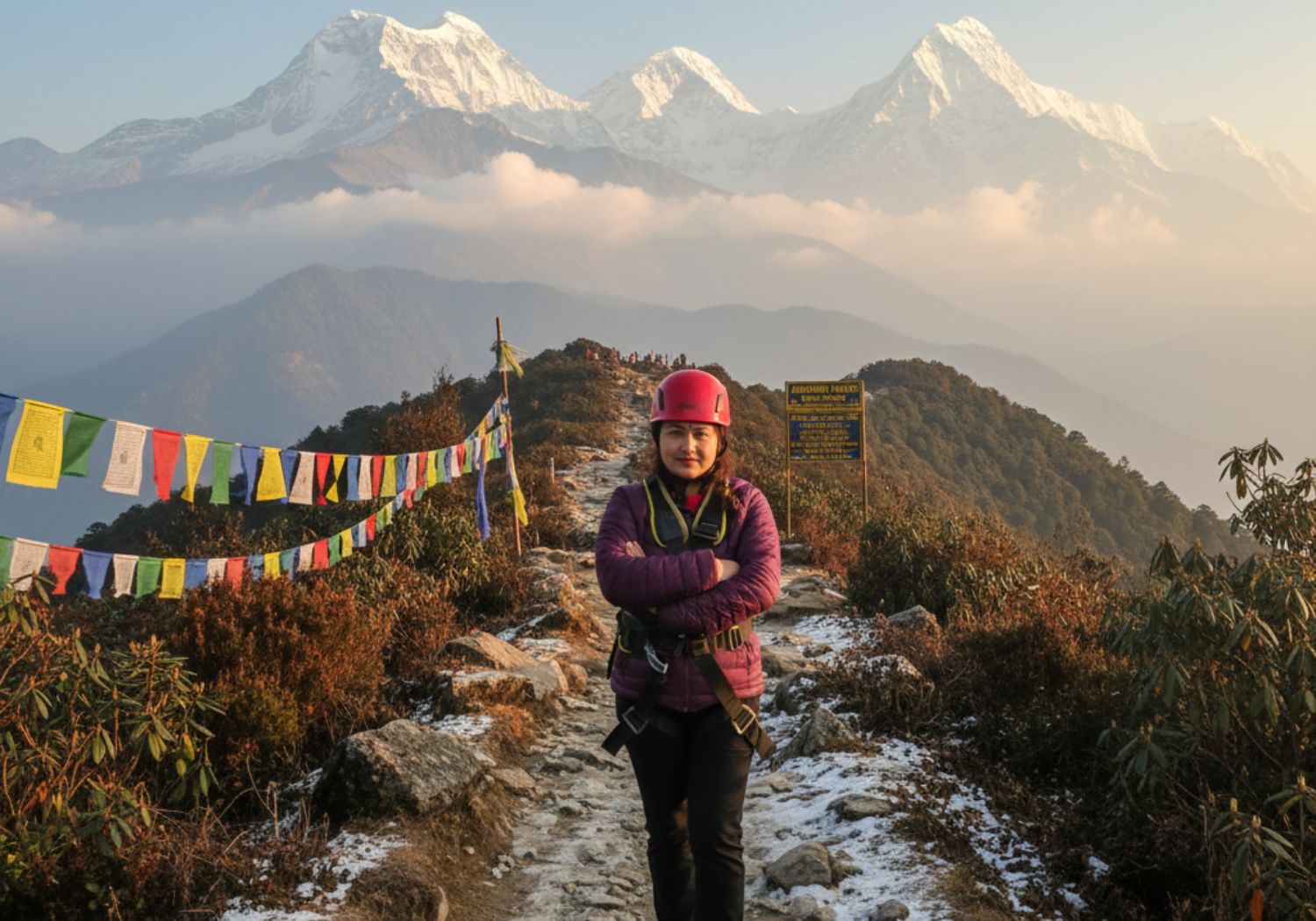
By Sunita Khadka
The alarm went off at 4:30 AM, waking me up from a restless sleep 3,700 meters above sea level. My head hurt a little, which was a sign that the air here doesn’t have as much oxygen as I’m used to. But when I unzipped my sleeping bag in the cold, dark teahouse, the thrill of it all made any discomfort go away. I would finally get to Annapurna Base Camp today, after six days of hiking.
When I first saw the snow-capped peaks from Kathmandu, ABC seemed like a far-off dream. It is 4,130 meters high in the middle of the Annapurna Sanctuary. It was only three hours away now.
The Trip Starts
My trek officially started in Nayapul, a small village on the side of the road that was about 90 minutes from Pokhara. The first day was deceptively easy. The trail was made of stones and went along the Modi Khola river, through terraced rice paddies, and through small towns. The monsoon season in September had just ended, and everything was impossibly green and the sky was clear blue.
The first thing that hit me was how alive the trail felt. Local women carried huge baskets of vegetables on their backs, which were held in place by tumplines across their foreheads. As they walked by, kids in school uniforms yelled “Namaste!” and their laughter echoed through the valleys. Porters carried loads that were sometimes more than 50 kilograms. They moved with such grace that my 12-kilogram pack felt very light.
I got to Ghandruk, a beautiful Gurung village on a hill, by late afternoon. The daughter of the teahouse owner told me about growing up in the shadow of Annapurna South, whose white peak glowed pink in the sunset. She told me this while I ate dal bhat, a traditional lentil soup and rice dish that I would eat twice a day.
Up Into the Mountains
There was a change on the third day. The trail got a lot steeper, and the subtropical forest turned into groves of rhododendrons and bamboo. I climbed up and down stone steps that seemed to go on forever. It was someone’s idea of improving the trail, but it felt more like a StairMaster marathon.
I crossed a suspension bridge at Chomrong that swayed a little with each step. The river was hundreds of meters below and sounded like a roar. That afternoon, I climbed 2,000 steps to get out of the Chomrong Khola valley. Even though the temperature was dropping, my shirt was still wet with sweat. But when I got to the top, tired and out of breath, I finally got a clear view of Machhapuchhre, the “Fish Tail” mountain that no one has ever climbed. Its unique double peak looked like it was floating above the clouds.
When I got to Deurali the next night, the scenery had changed completely. The villages and terraced fields were gone. I was now in the highlands, where only a few hardy teahouses clung to the side of the mountain. The air was noticeably thinner, and I had to stop more often to catch my breath.
Going Into the Sanctuary
On the fifth day, I reached Machhapuchhre Base Camp, which is 3,700 meters high. The trail had become a thin line carved into the side of the mountain, with steep drops on one side and high cliffs on the other. There were pieces of an avalanche all over the path, which was a sobering reminder of the forces at work.
But this is also where the Annapurna Sanctuary showed itself. I was suddenly surrounded by giants when the trail went through the Hinku Cave, a huge rock overhang. Annapurna South, Hiunchuli, and Machhapuchhre looked like white cathedrals on all sides, with their peaks scraping the sky at 7,000 and 8,000 meters.
I hardly slept that night at MBC. The temperature had dropped well below freezing, and I was shivering even though I was inside my sleeping bag with all my layers on. I could hear the wind howling above me, though, and I knew that tomorrow would be hard.
Day of the Summit
We left in the dark before dawn, with headlamps bouncing like fireflies on the path ahead. Rajesh, my guide, had done this trek hundreds of times. He moved slowly and carefully, not because it was hard, but so my body could get used to the high altitude.
He kept saying, “Bistari, bistari.” Slowly, slowly. And he was correct. A lot of people rushed past us in the dark, but later they were sitting on rocks, feeling sick and having headaches.
The mountains caught fire when the sun came up. First pink, then orange, and finally bright gold. The northern skyline was dominated by Annapurna I, which is 8,091 meters high and the tenth highest mountain in the world. The South Face looked like it had been cut with a knife.
The last hour was the hardest. I felt like each breath I took only had half the air I needed. My legs felt heavy. But then, as I rounded the last bend, I saw it: a simple sign that said “Annapurna Base Camp 4,130m” and a bunch of prayer flags fluttering in the wind.
I was in the middle of an amphitheater with a view of some of the tallest peaks on Earth. The wind howled across the glacier, bringing snow devils that danced on the ice. A group of Nepali hikers sang by the sign. A Japanese man who was hiking alone sat down to meditate. A couple from Germany held each other and cried softly. We didn’t know each other, but at that moment, we shared something deep.
What the Mountain Taught Me
It took four days to go down, which was faster than going up but just as hard on the knees. As I walked back through the rhododendron forests and past the terraced fields, I thought about what the hike had taught me.
The mountains first require respect and then reward humility. I met trekkers who had not thought about the altitude or the terrain and were in pain because of it at every turn. People who were patient and respectful on the trek, who listened to their bodies and changed their pace, were able to enjoy even the hard parts.
Second, I learned how strong the Nepali people are. People have built a life and a business in a country with poor infrastructure and villages that can only be reached on foot. The porters who carried supplies, the teahouse owners who kept hot tea flowing at 4,000 meters, and the kids who walked three hours to school each way all showed me a strength that made my small problems seem less important.
In the end, I learned that the journey was almost more important than the destination. Yes, it was unforgettable to stand at Annapurna Base Camp. But so was having morning tea with an old woman in Chhomrong who remembered when the first trekkers came through in the 1970s. Watching the mist rise from the river valleys every morning was also fun. So was the simple act of putting one foot in front of the other every day.
Helpful Tips
If you’re thinking about going on the ABC trek, here’s what I wish I had known:
It’s important to know when. I went right after the monsoon season, in September. The weather was nice, the trails were quiet, and the skies were clear. October and November are peak season—beautiful weather but crowded trails. In the spring (March to May), rhododendrons bloom, but there are more clouds in the afternoon.
Get a guide. While the trail is well-marked and many people trek independently, having Rajesh with me made all the difference. He took care of the teahouse reservations, changed our pace based on how quickly I was getting used to things, and told us stories about the area that no guidebook could match.
Bring the right things, but don’t bring too much. For ten days, I wore the same pair of hiking pants and three different shirts. Having layers for the cold nights at high altitude, a good sleeping bag, and boots that had been broken in were the most important things. I saw too many people with blisters on their feet from new shoes.
The height is real. I work out a lot and am in good shape, but altitude sickness doesn’t care how fit you are. The most important thing is to get used to the altitude by climbing slowly, drinking a lot of water, and knowing the signs. If you really feel sick, go down. The mountain will still be there.
The Come Back
The trek already felt like a dream now that I was back in Kathmandu, showered, and sleeping in a real bed. After days of hearing only wind, water, and footsteps, the sounds of the city seemed almost violent.
But I could still see it when I closed my eyes: the white peaks of the amphitheater, the prayer flags snapping in the wind, and the feeling of having done something that once seemed impossible. Not because I’m especially strong or brave, but because I kept going, one step at a time.
The trek to Annapurna Base Camp is hard. It will be hard on your body and mind. Your legs will hurt, you might get headaches from the altitude, and you’ll definitely question your life choices during some of those long, steep parts.
But at 4,130 meters, with some of the most beautiful mountains on Earth all around you, you’ll see why people keep coming back to Nepal. The Himalayas have a way of putting things in perspective and reminding you how small you are and how big the world is.
The mountains made me a different person. Not in a big, life-changing way, but in small changes. I have more patience now. More thankful for little things that make life easier. More sure that I can handle hard things.
Stop thinking about the trek and start making plans if you are. The mountains are waiting, and I promise you that the view from Annapurna Base Camp is worth every step.
Author Bio:
Sunita Khadka is the Account Head at Real Adventure Nepal Pvt. Ltd., where she has managed the company’s financial operations since starting her professional journey in 2011. Born in Nepal’s scenic Syangja district, she pursued her higher education at Tribhuvan University, earning a diploma degree in accounting that laid the foundation for her career in the tourism sector.



I’ve always wanted to trek in Nepal. How was the altitude change for you during the hike?