What Does Travelling the Silk Road Look Like Today?
The caravans are gone, but the route still makes sense to follow. Today a Silk Road journey through Central Asia usually means fast trains between oasis cities, short flights over deserts that once took weeks to cross, and long, slow afternoons in old trading quarters that never stopped trading.
That last part is what separates it from a tour of monuments. In the old towns, mosques and madrasas share the street with bakeries, barbers and workshops. A covered bazaar that sold silk in the sixteenth century sells it now, alongside everyday goods.
So a good itinerary has three layers: the historic cities, the working markets and neighbourhoods around them, and enough unscheduled time to see how people live. The sections below take each in turn.
Historic Cities and Stops Worth Making
Samarkand, Bukhara and Khiva belong on any Silk Road route, but each has a second layer that many visitors miss.
- Samarkand. After the Registan, go to the Afrasiab Museum on the hill where the earlier city stood. Its seventh-century wall paintings show ambassadors arriving at a Sogdian court, evidence that this was an international city long before Timur.
- Bukhara. Drive a few kilometres out of the centre to Sitorai Mokhi-Khosa, the summer palace of the last emirs, where European chandeliers hang in halls of carved and mirrored plaster.
- Khiva. Step through the gates into the outer town, where daily life goes on beyond the museum quarter.
Then add one or two stops outside the big three:
- Shakhrisabz, Timur’s birthplace, a day trip from Samarkand across a mountain pass, with the broken towers of his Ak-Saray palace.
- The Fergana Valley, the craft heartland of Uzbekistan, with Margilan for silk and Rishtan for ceramics.
- Turkestan in southern Kazakhstan, where the vast mausoleum of Khoja Ahmed Yasawi was left unfinished when Timur died.
- Kunya-Urgench in northern Turkmenistan, a ruined capital whose minaret, about 60 metres tall, still stands over open ground.
Why make the time? The headline sights are the busiest and the most hurried. Secondary stops are where a guide can slow down, and where the Silk Road stops being a list of buildings and becomes a network of places that depended on one another.
Experiencing Local Culture Through Food and Markets
A bazaar is the quickest way into the daily life of a Silk Road city. Go early, before the heat and the tour groups.
Start with the bread. Uzbek bread is baked on the wall of a clay oven, and each baker presses the centre of the loaf with a spiked stamp called a chekich, leaving a pattern that works as a signature. Buy one warm and eat it as you walk.
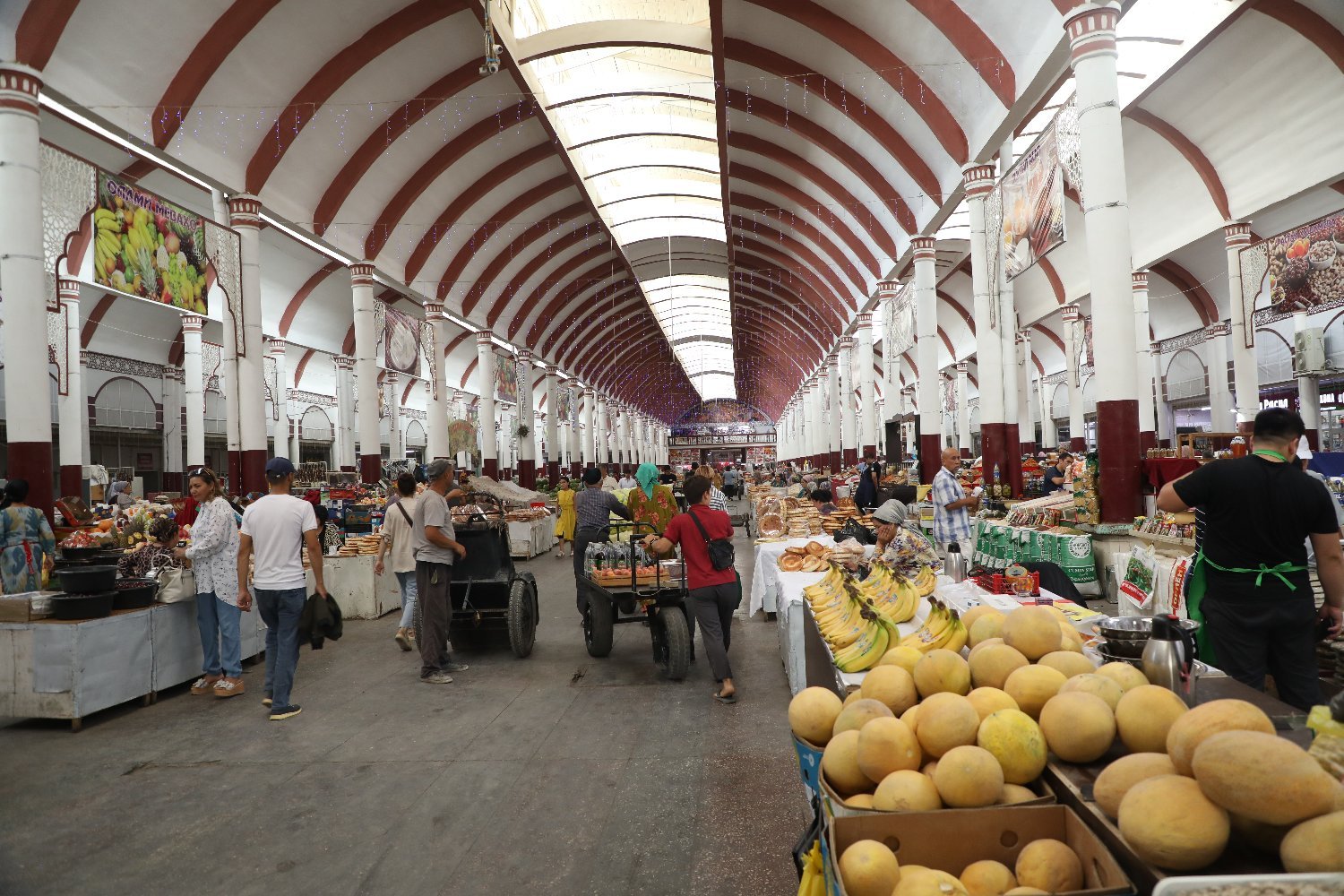
Then follow the produce. In Margilan, the Kumtepa bazaar on Thursdays and Sundays sells ikat silk by the metre next to sacks of rice and trays of dried fruit. In Osh, in southern Kyrgyzstan, the Jayma bazaar has traded on the same riverbank for centuries. Stallholders will often offer a taste: a slice of melon, a piece of halva, or kurt, the hard, salty balls of dried yoghurt that travellers either love or politely decline.
Tea is where the market slows down. In an Uzbek teahouse you sit on a tapchan, a raised wooden platform. The first bowl of green tea is poured and returned to the pot three times before anyone drinks, to help it brew. It comes with navat, crystallised sugar, and nobody will hurry you.
In March, look for sumalak, a sweet wheat paste cooked overnight for the Navruz festival.
Meeting Artisans and Discovering Living Traditions
Craft is the part of Silk Road culture you can still watch being made.
- Ceramics. In Rishtan, potters use local red clay and a glaze made from the ash of desert plants, which fires to the town’s characteristic blue and turquoise. Many workshops are in family courtyards, with the kiln at the back.
- Textiles. At a silk workshop in Margilan you can follow ikat from cocoon to cloth: threads are bound, dyed and rebound before weaving, which gives the pattern its blurred edges. In Bukhara and Samarkand, look for suzani, large cotton or silk panels embroidered by hand.
- Carpets. Turkmen carpets carry repeated medallions called guls, each traditionally linked to a tribe. Ashgabat’s Altyn Asyr bazaar is the place to see them in quantity.
Arranging a visit. Shops in the tourist quarters welcome walk-ins. For a master’s home workshop, or a hands-on session at the wheel or loom, ask your guide or tour organiser to call ahead. Village artisans work to their own schedule, and a kiln firing or a family wedding can close a workshop for the day. Allow an hour, more if tea is offered.
Being a good guest.
- Take off your shoes at the door if your hosts do.
- Ask before photographing people or unfinished work.
- Accept at least one bowl of tea.
- Do not bargain hard in someone’s home: the price reflects days of handwork. If you are not buying, a sincere thank-you is enough.
How Local Knowledge Enriches the Journey
Much of what makes these encounters work is invisible to the traveller, and it is where a local organiser earns its fee.
- Choosing stops. Someone who works in the region knows that Margilan’s bazaar is worth the detour only on market days, that a mountain pass may still be closed in April, and which secondary site fits naturally between two cities.
- Finding guides. A city guide in Bukhara and a mountain driver in Kyrgyzstan are different specialists. A local company matches them to the route and to your language.
- Opening doors. A potter or a weaver is more likely to welcome visitors when the request comes from a partner they already know.
This is the role of a Central Asia tour operator such as Travel Land, which has been based in Bishkek since 2016 and now works across all five countries. The company says it works with artisans, farmers, nomads and local families. Its website shows what that looks like in practice: scheduled small-group departures, private tours and a trip planner for custom routes, with the day-by-day programme of each tour published in full.
Choosing a Route with Time to Explore
Two itineraries can list the same cities and feel completely different. Before you book, read the programme for three things.
- Pace. Count the nights. Two nights in a city give you one full day plus an evening and a morning of your own. One night means you see the highlights with a guide and move on. Check, too, how many travel days run longer than five hours.
- Length of stops. A day that names ten sights is a day of photographs. Look for programmes that give a major site two hours rather than forty minutes, and that say how long a workshop or market visit lasts.
- Free time. The words “free time” or “at leisure” should appear more than once. An unscheduled late afternoon in Bukhara or Khiva is the time for the teahouse or courtyard you found on your own.
To practise, open a page of Silk Road tour packages such as Travel Land’s and compare the routes side by side. It lists group and private journeys of 10 to 21 days, each linked to its full programme, so you can check nights per city, driving times and free hours. If a route is close but too fast, ask whether a night can be added: on a private tour, it usually can.




Leave a Reply