We were at the junction in Besisahar where the road splits, and everyone else in the vehicle was going north, up the Marsyangdi, toward the Annapurna Circuit and the teahouses and the pass at 5,416 metres that people fly across the world to walk over. I asked to be let out at the turn for Hugdi.
The driver repeated the name back to me twice. Then he shrugged in the way Nepali drivers shrug at foreigners and at locals who are behaving like foreigners, and he let me out at a roadhead with a tea shop and nothing else.
I live in Kathmandu. I have spent a decade around the trekking industry here, and I have watched something odd happen to the hills: the famous routes have grown busier every year while the ridges between them have quietly emptied. Lamjung sits directly below the Annapurna massif, and most people pass straight through it on the way to somewhere better known. The Gurung villages on the slopes above that road have been there for centuries. Almost nobody stops.
I wanted to find out what stopping was like.
The Thousandth Step Out of the Midim Khola
There is a stone staircase that climbs out of the Midim Khola valley, and somewhere around the thousandth step I stopped pretending I was fit.
A woman passed me carrying a doko of millet on a headstrap, said something cheerful I could not follow, and kept going. She was perhaps sixty. I was thirty-six and sitting on a rock.
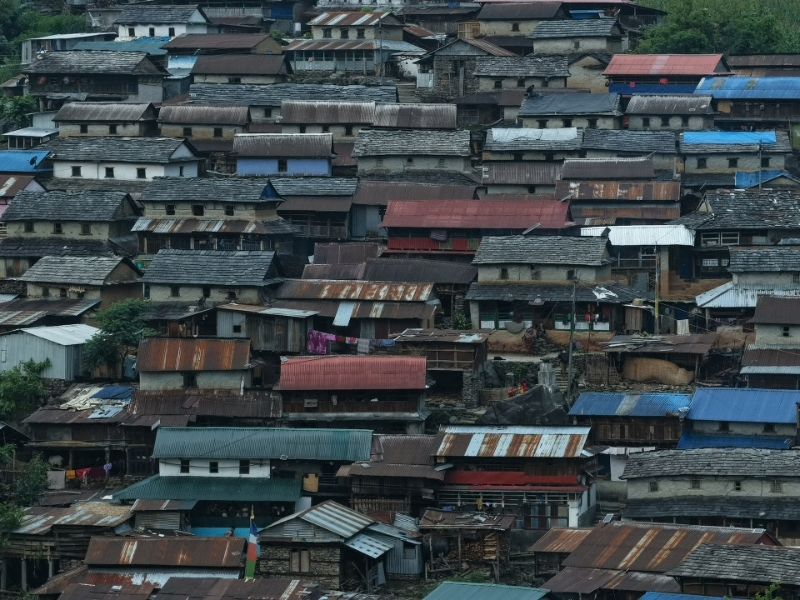
The walk up to Bhujung takes two hours, maybe three if you keep stopping the way I did. The paving predates everything motorised in the district. You climb past millet terraces and a water mill that is still in use, through a switchback of pine where Lamjung Himal shows itself whenever the cloud thins, and you arrive in a village of slate roofs with no entrance gate, no checkpoint and no map board telling you what you are looking at.
There is no permit office either. For the Circuit you need an ACAP permit and a TIMS card. For this you need to find the homestay committee and ask.
What a Village Looks Like When It Is Not Performing?
I went in October, which is harvest season. The millet was coming in. Cardamom was drying on every flat surface. Mornings started before six with the sound of threshing, which is a noise I had never heard sustained for three days and now associate entirely with that village.
This is the part that does not happen on the Circuit. A teahouse on Marsyangdi is a business built for people like me, and it is good at being one. Bhujung is a village that happens to put up guests. Those are different experiences, and the second one is harder to arrange and much harder to forget.
I paid NPR 2,000 a night for a room with a mattress on a wooden floor, a shared washing area and three meals a day. The food was dhido, which is millet or buckwheat flour worked into a stiff porridge and eaten with the fingers, alongside seasonal greens, fermented gundruk and chicken when there was chicken. I ate better there than in most of Thamel.
Electricity came and went. Mobile data gave up a few hundred metres above the village. My host’s daughter, home from her studies in Pokhara for Dashain, translated for three days and corrected my pronunciation without mercy.
The Ladder, Which Was the Real Reason
What got me on the bus in the first place was a conversation with a friend from Lamjung who told me the thing nobody films is the ladder.
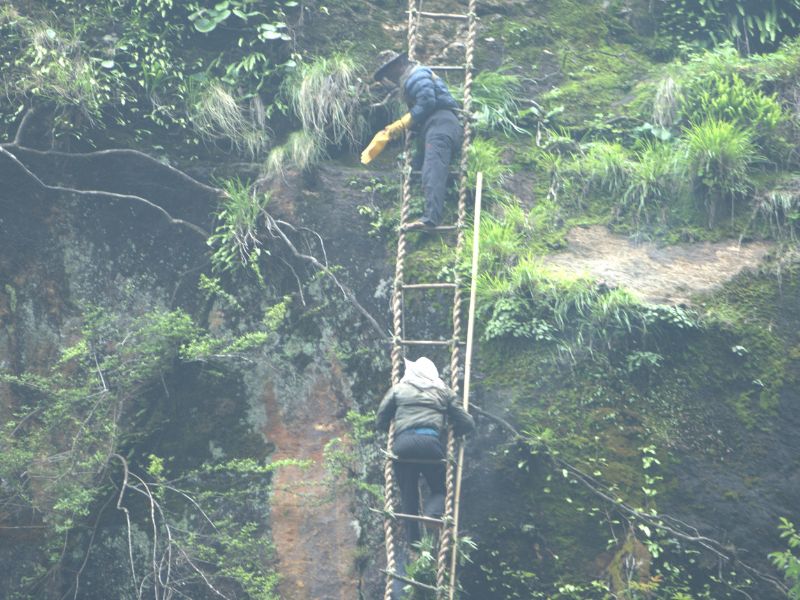
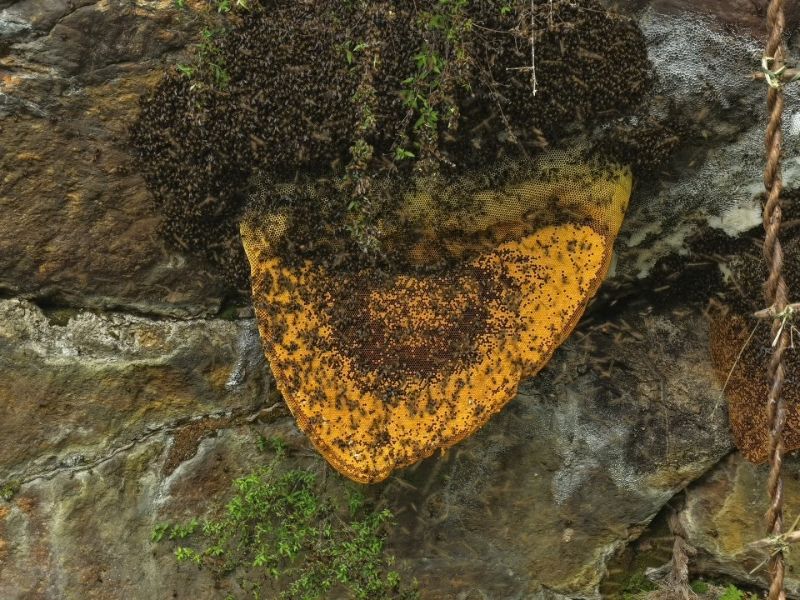
Bhujung is known internationally for its mad honey cliffs. Twice a year, in spring and again after the monsoon, men climb down the rock faces above the village to cut comb from the colonies of Apis laboriosa, the Himalayan giant honeybee, which builds its nests on overhangs between 2,500 and 4,000 metres. Documentary crews come for the climb. The harvest the villagers call bhir mauri ko maha has been photographed a great many times.
Nobody films the week beforehand, when four men sit in a yard building the ladder from fresh bamboo and allo nettle fibre, twisting the fibre into rope by hand.
I spent an afternoon watching that. It is an object on which a man’s life depends, made from plants cut that week, by people who have been doing it since before anyone kept records. The harvest I had half hoped to see was postponed eleven days on account of wind, which is how these things go. I got the ladder instead, and three days in a working village, and I am confident that was the better trade.
What the Cliffs Are Worth Now?
Gurung-harvested mad honey sells all around the world, but what is mad honey is really a question about this cliff, this bee and this week of ladder-building. Buyers who come to Lamjung directly have put cash income into households that previously had very little. Whether that keeps a tradition alive or quietly turns it into a product is a question I heard argued in a kitchen more than once, with no resolution. The young men are in Pokhara, in the Gulf, in Malaysia. One man told me there are perhaps three left in the village who can still cut properly, and that his own sons have no interest.
He said it without bitterness, the way you mention weather.
Ghalegaun and the View You Came For
On the third day I walked to Ghalegaun, about two hours along the ridge.
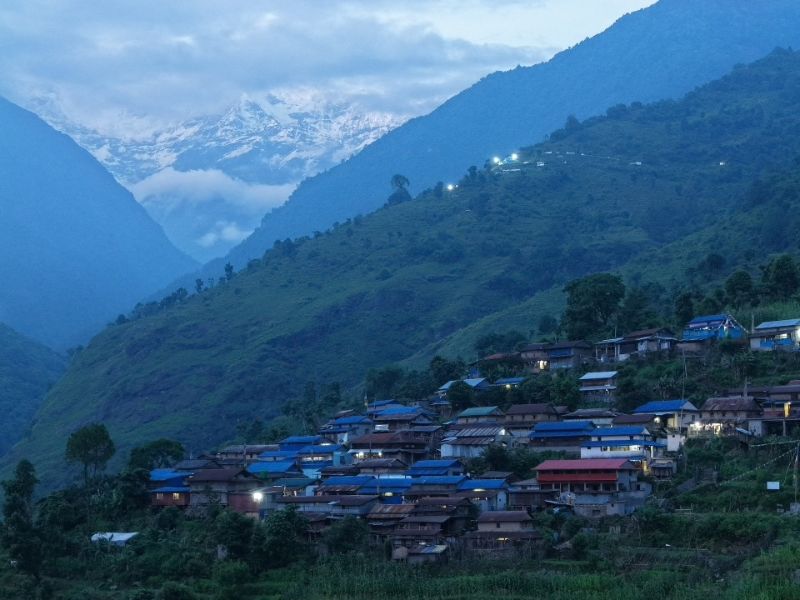
Ghalegaun was one of Nepal’s first community tourism villages and it shows. The houses are painted, the paths are swept, there is a visitor information board. It is more comfortable than Bhujung and considerably less surprising.
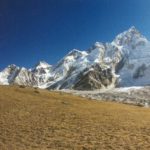
What it has is the view. On a clear morning the ridge gives you Annapurna II, Lamjung Himal and Machhapuchhre in a single sweep, and I sat with tea for an hour watching clouds build and clear across the face of it. Everyone on the Circuit that week was looking at the same mountains from the other side, having walked a great deal further to do it.
Both villages are worth the time. Ghalegaun if you want a bed and a view. Bhujung if you want to watch a place go about its actual business.
Who Should Do This Instead?
Not everyone. The Annapurna Circuit is famous because it is magnificent, and if you have come to Nepal to cross a high pass you should go and cross it.
But if you have four days rather than eighteen, or you have walked the famous routes already, or you would rather spend your evenings in a kitchen than a dining hall, Lamjung is sitting right there below the mountains that everybody else is circling.
Bring cash, because there is no ATM past Besisahar. Bring something for the household, since tea, salt or supplies for the village school land are better than money. Hire a guide who speaks Gurung if you can, which costs around NPR 3,000 a day and changes entirely what you are let into. Go in October or November for the harvest and the clear air, or April and May for the rhododendron.
And accept that nothing will run to your schedule. That is not a flaw in the itinerary. On this particular walk, it is the itinerary.
Coming Down
I walked back to Hugdi with legs that had stopped complaining and a notebook full of names I had asked people to spell for me.
The jeep took an hour. The bus took six. By evening I was in Kathmandu traffic with the horn of a microbus somewhere behind my left ear, thinking about the sound of millet being threshed at six in the morning by a household that had been doing it for a very long time and would be doing it again tomorrow, whether or not anybody came to watch.


Leave a Reply