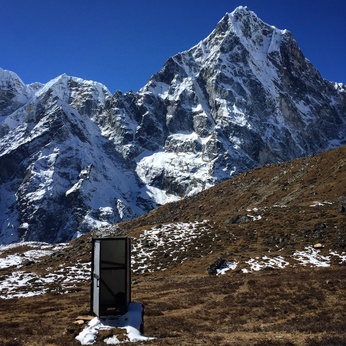
 The sanitation both in Nepal and on the trail in the Himalayas leaves something to be desired. I would say that most members of our 16 party group had some sort of food poisoning or upset stomach due to the food. There is a lack of sewer systems which results in a much higher degree of diarrhea. No water in Nepal should be trusted by the Western traveler. Even the tap water in Katmandu is suspect. There are certain ways around drinking the local water in its present state. You can buy sodas and bottled water along the trail. Buying these may be suspect as well since some of the bottled water is bottled filtered but not purified in the hills behind the town of Namche Bazaar.
Our group drank the bottled water and the sodas all the way up the trail. You can bring filters and filter the water. Filter pores must be small enough to catch parasitic eggs and larvae. However filter pores are not small enough to catch viruses, and are only slightly efficient in catching bacteria. Some recommended water filters are Katadyne Pocket Filter, First Need Filter, and Water Tech Water Purifier.
 Another method of insuring the safety of the water is to boil it. The boiling point of water at 14,000 feet is about 187 degrees F. Despite the lower boiling temperature, this is still hot enough to kill harmful bacteria. The problem with this method is that it takes time, a stove, and fuel. A pressure cooker is recommended instead.
My favorite method, but one that I only used once on this trek is the use of iodine pills in the water. The pills are very light and can be easily stowed in your backpack. Usually one pill is recommended per quarter of water but consult the individual instructions.
Leave a Reply