Most Taj Mahal tour rarely deviate from the script: you enter the Taj complex, stroll through its gardens, enter the main mausoleum to see the tombs, take a few pictures at the same spot as a million others and then leave the city. But beyond this Taj Mahal itinerary, there lie so many details most visitors miss out on.
I have visited the Taj Mahal around five times now, my first time being when I was 10. Each visit taught me something new on how to actually experience this wonder properly. And after my latest visit I realised– the guidebooks sure tell you the basics, but there’s a complete layer of inside knowledge that you can only pick up from locals who live and work in Agra. This blog shares what I have learnt so far.
When is the Best Time to Visit the Taj Mahal?
The Taj Mahal is gorgeous any time of the day, but if I had to choose just one time of the day to see its beauty, it would be sunrise. And, with the right network, you can also be the first ones to enter the complex. So if you have ever seen those photos of people with the Taj Mahal all to themselves, this is how you can get them too.
The views of the pure white marble shining as the sun comes up are stunning, and so are the photos. The gates open 30 minutes before sunrise, which generally ranges from 5:15 AM in summer to 6:45 AM in winter. The best time of the year to travel to Agra is between October to March. However, I’d recommend avoiding mid-December to the first week of January, which is similar to San Francisco winter. Also, the fog at sunrise during these months can get denser than SF’s Karl, which distorts the true experience. Avoid the summer months of April to June for their nearly unbearable heat, especially for afternoon sightseeing.
How to Book Your Tickets to the Taj Mahal?
As of 2025, the online booking system for the entrance tickets to the Taj Mahal has gotten much better. I would still recommend booking your tickets at least three days in advance through the official archaeological survey of India website. Besides, confirming the availability, it helps you skip longer queues.
Foreign tourists pay 1100 INR which includes entry to the main mausoleum (the marble building) as well as the mosque. Your ticket is valid for three hours from your entry time slot, which is plenty to take in the beauty of this absolute wonder. I recommend keeping a printed copy or a clear screenshot of your ticket handy; the network or Wi-Fi near the entrance gate can be unreliable at times.
Getting inside the Taj Complex
The complex has three main entry gates: east, west and south. While most tourists use the east gate (it’s closer to the parking), the west gate usually has shorter lines. Being a world’s wonder, there is no room for leniency on the security. The rules have gotten tighter over the years as the efforts to preserve the beauty of the monument increase.
Here is exactly what you can bring: your phone or camera, essential medicines, a small transparent water bottle (should be under one liter), a small wallet and your documents. Everything else gets stopped— no food, no large packs, no tripod, no selfie sticks, no power, banks, no chargers, no books, no cigarettes. If you’re making a same day trip from Delhi and worried about storing your luggage, there are paid storage facilities near each gate. They only charge around 50-100 INR per bag.
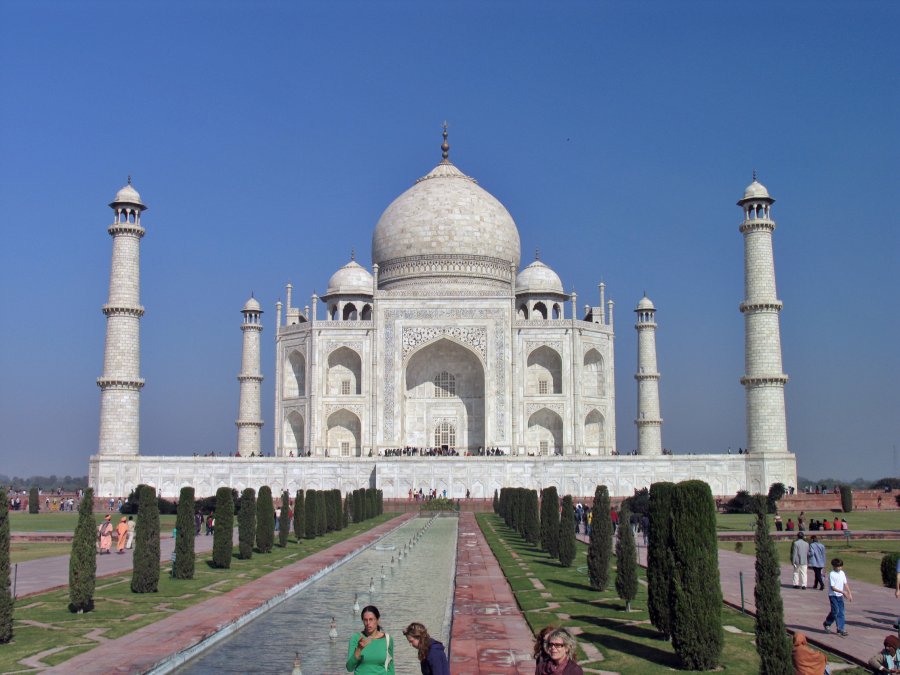
Once you’re through security and pass the main gate, take your time with approach. Just entering through the archway and biting the first view makes you feel like it was designed to take your breath away. It’s the kind of you that makes me pull out my camera, even after having seen it multiple times.
As you walk closer to the mausoleum, you see the scale becoming more apparent. The details on the walls of the Taj start getting more noticeable. Most people aren’t aware, but the marble isn’t uniformly white. It’s engraved with colourful semiprecious stones, in intricate patterns, featuring flowers and leaves. One could take an hour just studying the inlay work on the main marble walls.
The manicured gardens are inspired by the Persian “Char Bagh” design, which translates to “four parts”. This partition is done via water channels and the reflecting pool here is the most photographed spot. Another iconic spot for photographs is the “Diana Bench.” Yes! Princess Diana was once here, and this is the bench where she gracefully posed.
Where to Stay Near the Taj Mahal?
Those of you with less time in hand might prefer a same day trip to Agra from Delhi. Otherwise, I would always recommend staying overnight for a sunrise tour. Most tourists gravitate towards Tajganj for hotels, a neighbourhood only a stone’s throw away from the complex. The location is, of course, unbeatable, and you can find a good range of options from budget hostels to mid-range hotels. For those not wanting a touristy area to stay, there are a bunch of good luxury hotels on the Fatehabad Road. About 3 to 4 km from the Taj, you’ll find quieter, more upscale options here.
For my latest trip to Agra, I splurged on a stay in the world-class Oberoi Amarvilas hotel. This is where most celebrities and dignitaries from across the world stay on their trips to Agra. The best part about this hotel is how each one of their suites have direct views of the Taj. There is nothing more extraordinary than waking up to these stunning views.
How Do I Travel to See the Taj Mahal from California?
The best and most common way to get to Agra is via Delhi. You’ll find a bunch of good flight options from Los Angeles or San Francisco to Delhi. While the international airport here is only three hours from the Taj Mahal, I would recommend at least a day-long stay in Delhi first. This way, you can ease your 12-hour jet-lag from California. Besides that, it’s also India’s capital city, with a great variety of historical gems to explore.
From here, you have a couple of options, but I will be upfront about which one seems the best for most travellers: hiring a private chauffeur driven car. It might cost more, but the benefits are worth it. You leave when you want, and you have complete flexibility with your schedule and you might even want to stop at sites, such as the spiritual town of Vrindavan, before finally making it to Agra.
The second option is to book a premium train ride. The Gatimaan express takes about 90 minutes to take you from Delhi to Agra. The railway station in Agra is well connected to the rest of the city, and the tickets are quite affordable, ranging between 9 to 17 USD, depending on the class. This is especially favourable for those who look forward to an authentic Indian experience. Buses are a budget option, but I would skip them unless you’re really counting every dollar. High-end travellers who are short on time can also book private charters from Delhi to Agra, which are both quick and scenic.
Once you’re in Agra, you’ll find autorickshaws to be the primary local transport, but I would again recommend hiring a private car. This means you won’t have to worry about transport for each site repeatedly. If you’re still going with local transport, I would advise on always confirming the fare before getting or insisting on using the meter.
6 Beautiful Details Visitors Often Miss Inside the Taj Mahal
The main dome and pool are what most visitors see and then overlook the rest of the details. Here are a few things you should notice when you visiting the Taj complex:
1. Calligraphy – Inlay Work
The entrance gate itself is a masterpiece in its own right. Its ceiling is decorated with floral patterns as I mentioned earlier, being on the marble walls of the Taj, and there are verses from the holy book, Quran engraved around the archway. This calligraphy is stunning, but it’s not even glanced at by most visitors.
2. Mosque & Guest House
Inside the complex, quite a few people ignore the red sandstone gates that flank the main building. On the west side lies an active mosque. The Taj complex is closed on Fridays to respect the prayer times. The guest house on the east side is identical to the mask structure but built purely for symmetry. You can walk inside these buildings to appreciate the detail work on their walls, but they are mostly empty.
3. Pietra Dura
As I mentioned above the work on the main mausoleum might seem painted, but they are actually engraved semi-precious stones. This technique is called Pietra Dura and it is still practised in workshops around Agra by descendant families of two original artists who worked on these very walls. Those colourful stones are cut into tiny pieces and fit it into the marble so precisely that you can barely see the joints. For those fascinated by this artwork, you can also buy pieces and even customize one for yourself from these workshops.
4. The Minarets
The four minarets surrounding the main dome aren’t just for decoration. They are all tilted slightly outward by about 2 to 3° which was done to protect the main dome if they collapsed in case of an earthquake. When you look up, standing close to it, you will recognise the angle.
5. The Marble Screens
Inside the main mausoleum, the Cenotaphs take the attention, but the marble screens also called “jali work” that’s around them are remarkably designed too. Carved out of whole pieces of marble, the intricate geometric patterns on them let the light filter through. I am always fascinated trying to imagine how this level of craftsmanship was possible centuries ago. Another less known fact is that the tombs you see inside are actually replicas. The real tombs are located in a chamber right below them, not open to the public.
Also, the acoustics in the main chamber are amazing. If you’re coming here at sunrise, listen carefully when someone speaks and you’ll hear the echo sustain for nearly 30 seconds. This was a deliberate design to amplify sound, specifically Quran recitations.
6. Yamuna River View
For some serene views you don’t usually see on the internet, walk along the outer platform edge towards the back, if you look down, you’ll see the Yamuna river gracefully flowing. It’s usually much quieter there, and you get another perspective on the architecture. When the Taj Mahal was built, the river flowed right beside the foundation. This beauty was designed to be seen from boats.
What After?: Exploring Agra Beyond the Taj
Agra is not a one-monument city. And especially if you’re travelling all the way from California, I would recommend spending at least one and another half day here to see other sites.





Leave a Reply