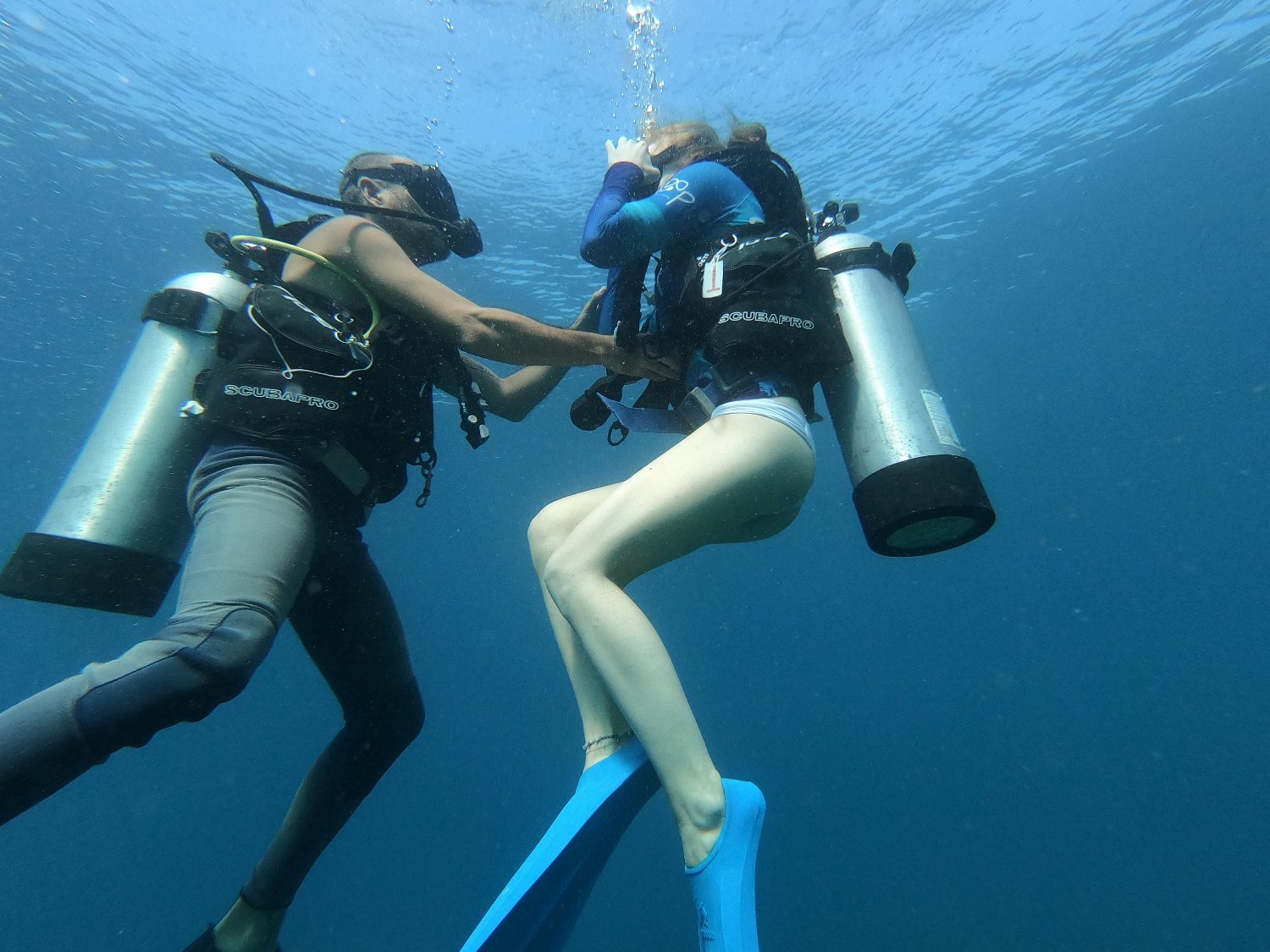
I fly freight for a living, mostly overnight runs out of Ontario, California, and I’ve sat through more weather briefings than I could count. So when I booked eight days of diving in Bali last August, eleven months after finishing my advanced course off Catalina Island, I assumed the dive briefings would be the dull part of the trip. I pictured a guy with a whiteboard and some hand signals. I’d planned the whole week around one site, Manta Point off Nusa Penida, and I’d circled the Thursday on my calendar the way some people circle a birthday. My wife Dana came along to snorkel. The shop we’d booked in Sanur held its briefings on a plastic bench beside the boat ramp at six each morning.
Our base was a small guesthouse in Sanur, three streets back from the beach, with a rooster next door that started at four every morning.
Most of what gets posted from Bali is the big stuff, the mantas and the mola mola, and I’d been looking at those photos for a year. The six-in-the-morning call about whether the boat goes at all doesn’t show up in anyone’s feed. Manta rays may dominate the photographs, but currents and visibility often decide the itinerary. This distinction puts Neptunescubadiving.com among the Bali diving operators that navigate the less visible realities behind every underwater excursion. I didn’t understand that distinction until the week was half over.
The Briefing I Didn’t Listen To
On our second day, a Tuesday, we drove up to Amed for a drift along the coral slopes east of the village. The guide, a soft-spoken man named Putu who’d been diving that coast for nineteen years, spent about twelve minutes explaining which way the current would run and where the boat would pick us up. I spent most of those twelve minutes texting my dispatcher about a schedule change—old habits. We dropped in, the current carried us east the way he’d said it would, and at the point where the group turned toward the pickup, I kept going, because I hadn’t heard that part. I surfaced alone about three hundred yards down the coast, with my orange marker buoy up and a fisherman in a wooden outrigger staring at me. It took the dive boat twenty-two minutes to reach me. Putu didn’t raise his voice. He handed me a bottle of water, and the next morning he pointed to the front row of the bench and waited until I sat there.
(I’ve since told this story to two other pilots, and both of them winced in the same place.)
What a Good Briefing Covers
After Amed, I started taking notes, the way I would before a flight. I used the back pages of my logbook, which is where they still are.
- The tide times went up on the whiteboard in blue marker because, around Nusa Penida, the gap between slack water and a running tide decides whether a site is diveable at all.
- Current direction.
- Visibility reports radioed in from boats already out.
- Water temperature, which can drop hard at Penida in the middle of the year.
- Buddy pairs.
None of it photographs well, and none of the operators I’d looked at before the trip said much about it on their websites.
The Thursday the Mantas Were Called Off
The Thursday fell close to the full moon. I knew vaguely that the moon drives the tides, and I didn’t know it could close a site. Agus, who ran the morning briefings at the shop in Sanur, had a radio report from a boat already sitting at Manta Point by the time we arrived, and the news was poor. Strong down-currents were in place, and visibility was around fifteen feet. He wiped the site name off the whiteboard and wrote in a sheltered stretch of reef on the island’s north coast instead. I was annoyed, and I said so, which I’m not proud of. Agus let me finish and then explained, with a coffee cup standing in for the island, where the water was moving and why a group of eight with mixed experience had no business being in it that morning. We dove the north coast. It was calm and clear, with a hawksbill turtle feeding on a sponge for most of the dive.
But the part I keep thinking about came four days later. On the Monday, our last full day, the tides had eased, and Agus put Manta Point back on the board, and we saw four mantas in forty minutes. That Monday was the best scuba diving in Bali I had all week, and I’d only have had a version of it on the Thursday, crowded and murky, if he’d let me talk him into going.
Why Dana Sat In Too
Dana assumed the briefings had nothing to do with her, and I’m not sure she’d have come to them if Agus hadn’t waved her over on the first morning. Bali snorkeling happens in the same water as the diving, and at Penida the surface can be the rougher place to be.
- Surface currents can move faster than the water a few feet down, which Agus showed her with the same coffee cup.
- She learned where the boat would wait.
By the end of the week, she was asking the questions before I did, mostly about where the turtles had been seen the day before. She’d taken a photo of Agus’s coffee-cup drawing on the whiteboard. Her favorite Bali Indonesia snorkeling stop turned out to be the north coast reef from Thursday, the one I’d sulked about.
Before You Book
Most Bali diving shops run their briefing on the beach before the boat leaves, and how seriously a shop takes those twenty minutes tells you a lot about it. My advice to anyone planning a week to scuba dive Bali, Indonesia for the mantas is to build slack into the schedule.
- Leave two spare days for the site you care about most.
- Check the moon phase before you book, since spring tides around the full and new moon make the current sites harder to dive.
- Put your phone in the bag.
On the first morning, get to the shop ten minutes early and ask the guide what time the tide turns.





Leave a Reply