I live in Collbató, at the foot of Montserrat’s southern face. When I climb toward the mountain along the Camí de les Coves, there’s a moment I never tire of: as I round a bend in the path, a small chapel appears in the distance, wedged into the rock. This is the Santa Cova, and for many of us who live here it’s the true spiritual heart of Montserrat, even more than the famous Benedictine monastery.
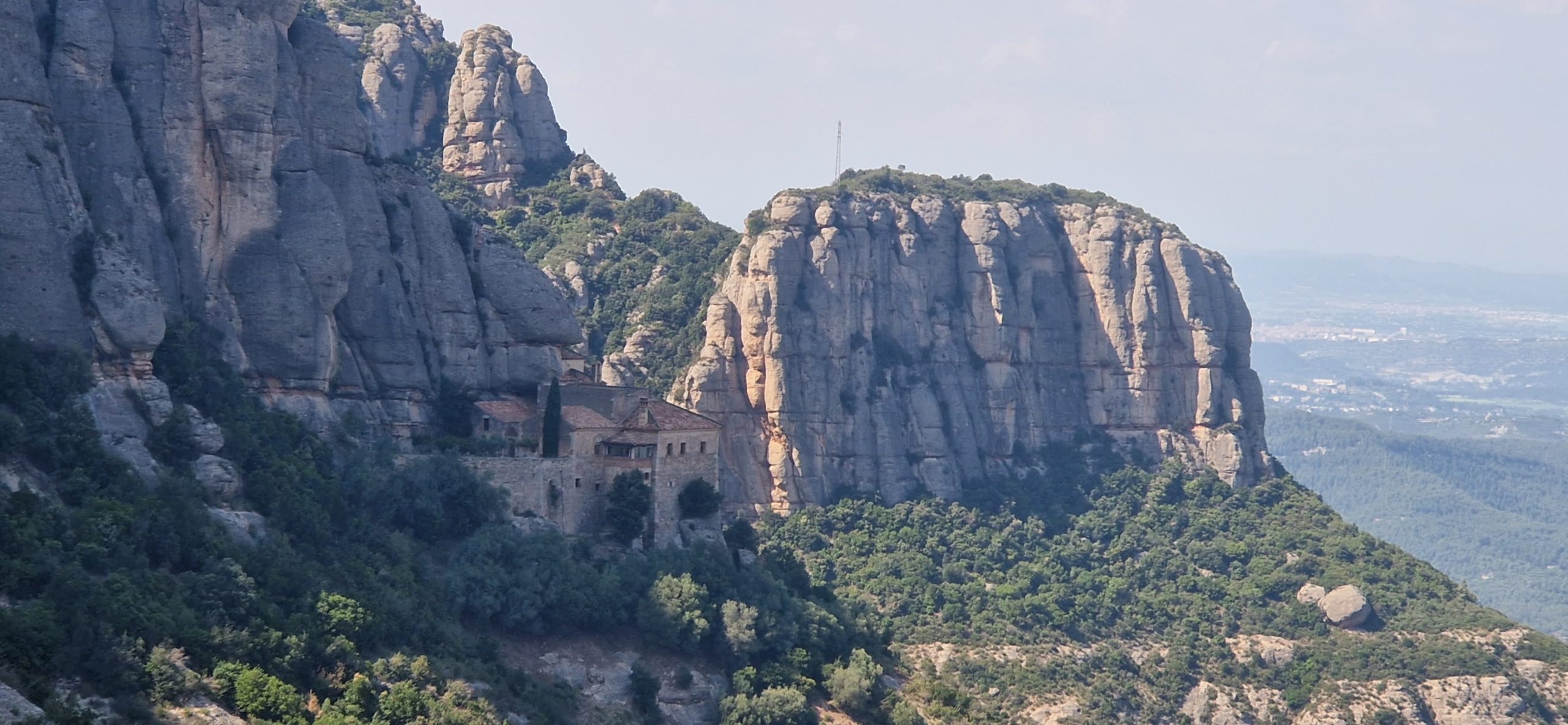
The Santa Cova chapel, seen from the Camí de la Santa Cova.
This is the place where tradition sets the finding of the image of the Virgin of Montserrat, the Moreneta. Most people who come up here don’t come as tourists, but out of devotion. They feel this is the original spot, the exact point where the Virgin appeared and made herself present on the mountain.
That faith, that energy, is something you breathe in here. You sense a deeper, more intimate spirituality than in the monastery itself, which is always full of people.
The legend of the finding
The documented history of the Santa Cova — set down in detail by the historian Josep Galobart i Soler in the Butlletí del Santuari of Montserrat — begins with a legend the mountain has been telling for a thousand years. It goes that, back in the Middle Ages, young shepherds gathering their flock at dusk saw strange lights and heard singing that came down from the sky and always stopped at the same point on the mountain. They told their masters, who checked for themselves and reported it to the rector of Olesa, who in turn informed Bishop Gotmar of Manresa.
The bishop came up with a crowd of people, saw the lights too, and in a cave found the image of Saint Mary. When they tried to move the image to Manresa, the legend says, it grew so heavy that it was impossible to take it off the mountain.
This was read as a sign of her will: the Virgin wished to stay here. That image — a 12th-century Romanesque carving — is today the Moreneta that presides over the monastery basilica: the famous Black Madonna of Montserrat, patron saint of Catalonia.
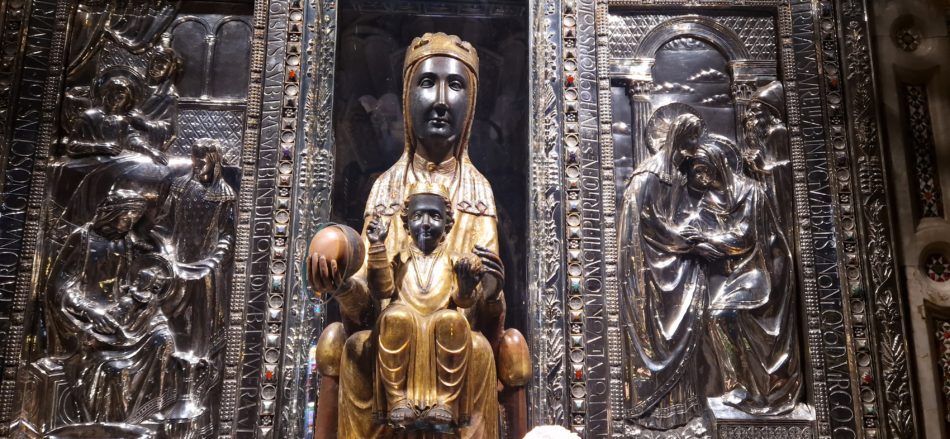
The Moreneta, the Mare de Déu de Montserrat.
The silver road and Gaudí’s Rosary
You reach the Santa Cova along a path carved into the rock that starts near the monastery. It’s a beautiful walk, and along the way you’re accompanied by the sculptures of the Monumental Rosary — groups representing the mysteries of the rosary, the work of some of the great names of Catalan Modernisme. Antoni Gaudí himself had a hand in the First Glorious Mystery. They were built between 1893 and 1916, and Puig i Cadafalch, Josep Llimona and the Vallmitjana brothers worked on them too. The last ones, the glorious mysteries, occupy the final stretch before the cave, facing east to catch the full light of the morning sun.
The path also has a story that explains its name. The Marchioness of Tamarit, who funded the works, saw how terribly expensive it was to build and asked whether they were making it out of silver. That’s why, to this day, we call it the camí de la plata — the silver road.
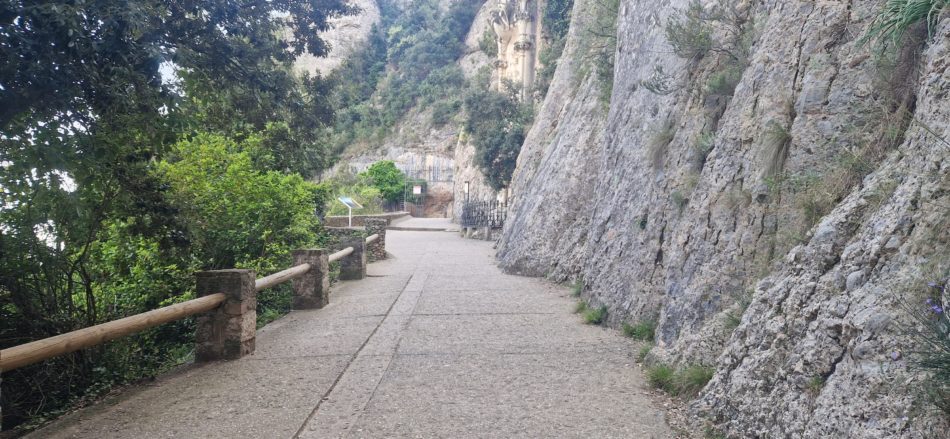
The final stretch of the silver road, at the entrance to the Santa Cova chapel.
A thousand years clinging to the rock
The history of the Santa Cova is absolutely fascinating, and I’ll tell it in my own words, drawing on the research of Galobart i Soler and of the sanctuary itself. The earliest engravings show the Santa Cova, already in the 16th century, as a cave hanging on the hillside halfway up the mountain. Around 1570 a small first chapel was raised at the spot where the image was believed to have appeared. But the chapel we see today was born of a death and a will: that of the first Marquis of Tamarit, whose daughter, the Marchioness Gertrudis, as executor, paid for the works and carried out her father’s wishes. Building the path and the whole complex dragged on for years and wasn’t finished until 1705.
There’s one detail I love: when the chapel was rebuilt on a Greek-cross floor plan (four equal arms), the presbytery had to be dug back into the rock — which tells us that the original cave, where the image was believed to have appeared, was in fact very small.
History didn’t always treat this mountain’s hermitages and chapels kindly. In 1812, during the Peninsular War (here we call it the Guerra del Francès), Napoleon’s troops burned and looted many hermitages and chapels, the Santa Cova among them. And with the confiscation laws of 1835, worship was banned and the community scattered.
In those days the image of the Moreneta itself was kept safe, hidden away in the farmhouse of Can Jorba, at the southern foot of the massif, in the municipality of El Bruc. Worship wasn’t restored until 1844: the queen signed the reopening order on July 20, and the image returned to its alcove on September 7 of that same year.
The burned chapel was restored by the architect Francesc de Paula del Villar — who years later would be one of the teachers of a young and promising Antoni Gaudí.
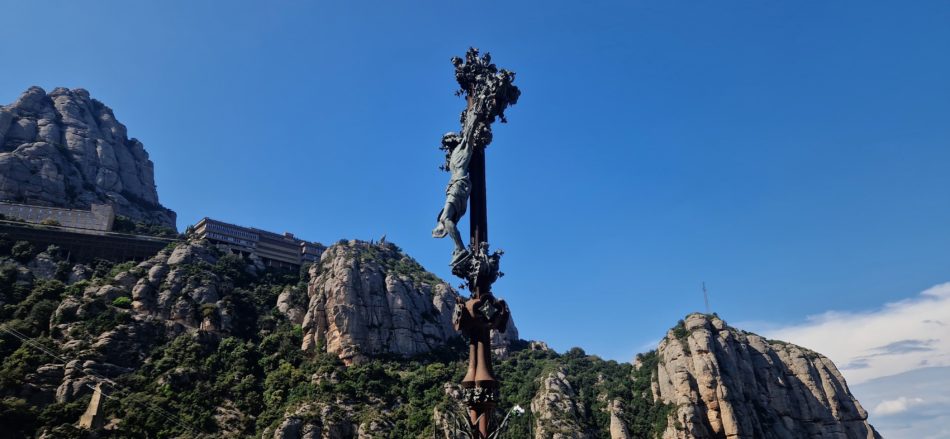
The Fifth Sorrowful Mystery, designed by the architect Josep Puig i Cadafalch (1867–1956).
Inside the Santa Cova
The chapel is austere, built literally on and against the conglomerate rock of the mountain. Don’t expect dazzling gold or marble: what’s here is something else. It’s a weighty silence, a spiritual stillness that almost everyone feels the moment they step inside. Photos are no longer allowed inside today — though they once were, so here’s an image of this wonderful place of quiet.
If you’d like to go deeper into its history, opening hours, and how to visit it at your own pace, I cover it all, step by step, in my complete guide to the Santa Cova of Montserrat.
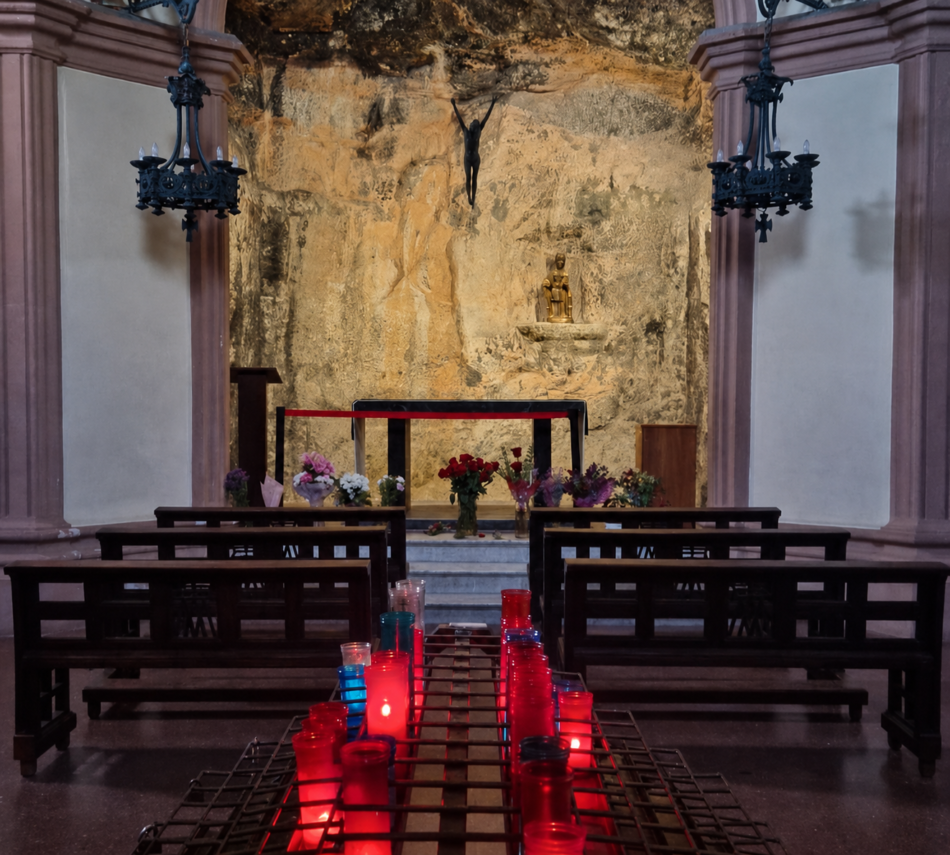
The presbytery of the Santa Cova.
How to get to the Santa Cova
The Santa Cova sits halfway up the mountain and, for centuries, was a hard place to reach. Today it’s easy. From the monastery of Montserrat you can walk down the Camí de la Santa Cova, about 20–30 minutes following the Monumental Rosary path, or take the Santa Cova funicular. If you’re coming from Barcelona, you’ll first reach the monastery by train (FGC line R5 to Monistrol de Montserrat, and from there the rack railway or the cable car).
You can also do it the way the locals do — we like to walk up from Collbató and enjoy this mountain our own way. It’s not just a pretty chapel hanging in the middle of the rock: it’s the place where, according to tradition, the whole history and spiritual life of Montserrat began.
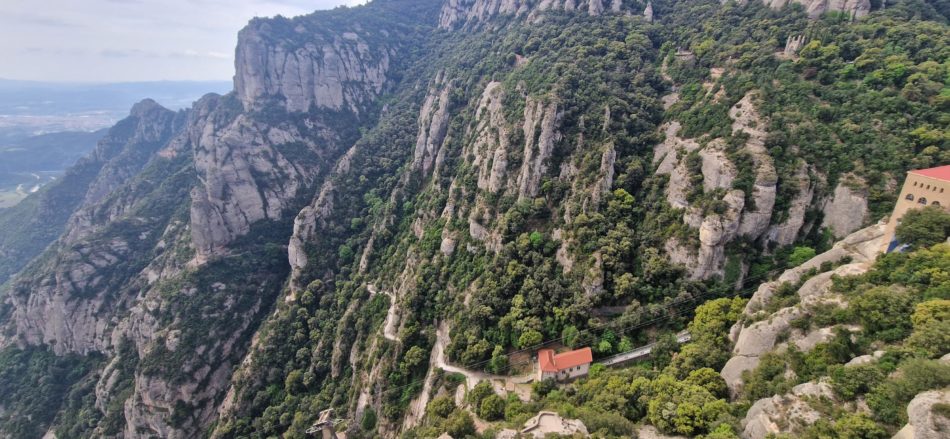
The silver road to the Santa Cova, seen from the monastery.


Leave a Reply