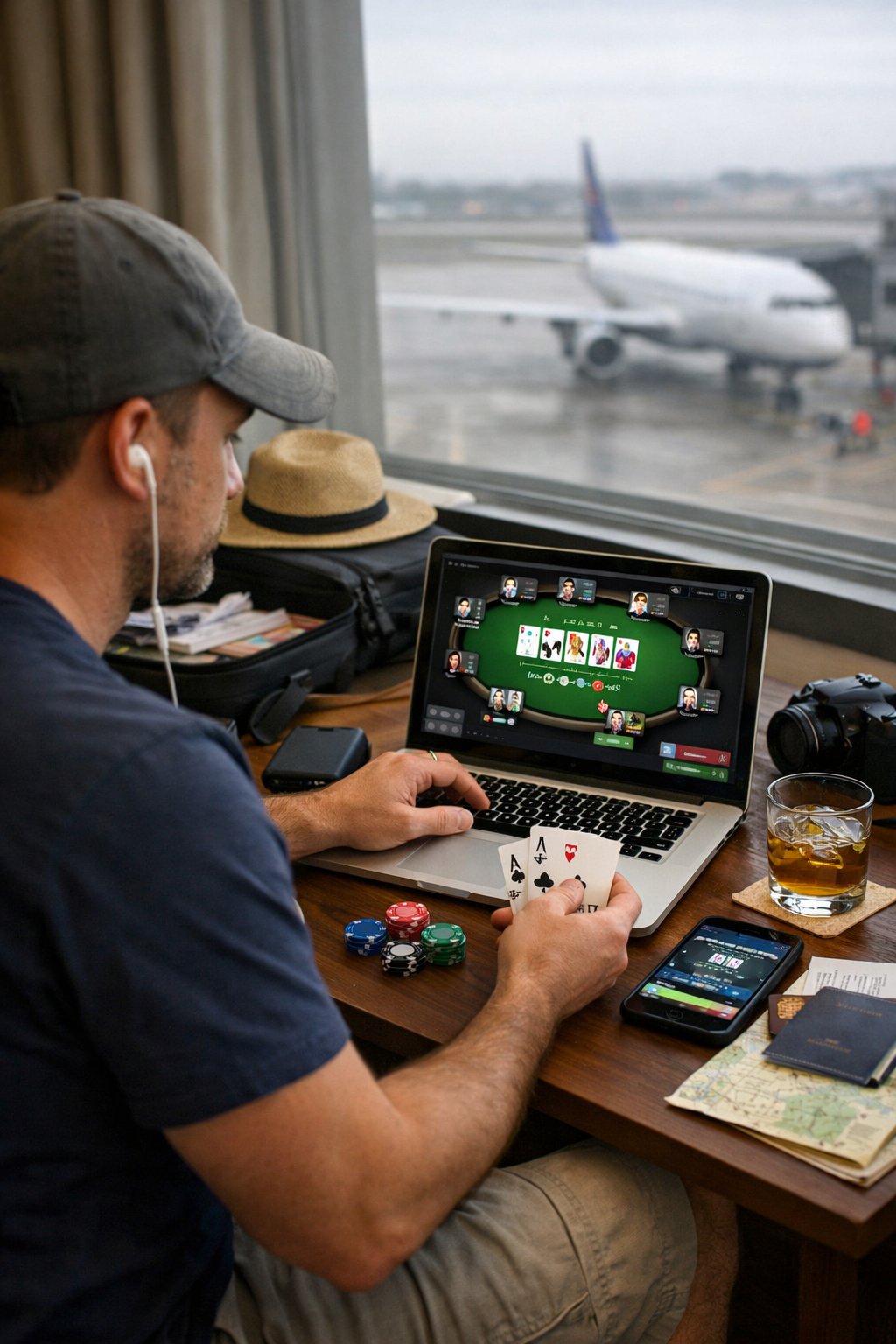
 You packed your laptop, booked the hotel, and figured you would grind a few tournaments from the road. Then you opened the app, and it refused to load. This is the reality for poker players who travel within the United States and assume their accounts will work the same way in every state. They do not. Where your body is physically sitting determines everything, and that fact catches people off guard more often than you would expect.
Online poker in the U.S. operates under a patchwork of state laws, and each licensed platform is required to confirm that you are located inside an approved state before you can sit at a table. As of February 2026, 9 states have passed legislation to legalize online poker: Connecticut, Delaware, Michigan, Nevada, New Jersey, Pennsylvania, Rhode Island, West Virginia, and Maine, which came online in January 2026. Of those 9, only 6 have active, regulated platforms running right now. The remaining 3 have authorized it on paper but have not yet launched live sites. So your travel itinerary matters quite a bit if you want to play.
How Geolocation Actually Works on Your Device
Every time you open a poker app in a regulated state, geolocation software runs in the background to verify your physical position. The most widely used system, GeoComply, pulls data from GPS, Wi-Fi scanning, Bluetooth, cell tower triangulation, and IP address information. It performs more than 350 individual checks per verification attempt. The goal is to confirm, with high accuracy, that you are inside a state where the platform holds a license.
One thing people get wrong is thinking they need to connect to a Wi-Fi network. They do not. The device needs Wi-Fi enabled so it can detect nearby access points and use those signals as part of the location check. You can be on cellular data and still pass verification, as long as Wi-Fi scanning is turned on. If you disable Wi-Fi entirely, the system may not collect enough reference points, and verification will fail.
Hotel Wi-Fi and the Border Problem
A player sitting in a hotel room in Atlantic City will have a different outcome than one booked at a lodge five miles from the Pennsylvania line. Geolocation systems run over 350 checks using GPS, cell towers, Bluetooth, and nearby Wi-Fi access points to confirm a user’s physical location. Wi-Fi needs to be enabled on the device, though connecting to a network is not required. Near state borders, these checks can fail because the precision drops enough to leave your location ambiguous.
This matters for anyone playing online poker from a road trip stopover or a conference hotel, the same way sports bettors and fantasy league players deal with state-line restrictions on mobile apps. Six states currently run active licensed sites, and all six participate in the MSIGA shared liquidity compact. If your GPS reading places you outside those borders by even a small margin, the session will not load.
The 6 States That Actually Matter Right Now
Delaware, Michigan, Nevada, New Jersey, Pennsylvania, and West Virginia are the 6 states with live, operational poker platforms. All 6 participate in the Multi-State Internet Gaming Agreement, a shared liquidity compact that covers more than 38 million Americans. This agreement lets players from different states sit at the same tables, which improves the size of player pools and tournament fields.
If you are flying into Las Vegas for a weekend, you can play online poker from your hotel room without any issues. If you are driving through Ohio and stop for the night, you cannot. Ohio has not legalized online poker. The same applies to states like California, Florida, and Texas, none of which have authorized it. Your account might be in good standing, your bankroll might be loaded, and it will not matter. The software will block you before you reach the lobby.
VPNs Will Get Your Account Banned
Some players try to get around geolocation restrictions by using a VPN to mask their actual location. This is a bad idea for a few reasons. Platforms explicitly prohibit VPN use in their terms of service, and the detection technology has become very good at flagging it. If you are caught, the likely outcome is a suspended or permanently banned account. Funds in your balance could be frozen during a review process, and reinstatement is not guaranteed.
The geolocation systems are built to catch this kind of workaround. Spoofed GPS signals, VPN tunnels, and proxy servers all produce inconsistencies across the 350+ data points being analyzed. A device that claims to be in New Jersey through its IP but has cell tower pings from Virginia will get flagged immediately.
Planning Your Trip Around Poker Access
If you want to play during a trip, the simplest approach is to plan around it. Book hotels in the interior of a legal state, away from borders. Confirm that your device’s GPS and Wi-Fi are functioning properly before you leave. Download and update any apps in advance, since some platforms require state-specific versions.
Traveling between states that have active sites can work well. A trip from New Jersey to Pennsylvania to Michigan, for instance, keeps you inside regulated territory the entire way. But a detour through New York or Maryland, neither of which has live online poker, means your sessions stop until you cross back into a legal state.
The bottom line is mechanical. Your phone or laptop tells the platform where you are, and the platform decides if you can play. There is no appeal process at the table. You are either inside the lines or you are not.
Related posts:
 Day Hiking Connecticut: 5 Best Places to Hike in One Day
 What to know in regards to receiving EU & USA compensation for delayed flights
 7 Van Essentials: What to Know Before Your First Van Trip
 Stay: Miracle Hot Springs of Desert Hot Springs California + Local Attractions
 El Salvador Wedding and Lago De Coatepeque
Leave a Reply