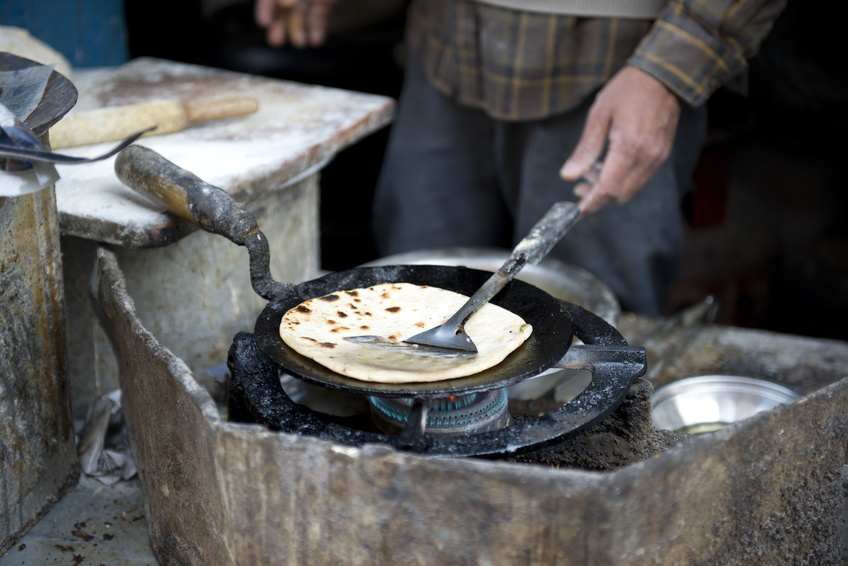

Katmandu, for all its poverty and dilapidated buildings, is a relatively safe city. In all my walks and travels through the neighborhoods I never once felt unsafe. In comparison, many times I felt unsafe walking through Bangkok, Thailand or even cities in California. The people in Katmandu were very friendly and easy going.
This was the first city that I have ever seen that appeared to be crumbling to the ground. There were few paved streets, some streets had water running through the center of the street. There were dogs everywhere, some dead, some alive. Most of the buildings were made out of brick, and most if not all appeared to be only half completed. Some of the brick buildings were surrounded by bamboo scaffolding. Others looked like a bomb had exploded inside scattering brick and debris everywhere. Oftentimes you would find recently killed animals lying in the streets, with their blood draining into a bowl. We saw goats and chickens lying in the streets. These animals unlike the dead dogs, were going to be eaten by the locals.
The poverty was overwhelming. We saw children lying in the gutters sleeping, with their small heads piled on each other. We saw people cooking their meals over a fire on the sides of the street. If there is a “good” neighborhood” in Nepal we never found it.
The pollution is among the worst that I have ever seen (comparable to some places I have been in Africa). It makes certain cities in the US look mild in comparison. In parts of the city garbage is piled up on the sides of the streets. You will see wild dogs and other animals picking their way through the scraps. You will see homeless picking out cans and bottles from the piles.
Water Situation
Katmandu’s water situation is pathetic. They dump cremation ashes, solid waste, sewage, and animal carcasses in the Bagmati, their main river. The water flowing from the city pipes is fairly clear but this is deceiving. Do not drink the water. Some of the hotels will provide filtered water which is much safer then the tap water. Our hotel put filtered water in our rooms once a day. I drank this and had no side effects.
Air Pollution
 The air pollution in Katmandu is quite great. When you are taking great sunset pictures at two in the afternoon, you know that there is allot of pollution and haze in the air. You could feel it in your lungs all day long. You could barely see the sun throughout the day. During the dry season the air quality is worse not only because of the emitted exhaust but also because of the very dry dusty roads.
We stayed in Thamel, a small part of Katmandu. The few streets in the heart of Thamel where all the tourist shops were, remained fairly free of garbage. However, a short walk away one could find devastation. We stayed in a nice hotel called Hotel Tenki. The rooms were very clean and there was a hot shower. The feeling after taking a 45 minute hot shower after not cleaning oneself after 9 days on the trail, is indescribable. You can not become clean enough, you keep scrubbing and scrubbing and you still think that you are dirty. This hotel had a dining area and a television in their fancy lobby. We paid $20 dollars per person per night. Of course you could easily find less luxurious accommodations for much less.
Hotel Tenki
Hotel Tenki can be reached at P.O Box 10866, Pakanajol, in Thamel which is a part of Katmandu. Their PHONE NUMBER is 414483 or you can email them at: tenki@enet.com.np
One feature that most of the hotels will do for their customers is store all their belongings between visits. We stored all of our items in large duffel bags during our Himalayan trek. There were many many shops right outside of our hotel. Many of these shops sold good quality trekking gear. Some was used, some was new. You have to know what you are looking for and what is good quality. Some of the shop owners would put name brand tags onto cheap quality goods. If you wanted climbing gear and sleeping bags, this was the part of Katmandu to be in. I became quite tired of seeing all the trekking stores. After you have seen one, you have seen them all. Actually the goods were similar between stores, but the prices varied considerably. You needed to bargain of course.
Shops
There were many other shops besides trekking stores. We found small trinket stores, one of which was selling beautiful carved animal figurines. One of the more impressive carvings in this store was a hand carved elephant. Normally you would find just an elephant but this carving had 2 hand carved elephants inside of the outside elephant. It is amazing to me the precision and skill the craftsman had in carving the inner elephants without breaking the stone. We were able to easily bargain in this store and by the time we walked out of this store with our “treasures” we had slashed the prices in half. I ended up paying a few American dollars for the elephant.
There were lots of clothing stores also. Many of the stores carried “Tintin” clothing. Tintin is a comic strip character and in one of his travels, hikes in the Himalayas.
An awesome restaurant which served exceptional Thai food is called the Ying Yang (one of the oldest restaurants in the Thamel district – founded 1970) and is not far from the Tenki Hotel. They have their own bakery and are open from 7am to 10pm. Car parking is available. All major credit cards are accepted. PHONE NUMBER: 425510
Communication
Using the Internet or making local or international telephone calls in parts of Katmandu is not a problem. In Thamel there are many “international communication centers” which offer telephone, fax, and Internet services. In one of these centers it is cheaper to make a short phone call out of the country, and then have your party call you back. The reason for this is that it is much cheaper to call Nepal than to call from Nepal. If you are dialing from another country, Nepal’s country code is 977 and the Katmandu city code is 1.
Helpful phone numbers when calling from within Nepal are:
Nice to read about Nepal. Thanks for sharing this article