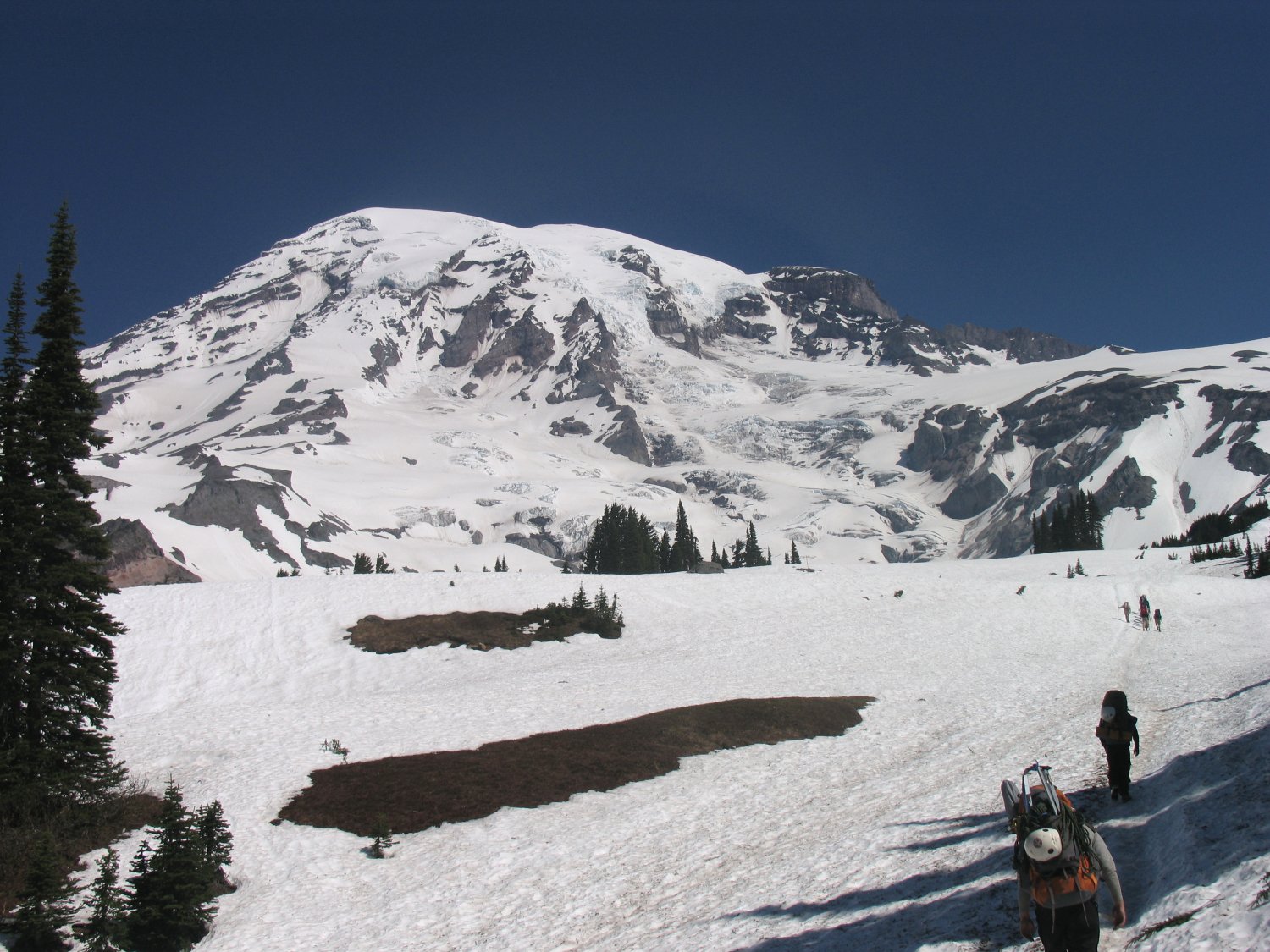
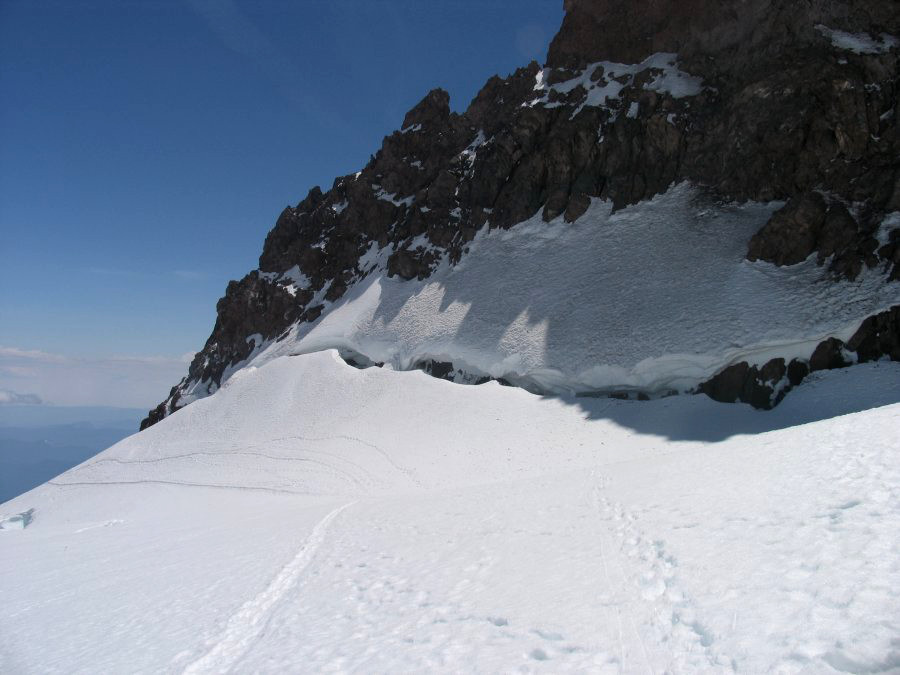
Rainier as seen from start of trail on the way to Camp Muir, and Bergshrund above Ingraham Flats
A note regarding the National Park Service links listed on this page. The National Park Service is the most unorganized department for constantly changing links and NOT updating old URL’s to point to their new URL’s. We like to point our users directly to the correct information and this is a nightmare to keep updated across the articles posted on our site.
If the NPS has changed the links yet again and you notice any of the links below are not working, please email dave@pon.net so he can quickly update these. Thanks.
Find yourself climbing partners. Unless you have plenty of technical alpine experience doing solo climbs on glaciated peaks you should climb with at least one other person (a total of 3 climbers is more recommended than two, as it gives you more resources in the event someone falls into a crevasse or if another problem occurs).
Typically climbing partners are people you have climbed with in the past and know pretty well and who you can trust on a mountain. I’ve found that it can be sometimes problematic climbing with someone you don’t know and who you don’t have any prior climbing experience with. If you climb Rainier with people you know from previous climbs hopefully you will have already identified each others climbing strengths and weaknesses.
Consider walking around with a heavy backpack for at least an hour or two several days before your departure. This is helpful training as chances are your hips will be sore after carrying the backpack. Do this until your hips are no longer sore and then take a few days break right before your climb departure date.
This author soaked his feet in ice water each night for 7 days before the departure date. Some say this helps prepare your feet for cold weather however there may not be much validity to this. Next time we climb Rainier we will soak the feet in cold water ever day for at least a month.
If you want to climb Mt. Rainier solo you have to fill out a reservation form PDF and email it to the Park Superintendent/Solo Climbing Department. Note: you *must* have written permission from the park Superintendent before climbing Rainier solo. The form will ask you to write in your previous experience on glaciated peaks.
In preparing for Mt. Rainier, if you intend to climb the mountain without a professional guide, you need to ensure that you are in good physical shape. You must have previous climbing experience on glaciers, being roped up, dealing with crevasse rescue, know how to use your mountaineering & climbing equipment and be able to read the weather, and glaciers.
Disappointment Cleaver route on Rainier is a route that technically one could climb with crampons and an ice ax and the proper clothing and some outdoor experience. The very first climbers or Rainier certainly did not have the gear and experience that mountaineers have today, however what I’m trying to say, is it would be quite stupid to attempt a climb of Rainier if you do not have previous experience with similar glacier and alpine terrain. There are too many factors that determine success on a climb of Rainier.
Because this mountain sits so close to the Pacific Ocean, storms can roll in unexpectedly *any* time of the year without warning.”
Other factors such as hidden crevasses, unstable snow bridges, ice, rock and serac falls, altitude, level of your conditioning and experience, wind, and cold can all make this climb a very challenging one. Before your climb review current Rainier weather and historical weather conditions here: www.nps.gov/mora/planyourvisit/weather.htm
In addition you can check out the webcam at Paradise here: www.parkreservations.com/rainier/webcam.htm
If you have not earned your experience from previous glacier and altitude climbs then consider taking a guided course and summit climb from one of the following companies certified to offer climbs on Mt. Rainier. The most well known of these for climbing Rainier is Whittaker Mountaineering www.rmiguides.com/ or call (888) 892-5462
The other guides offering trips and glacier classes on Rainier are:
| Company | Phone |
| Alpine Ascents International | (206) 378-1927 |
| American Alpine Institute | (360) 671-1505 |
| North Cascades Alpine Guides | (800) 981-0381 |
| International Mountain Gudes | (360) 569-2889 |
Dave’s climb of Mt. Rainier was done using the classic Muir Camp/Disappointment Cleaver route in late June. The weather during the climb except for the summit day was almost perfect – warm days and clear nights and not much wind. Unfortunately the wind started in the evening of our summit climb and continued until we were well below Muir Camp.
If you are planning on climbing during holiday weekends or other busy times, consider reserving your summit pass ahead of time. The National Park Service offers a reservation form on their website which you will need to fill out email back to the address listed on the form. Typically you will receive your summit passes within 10-14 days.
The start of a typical climb up to Muir Camp begins at the Henry M. Jackson Visitor center where you need to check in with one of the rangers and fill out a “climbing pass” card. The highlights of this card are the number of people in your group, the dates you will be on the mountain, your high camps and the equipment that you will be using for the climb. You must keep the receipt part of this card and check back in with the rangers when you finish your climb; at that point you give them the receipt to show that you arrived back safe and sound.
Note that the circular Henry M. Jackson Visitor Center was torn down in early 2008 due to its age and high cost of maintaining it year round. The amount of diesel that is used in the wintertime just to keep the roof free of snow was amazing. This old center was replaced by the Paradise Visitors Center. Visit: www.nps.gov/mora/planyourvisit/paradise.htm
A parking lot with limited number of spaces below the visitor center is available for longer term parking, IE multiple day summit climbs.
Click the Next Page link below on the right side to find out about Equipment and climbing gear needed for climbing to the top of Mt. Rainier.
Leave a Reply