<?xml version="1.0" encoding="utf-8"?>
<feed version="0.3" xmlns="http://purl.org/atom/ns#" xmlns:dc="http://purl.org/dc/elements/1.1/" xml:lang="en">
<title>Solomon&apos;s African Blog</title>
<link rel="alternate" type="text/html" href="http://www.davestravelcorner.com/blogs/solomon/" />
<modified>2005-07-02T22:27:16Z</modified>
<tagline></tagline>
<id>tag:www.davestravelcorner.com,2005:/blogs/solomon//26</id>
<generator url="http://www.movabletype.org/" version="3.11">Movable Type</generator>
<copyright>Copyright (c) 2005, DaveDTC</copyright>
<entry>
<title>On the Road in Morocco</title>
<link rel="alternate" type="text/html" href="http://www.davestravelcorner.com/blogs/solomon/archives/2005/07/fuck.html" />
<modified>2005-07-02T22:27:16Z</modified>
<issued>2005-07-01T22:13:42Z</issued>
<id>tag:www.davestravelcorner.com,2005:/blogs/solomon//26.10</id>
<created>2005-07-01T22:13:42Z</created>
<summary type="text/plain">The travel bug bit me again, after more than eight months of staying put around my home base of Orange County, California....</summary>
<author>
<name>DaveDTC</name>
<url>www.davestravelcorner.com</url>
<email>dave@davestravelcorner.com</email>
</author>

<content type="text/html" mode="escaped" xml:lang="en" xml:base="http://www.davestravelcorner.com/blogs/solomon/">
<![CDATA[<p>The travel bug bit me <strong>again</strong>, after more than eight months of staying put around my home base of Orange County, California. </p>]]>
<![CDATA[<p>I gave South America some serious consideration, especially now that it is summer in the more southern and chilly parts of the continent. But for various reasons, the most important of which is the chance to meet up with my brother Abdul, I settled on Africa. He is roaming around South Africa now and I will be there next week. But this report reaches you from the kingdom of Morocco. I left the bike at home this time and packed a relatively small backpack with the utmost minimum of gear. Unfortunately, tropical Africa remains out of reach for me because I did not get the numerous immunizations required for travel there. However, the northern and southern portions of the continent will be more than enough to tackle in such a short period as two months. At least that is the plan, but my plans don't always pan out, as some of you know, and I may have to come up with alternatives.</p>

<p>After two weeks here in Morocco I learned to read some Arabic and even understand a few words, but for the life of me I can't pick up French, the other important language of the country. As a former colony of France, Morocco has been either blessed or cursed (depending on one's view) by a sort of dual Arab/Berber and European culture. Not only do large industrial cities such as Casablanca stand in stark contrast to tiny Saharan Berber villages, but the people range from completely veiled to miniskirt wearing and midriff baring, often found walking arm in arm. </p>

<p>However, three millennia of recorded civilization preceded the French colonization of Morocco and evidence of Phoenician, Carthaginian, Roman, and Arab conquests are everywhere. A few impressive Roman ruins still dot the countryside, but the Arab Islamic influence has had by far the greatest impact on the original Berber population. The primary language is Arabic and Islam permeates every aspect of life, including that of the beer swilling bar hoppers of metropolitan Casablanca and Rabat. On one occasion a young gun in Levis and a DKNY shirt admitted to me how much he loved American women "because they all look like Britney Spears". Two sentences later he exhorted the rigorous moral codes of Islam and how everyone should live by them. I'm sure he tries his hardest to meet those religious demands but the temptation of Britney’s supple loins must be just as great. Speaking of loins, one day I was completely minding my own business (really), walking down a busy street in the city of Agadir when two loin baring women literally crossed my path and one reached out with her handbag to stop me. I did stop and looked up dazed to see a wild-eyed Berber girl smile and say "bonsoir monsieur". I didn't really respond with anything that made sense, so they went on their merry way laughing. Obviously an exception, but this showed that Morocco is a relatively free society where everybody can live side by side. This realization was the biggest surprise that this country harbored for me.</p>

<p>The other surprise, which I had been warned of previously, was just how adept most Moroccans are at selling you virtually everything you don't need. I naively considered myself a seasoned traveler, able to ward off all sales pitches and hustlers without a hitch, but the quick wit of these people left me dumbfounded. I was almost convinced to buy a portable refrigerator from one man. And when I really did need a jacket for the chilly Marakesh nights, a horde of sellers almost tore me to pieces trying to drag me into their little stores in a "suq" (a covered bazaar). After on particularly burly Berber got me into his store and showed me his selection of colorful handmade wool jackets, I settled on one and the battle for the price began in earnest. "How much would you like to pay for this, my friend?" the man asked me; prices are never fixed and every seller will try to squeeze the most out of customers, particularly foreigners. After much haggling, during which he theatrically accused me of trying to starve his family, we settled on what seemed fair to both of us. At least it seemed fair to me, he may have made a killing and only feigned moderate satisfaction. Afterwards he asked if he could interest me in a traditional jacket for my wife/mother/father/daughter/brother etc. </p>

<p>Sometimes the salesmanship becomes very elaborate with invitations to mint tea or even a family dinner. Then one should be aware of serious offense if not interested in buying after such a treat. Shopping in Morocco is always an adventure and the haggling is worth it if the goal is Moroccan handicrafts. I have seen some incredibly beautiful thuya hardwood furniture and carvings, pottery, silver jewelry, leather jackets, and Berber carpets. It must also be said that the architecture is a unique blend of repeating geometric patterns typical to Islam, berber gilding, and a strong Andalusian influence from Spain. The result is for example a white, peach or pink hued house with a terra cotta roof and Berber columns with intricate geometric patterns everywhere on walls and ceilings. Out in the countryside, reddish to brownish mudbrick "qala" (a fort) are common, usually piled on top of each other to look like impressive fortresses. Fortress like walls also surround the "medina" (old town) of each and every city, while modern development spills over into the surroundings. </p>

<p>In the last couple of days all of Morocco and the Islamic world celebrated "Eid", a holy day held to commemorate biblical Abraham's sacrificial offer of his son Isaac to God. After becoming convinced of Abraham's absolute faith in him, God commanded him to sacrifice a sheep instead. So today, many many sheep were sacrificially slaughtered in people's homes and great dinners were cooked with the meat and extended families gathered to feast. Leftovers are passed on to poorer neighbors who couldn't afford a sheep. Although slaughters are not done on the street, the freshly cut off heads of the animals were brought outside and charred on hot fires, which let loose a pungent odor of burning wool. Someone explained to me that this way the wool burns off and the skin gets charred just enough. Then the rest of the cooking is done in an oven and the head is consumed as a delicacy. </p>

<p>Incidentally, a day before I noticed quite a few live sheep in the backs of trucks, in the open trunks of cars, in backseats, in front seats, on donkey carts, even once on a motorcycle wedged between rider and fuel tank with all four legs projecting comically out to the sides. Little did they know in their docile manner that this would be their last trip.</p>

<p>Now is the time for me to join exactly such a dinner, as a new acquaintance invited me to his family's home. Such hospitality is also very common among Moroccans, as this was not the first time I have been invited with an open heart into people's homes here. I only have one more week left in this North African nation, before I continue down to South Africa to meet my brother Abdul. Although Saharan nations such as Mauritania and Mali also sound very tempting, there is too little time and too great distances to squeeze all of them in. Here alone, I barely scratched the surface. I hope you are all well and fine, keep your eyes peeled for more updates from elsewhere.</p>

<p>Solomon</p>]]>
</content>
</entry>
<entry>
<title>Where&apos;s My Crown of Olives</title>
<link rel="alternate" type="text/html" href="http://www.davestravelcorner.com/blogs/solomon/archives/2005/06/wheres_my_crown.html" />
<modified>2005-06-11T22:54:43Z</modified>
<issued>2005-06-03T00:51:14Z</issued>
<id>tag:www.davestravelcorner.com,2005:/blogs/solomon//26.17</id>
<created>2005-06-03T00:51:14Z</created>
<summary type="text/plain">There is far more to Morocco, Al Maghreb, as it is known among its citizens, than I can describe in just a short little blurb....</summary>
<author>
<name>DaveDTC</name>
<url>www.davestravelcorner.com</url>
<email>dave@davestravelcorner.com</email>
</author>

<content type="text/html" mode="escaped" xml:lang="en" xml:base="http://www.davestravelcorner.com/blogs/solomon/">
<![CDATA[<p>There is far more to Morocco, Al Maghreb, as it is known among its citizens, than I can describe in just a short little blurb. </p>]]>
<![CDATA[<p>Other than the intrusions of various cultures into this part of the african continent, the geography plays a large role in shaping Morocco as well. First and foremost, the High Atlas mountain range dominates the heart of the land. Eclipsed only by Kenya's volcanic Mt. Kilimanjaro, the High Atlas rise to a maximum height of just under 14000 feet and hold the largest mass of snow in all of Africa. </p>

<p>The snowcapped mountains make an especially beautiful backdrop for the city of Marrakesh if they can ever poke through the dusty, sooty air that blankets this town constantly. Widely inaccessible in winter, the high valleys and plateaus hide coniferous forests and, during the summer months, alpine meadows that rival those of California's Sierra Nevada range. To the north the gentler rising Middle Atlas and the Rif Mountains flank the High Atlas; to the south the drier Anti Atlas leaves its mark on the land. The Anti Atlas is unique because it marks the gateway to the sand dunes of the Sahara desert in the east and is also the site of the Kasbahs, ancient berber villages encased within high protective mudwalls in the fertile valleys of these relatively barren mountains. What are not mountains or Sahara desert has been turned from stony hillsides and plains into fertile agricultural land. The main crops are wheat, which now in winter gives mile after mile of rolling hills a velvety green cover, as well as olives, argan, and almonds. </p>

<p>In the south, almond trees are now at the peak of their bloom, while elsewhere olives and argan (a tree that's very similar to olives) are being harvested laboriously by beating the branches with sticks and collecting the fallen fruit. In fact, during a four day hike in northern Morocco, I saw nothing but olive trees, so many that I thought I somehow got into southern Spain, if it wasn't for the minarets of mosques rising out of small villages. During this hike I noticed that men tend the herds of goats and sheep and camels while all dogs seem to roam in packs across the countryside and not bother with herding. Life out on the land moves very slowly, as slow as I moved at the end of my first day's hike. Most labor is done manually or through the use of horse and ass. That goes for plowing, pulling carts, and driving the heavy grindstones that squeeze the oil out of olives and argan. </p>

<p>Sleeping out on the land posed its challenges with the hordes of dogs howling all night long in imitation of their wild ancestors. Add to that the competition between the various roosters on each farm and you can kiss a restful sleep under the skies goodbye. The heinous braying of a nearby arse would put a complete end to my snooze attempts and, thus, every night spent outside I watched the constellation Orion sink in the western sky and Scorpio rise from the east as the night wore into early morning. But then again, there were plenty of opportunities for daytime naps under gnarled olive trees. I survived this little countryside trek with only a couple of blisters and one dog bite in the left calf, inflicted by an especially aggressive little bastard. In return it took a solid kick in the head from me. I cleaned the wound right away with a first aid kit, but decided to hitch a ride into the next town to get it thoroughly cleaned and some shots for tetanus and rabies. Luckily none of the teeth went past skin deep or else continuing to walk might have been painful. Occasionally I let the thought of sharks scare me while in the ocean surfing, while various loose dogs have nipped me three times so far in my life. At least dogs don't have the teeth of shark.</p>

<p>Out of the countryside and back into the noisy and crowded capital city of Rabat, I once again savored the smells of exotic spices, couscous, and tajines with sheep meat. Oh yeah, and the stench fo sewer and diesel exhaust here and there, but that's Morocco. A visit to a hamam, a traditional public bath house, cleansed my skin of the road grime. Unlike my brother Abdul's visit to a Moroccan hamam last year, I found that the...uhh...sensual skin rubdown by another man is not mandatory. I still don't know how they convinced an avowed heterosexual like Abdul to get every nook and cranny of his body scrubbed by some hairy dude. Well, I've had my moments, too...</p>

<p>A sweet crowning moment before my departure from Morocco occurred in Rabat. The Moroccan national soccer team was playing Algeria in the African Cup, when I was getting ready to leave for the airport. The normally bustling streets were eerily quiet and layer upon layer of men crowded into teahouses to catch a glimpse of the match on TV. Soccer rules here; Morocco is currently competing with Egypt and South Africa for a chance to host the 2010 world cup. I'm not much of a soccer spectator but the tense atmosphere and various emotional outbursts lured me into such a teahouse. All of a sudden three men near me got into a face-slapping match over an argument as to why a Moroccan attack on the goal failed. But each one of the three goals that Morocco scored, rocked the foundations of the city. Cheers blasted out everywhere. Windows shook. Many a fist raised in triumph smashed into concrete ceilings. The cheer increased to apocalyptical levels when ninety minutes passed and Morocco won with a score of three to one. The streets exploded with life again. Then it became larger than life: hordes of flag waving, drum beating, and chanting youths spilled out from everywhere into the streets. Cars loaded to the window brims with people honked their way into absolute gridlock in the center of Rabat. Police here and there seemed helpless, hell, they celebrated, too. Finally, the sidewalks couldn't contain all these revelers anymore and the broad boulevards overflowed with raucous people among all the honking cars. A fifteen-minute walk from the hostel to the train station took me a giddy hour and a half. The joy was just infectious. Luckily I caught the second to last train to Casablanca airport, although I would have loved to continue participating in that wild mayhem. One soccer match! What if this team ever wins the world cup?</p>

<p>Morocco, with its intense mix of cultures and a timeless landscape has left an indelible impression on me and I am looking forward to returning to experience more of it. From here my next step is a long flight across the entire landmass of Africa to Capetown. The flight will also take me from winter to summer as I will end up in the southern hemisphere. I am already looking forward to ditching the pants in favor of shorts and shoes for sandals. You will hear from me, once I get my bearings there and find an opportunity to write. Until next time, enjoy life.</p>

<p>Solomon </p>]]>
</content>
</entry>
<entry>
<title>No Baboons Live in California!</title>
<link rel="alternate" type="text/html" href="http://www.davestravelcorner.com/blogs/solomon/archives/2005/05/no_baboons_live.html" />
<modified>2005-06-11T22:54:18Z</modified>
<issued>2005-05-16T00:52:04Z</issued>
<id>tag:www.davestravelcorner.com,2005:/blogs/solomon//26.18</id>
<created>2005-05-16T00:52:04Z</created>
<summary type="text/plain">Dear friends, What an amazing feeling to step out of an airplane and get blasted by the heat of the southern hemisphere&apos;s summer sun high up in the sky. Morocco was by no means cold, but its mild temperatures pale...</summary>
<author>
<name>DaveDTC</name>
<url>www.davestravelcorner.com</url>
<email>dave@davestravelcorner.com</email>
</author>

<content type="text/html" mode="escaped" xml:lang="en" xml:base="http://www.davestravelcorner.com/blogs/solomon/">
<![CDATA[<p>Dear friends,<br />
What an amazing feeling to step out of an airplane and get blasted by the heat of the southern hemisphere's summer sun high up in the sky. Morocco was by no means cold, but its mild temperatures pale in comparison to South Africa's summer heat.</p>]]>
<![CDATA[<p>I could barely contain my excitement over arriving in Capetown and setting foot on the southernmost latitude I have ever been to. However, the excitement quickly gave way to horror when I almost had my toes and knees taken off by a speeding car driving on the wrong side of the road, just as I attempted to cross it. And then it happened again...and again. What's wrong with these people? But that's exactly what they asked me, because everyone here drives on the left side (i.e. wrong side) in the good old British fashion. I just can't get this vital fact into my head and it has nearly cost me a few body parts. Oh, just wait you people until I get behind the wheel myself! Eventually I did find the hostel where my brother Abdul and I had agreed to meet at. There he was sprawled on a bench munching on litchi, a delicious local fruit. I assumed that he would be tanned or sunburned, but I was shocked to see just how mangled he got by the local insects. I guess we really are in Africa now. And we haven't even left the very cosmopolitan Capetown yet. </p>

<p>Additionally, I had a little reunion with South Africa native James, a long distance cycling buddy of mine. He introduced us to the South African passion: braai. That's Afrikaans for barbeque and the meats include boerwors, (chunky bloody sausage about 2 feet in length curled up), ostrich meat, buffalo, and good old beef. I guess if you get to a fancy place you might find bushmeat such as zebra, wildebeast, and baboon but we were more than satisfied with our boerwors. It was incredibly good after the hot coals turned the bloody meat into a very appetizing roasted brown rolled up tube. Unfortunately we didn't leave as much time for the Cape region as it deserves because we will return to a closer inspection at the end of our loop at some point in the future. </p>

<p>However, the Western Cape province that we drove through on our way north to Namibia was surprisingly Californian. The grass dried out to a gold glow in the sun and the rolling hills reminded me of the central valley of California. Not to mention the brilliant blue sky and the eucalyptus trees clustered along the road. Soon enough we passed through the south African wine country and its accompanying cypress trees. I could swear I was back home speeding through the center of my state. Only the baboons hanging out by the roadside tore into my hallucinations and reminded me that this is new land here. As we made our way north into the drier Richtersveld plateau, the mountains rose in height and the terrain became rockier and devoid of trees. Far back to the south we could see distant thunderheads tower high into the sky as the day dragged into afternoon and the sun's intense heat caused these clouds to build and darken ominously. Incidentally, in all of southern Africa summer is also the rainy season and the downpours occur virtually daily, always intense, sometimes ruthlessly intense. I have yet to see a gentle rain not accompanied by fierce wind and lightning. </p>

<p>Eventually the bumpy two-lane highway found itself coursing along the Olifants River and the occasional town we passed had a genuine outback character with red dust blowing and cattle ranching the number one livelihood here. As we neared the Namibia border, the land became even drier and the cattle ranches more spread out. This was not the impression I had of southern Africa, but now I know better. We hadn' t come across many natives in this region, the ones we did meet were mainly ranch hands. In the past as now this was the ancestral land of the Bushmen, who are actually called by their ethnic name San. Unless they gave up their traditional hunting and gathering lifestyle in favor of cattle ranching, I didn’t see any of them running around stalking small prey or squeezing water out of bulbous roots of the local plants. We would have to get way off the beaten track, but our bus seemed more set on making it to Windhoek, the capital of Namibia by the next day than to chase these amazing natives around the bush. Late at night we crossed Fish River, which, like the Colorado River, has carved its way through an uplifted plateau to create Fish River Canyon, second in length and width only to Arizona's Grand Canyon. </p>

<p>The border crossing was surprisingly straightforward and devoid of bureaucratic formalities that I had expected of Africa. Back then I had no idea what corrupt and arcane border procedures I would be facing later on this trip. Before getting back on the bus I briefly glanced up to the starry southern sky and there it was: the Southern Cross. Bright and blatantly obvious, it was the only constellation I knew of in this part of the Milky Way. This was the first time I laid eyes on it and it definitely drove the point home that I am in the southern hemisphere! All other formations of stars were completely unknown to me and a refreshing sight in the black night sky. No thunderclouds had formed here yet, so I could count myself lucky to see a full night sky.</p>

<p>We continued driving through the night across the huge Richterveld plateau in direction of the Namib desert and Windhoek, the capital of the country. At this point I will call an end to this installation and continue with the Namibian experience next time, due to computer restrictions. As internet access is sparse, exceedingly slow, and heinously expensive, I might relegate the rest of my ramblings to my notebook and continue when I set foot on South Africa again or maybe even when I return north again. So don't get too worried if I don't chime in every now and then. I got all my immunizations squared away and am heading further into the wild heart of black Africa. </p>

<p>To be continued....Solomon </p>]]>
</content>
</entry>
<entry>
<title>Was that Thing a Rhino or a Boulder?</title>
<link rel="alternate" type="text/html" href="http://www.davestravelcorner.com/blogs/solomon/archives/2005/05/was_that_thing.html" />
<modified>2005-06-11T22:53:50Z</modified>
<issued>2005-05-06T00:53:05Z</issued>
<id>tag:www.davestravelcorner.com,2005:/blogs/solomon//26.19</id>
<created>2005-05-06T00:53:05Z</created>
<summary type="text/plain">The last time I signed off, my brother Abdul and I had just arrived in Windhoek, the capital of Namibia by bus from South Africa....</summary>
<author>
<name>DaveDTC</name>
<url>www.davestravelcorner.com</url>
<email>dave@davestravelcorner.com</email>
</author>

<content type="text/html" mode="escaped" xml:lang="en" xml:base="http://www.davestravelcorner.com/blogs/solomon/">
<![CDATA[<p>The last time I signed off, my brother Abdul and I had just arrived in Windhoek, the capital of Namibia by bus from South Africa.</p>]]>
<![CDATA[<p>We decided to pony up some extra money and take a Greyhound type coach and survive the trip, as opposed to paying next to nothing on one of the ubiquitous minibuses but putting our lives into the hands of a crazed driver hell bent to make it to his destination in the shortest time possible. Our guidebook called these vans “unguided missiles”, as they are filled to the last cubic inch with people, luggage, even animals and one driver who has usually not slept the night before. Once they hit the road with the back of the van sagging under the sheer mass of twenty or more bodies and all their belongings, there is no slowing or stopping for anything, not the curves on the road nor the cattle nor the game animals, let alone people walking along the roadside. That’s the brutal truth to the minibus system in all of southern Africa. As much as we could, we avoided them until we reached areas where we had no choice. With a large brush/animal guard bolted to the bumper, our bus had no problem delivering us all to Windhoek with impunity. </p>

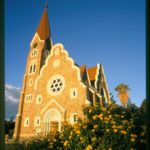
<p>The city, built among the brushy rolling hills of the central plateau of Namibia has a decidedly modern feel to it with gleaming high rises and a well planned street system. But there was something about it….something German. German street names, stores, and most of all, architecture. Namibia became a colony of Germany in the late 1800s during a mad dash for land by the European powers. This period lasted until World War I, during which Germany lost its status as colonial power, but it certainly didn’t lose its profound influence on this nation. Entire city blocks look like they have been torn straight out of some medium sized German city and deposited in the middle of this arid plateau. Only the palm trees indicate that this is not central Europe. The large townships that have sprung up in many areas around the city center also don’t convey a European feel. Just like their South African counterparts, townships consist of ramshackle squatter buildings, <br />
primarily inhabited by impoverished black people who hope to score jobs in the city, while living in these simple conditions nearby. In reality the conditions are very horrid: many townships have no running water and some still have no electricity. Trash piles up on the perimeters, as there is no garbage service in these areas. Sure enough, crime seems to be rife, as well. Unemployment reaches outrageous levels; men, young and old, usually gather in street corners and just sit around. I asked what they waited for and the reply was “food”. In other words, work and money. By contrast, most Namibian businesses seem to be owned by people of European ancestry, who drive late model cars and live not very differently than us in North America and Europe. Although the government is mostly made up of the local tribes which have inhabited Namibia for thousands of years, the wealth lies effectively in white hands. Just like South Africa, such economic disparity is a fact of life. </p>

<p>The native population present before colonial times is represented by the Ovambo and Kavango people for the most part. However, for us the most well known tribes are the Bushmen tribes (known as the San people) and the unique Himba. While the Bushmen are famous for their hunter-gatherer lifestyle, the Himba are goat and cattle herders who still to this day openly display their bosoms, despite the very best efforts of Christian missionaries. Their skin and hair glow a dark red from a paste made of a mix of butter and local iron oxide rich soils. Many of the San bushmen have adapted western clothing and homes, but the staunch Himba retain their skin art, their dress (or lack thereof), and their simple reed and animal skin shelters into the twenty first century. I find it commendable. </p>

<p>We spent a few days in the metropolitan Windhoek looking for some other travel partners, a reliable vehicle, and supplies in order to hit the hinterlands of Namibia. Those nuts enough to join our haphazard journey included two Aussie girls from Perth (Australia) and a like-minded dude from Brooklyn, NY. With this rag shag combination of veteran travelers and two prankster brothers we piled into a hired car and hit the lonely roads of this vast country. An early start seemed advisable because the intense sun heats everything up quite a bit and afternoons are best spent resting somewhere in the shade. Although hard to predict with certainty, thunderstorms rolled in on a massive scale after the ground had heated up enough and caused the hot rising air to condense into menacing anvil shaped <br />
thunderheads. The downpours that soon followed such cloud build-ups would frequently cause flash flooding and quickly tear into the gravel roads we drove on. These rains came with amazing intensity and quickness, so that the previously bone-dry gravel road would turn into a brown, muddy, and slippery mess, exceedingly difficult to navigate. On more than a few occasions we had no choice but to stop before a boulder crushing washout and wait until the raging current subsided somewhat before attempting a crossing. Once we got lucky and met up with a bulldozer near a massive washout and it towed us across without a hitch. The downpours can last anywhere from one hour to the next morning. But without fail, the subtropical summer sun would break through by late morning, evaporate everything in a cinch, and leave the ground dry again. </p>

<p>The vegetation of this vast plateau land is known as bushveldt and if you imagine a classic African savannah from the discovery channel, you are on the right track to visualizing this chunk of north <br />
eastern Namibia. The underlying brush grows a bright green this time of year, as does the back drop of acacia and camel thorn trees. We hadn’t spotted any wild animals so far with the exception of the springbok which inhabit the bushveldt in massive numbers. Not until we entered the fabled Etosha National Park, did we spot more than springbok and termite mounds. </p>

<p>Etosha is considered one of the world’s pre-eminent game viewing sites in all of Africa, especially during the dry season, as almost all animals of the park congregate at a few water holes to drink life giving water. We kept our expectations suppressed because we knew that the abundance of water during the current rainy season of summer would keep most animals scattered all over this immense park. Sure enough, the land seemed devoid of any game, especially during the oppressing daytime heat. During the afternoons, however, we could spot small herds of zebra, wildebeest, and springbok grazing not too far off the gravel roads. We accidentally spooked a few springbok and were treated to an amazing view of their ludicrous jumping ability. Startled, they jumped to twice their shoulder height and five or six times their body length to escape our presence. By the way, visitors are allowed to drive their own vehicles, but they have to stay inside and on the roads. </p>

<p>Occasionally we spotted the curiousostrich running across more open stretches of veldt with white stubby wings flapping uselessly by their sides and their long skinny legs bent forward with each step. It’s mind boggling to watch them careen past us with their baffling gait. I find them definitely one of the weirder animals out here. Things picked up some more <br />
as the afternoon dragged into evening and the black and white faced gemsbok with horns shooting 2 feet out of their skull and straight as arrows appeared across the savannah. They were joined by herd of slender and graceful impala with their rich brown red coat and narrow faces. These animals tended to be the staple diet of the large predators of Etosha, the lions, leopards, cheetah, and hyenas. The carcass of some dead herbivore was the closest we came to a predator in the park. Luck was not on our side. The carcass did, however, attract hundreds of vultures circling overhead on the rising hot air. Giraffes offered a little feast for the eyes with their long ungainly necks, muscular legs, unusually large eyes, and their trademark red flagstone coat pattern. </p>

<p>To see them run is truly fascinating, as they moved their long legs at a very slow rhythm but covered large sections of ground. It looked almost unreal, how far they could get with just a few slow motion sprints. The grand finale for Etosha National Park came in the middle of the night at a bush camp right next to a full water hole. Two rhino came within sighting distance, but stayed back probably because they could smell the <br />
presence of humans. The camp backed the water hole and it was possible for a good overview from behind the kraal (the fencing that kept us inside and most critters out). Unfortunately, they stayed back during their entire presence, as if unsure of the water. Eventually their massive, rocklike bodies disappeared silently into the dark night. We could not make out more than a few vague outlines. Although disappointed, the nightly roar of lions nearby gave me the warm and fuzzy feeling that more encounters will be waiting for us. </p>

<p>We left Etosha for the far north western corner of Namibia, not too far from the Angolan border, an area known as Damaraland. A vast land of arid valleys, distant mountains, dry stream beds, wide open grazing land, and huge skies, it is home to isolated ranches and Bushmen. It was here that we met them. Not dressed in animal skins, neither with bows and arrows, nor squeezing precious water out of some desert plant root, but dressed in worn out slacks, long skirts, t-shirts, and bucket hats. Presumably, modern <br />
amenities made their way to these people as well, as they caught rides in the backs of pick ups, drank soft drinks, smoked and spoke European languages along with their local tongues. Their trade has been transformed from hunting and gathering to guiding, handicrafts, and ranch work. </p>

<p>On a number of hikes we hired these amazing people as our guides and they dazzled us with their knowledge of their ancestral land and everything in it. They also dazzled us with their language. One guide taught us four different clicking sounds, which are an integral part of their alphabet. Being able to mouth these clicks did not mean that we could use them within words, however. That took more practice and a certain talent than we seemed capable of. One insightful foreigner described a conversation between two Bushmen crudely but effectively: like two people talking in an incomprehensible language and two more playing ping pong at the same time in the back ground. That hit the spot. </p>

<p>The last highlight of Namibia that I definitely wanted to share with you is the Namib Desert. It has been described as the oldest, one of the driest (in some areas rain has never been recorded), one of the hottest, and definitely one of the most interesting deserts in the world. It occupies a relatively narrow but long slice of Namibia right along the Atlantic coast. The color of the sand varies from tan along the skeleton coast to the rich reds of the Namib Naukluft National Park. The skeleton coast, an inaccessible section of northern coast, earned its name because of the large number of ships it claimed during ferocious storms in the South Atlantic. Some of the shipwrecks are still visible, but only from the air. We found land access to be impossible, but judging by photographs that exist of old wrecks, there must be some way. Driving on salt roads along the Atlantic coastline, we came across the solution that plants and animals of this region devised to ensure their access to precious water: the life giving fog that drifts inland at night from the Atlantic Ocean. Drop by drop this moisture is harvested by anything living in this area. That’s how life carries on in an area where rain has never fallen. The icy cold Benguela current from the Antarctic keeps the ocean temperatures low enough that the air above it is also cooled. As the hot desert sand causes inland air to heat up and rise in the afternoon and evening, the cool moist air from the water moves in and condenses into a dense fog. So simple. Amazing. The largest dunes in the world can be found in the more inland Namib Naukluft National Park, where the tallest red dunes reach heights of nearly 400 meters. That’s a whopping 1300 feet! Climbing these sandy mountains was no easy feat, but worth every bit of sweat because I was able to see something I remember as a kid on TV. </p>

<p>The numerous little lizards that scamper across the dunes keep their limbs cool by alternately placing two diagonally opposing limbs in the air to let them cool. After a few seconds they would switch to the other diagonal. The tail would occasionally touch as well, to provide some balance. I had to perform a similar act to keep my own limbs cool, when I attempted to observe them in the heat of the day. It works. </p>

<p>My next installment will cover our trek into the volatile Caprivi Strip and some less democratic countries of southern Africa. And of course our ceaseless quest of the “Big Five” large animals of the continent: lion, leopard, elephant, rhino, and cape buffalo. They are out there; I know it.</p>

<p>~ Solomon </p>]]>
</content>
</entry>
<entry>
<title>The Zim &amp; Zam of Victoria Falls</title>
<link rel="alternate" type="text/html" href="http://www.davestravelcorner.com/blogs/solomon/archives/2005/04/the_zim_zam_of.html" />
<modified>2005-06-11T22:53:09Z</modified>
<issued>2005-04-27T00:56:32Z</issued>
<id>tag:www.davestravelcorner.com,2005:/blogs/solomon//26.21</id>
<created>2005-04-27T00:56:32Z</created>
<summary type="text/plain">“I can’t leave this place. Africa is in my heart…I love the unpredictability here; today we have food, tomorrow we might not”. These were the musings of Ivor, a white Zimbabwean grocery store owner we met in Bulawayo, Zimbabwe....</summary>
<author>
<name>DaveDTC</name>
<url>www.davestravelcorner.com</url>
<email>dave@davestravelcorner.com</email>
</author>

<content type="text/html" mode="escaped" xml:lang="en" xml:base="http://www.davestravelcorner.com/blogs/solomon/">
<![CDATA[<p>“I can’t leave this place. Africa is in my heart…I love the unpredictability here; today we have food, tomorrow we might not”. These were the musings of Ivor, a white Zimbabwean grocery store owner we met in Bulawayo, Zimbabwe.</p>]]>
<![CDATA[<p>Ivor was one of the few white Zimbabwe citizens left after the country’s strong-man president Robert Mugabe changed the constitution to allow himself unlimited terms and, in 2000, instituted a series of disastrous land reforms aimed against native white farmers who had plowed the fields for generations and created a breadbasket for much of southern Africa. Some of the farmers were killed in the ensuing resistance, but most fled the country and left large commercial farms behind, which were then distributed among the black villagers who lived nearby. Untrained in commercial farming methods, these nascent land owners reverted to subsistence farming and grew just enough food to feed their own families. Gone were the days of Zimbabwe’s grain, tobacco, and beef exports. Despite the failures of one party socialism and Marxist land reforms elsewhere in Africa, President Mugabe followed this disastrous course and virtually crippled this once prosperous nation’s economy. The extensive tourism industry has collapsed in the past few years. A well developed and extensive infrastructure lays in complete decay now, as resources are not available anymore.</p>

<p>Such was the chaotic background to our relatively short visit to Zimbabwe. With a country as beautiful such as this and people as friendly as you can imagine, given the dire circumstances, I could sort of understand Ivor’s fondness for his land and his refusal to leave even when threatened. My brother Abdul and I unfortunately had precious few moments when we could lose ourselves in these incredible surroundings, because we kept running into this utterly inept and corrupt government of Zimbabwe. </p>

<p>Starting at the border post known as Plumtree, we left the Botswana customs unscathed and with minimal wait times. We got back on the rickety old school bus, which we shared with droves of Zimbabweans and rumbled over the no man’s land toward the Zimbabwe customs building. Little did we know that we would spend the next five hours in this crumbling, but once impressive, brick building. After an hour or so wait in the first line we were informed by the reasonably official looking man behind the counter that we would have to pay a fee of about $30 in US dollar bills to get an entry visa. Initially we protested and pointed out to him that nowhere is it written that US citizens would have to pay, but then we realized what a futile argument it was. They could charge us whatever they wanted, so we just coughed up the cash and moved on to the next line. That money disappeared in his pocket. The next four lines were a confused and snarled mess of resigned looking people that led to more bureaucrats looking to take their loot. Personal property could be declared illegal on a whim and taken from the hapless owner, if the “customs official” decided so. We witnessed such a seizure after we boarded our bus and attempted to leave the border area. After several agonizingly long false starts, we moved a whopping quarter mile down the road, as some soldiers stopped our overcrowded vehicle and entered with their guns. No one dared to look at them but held up their passports for them to grab, if they wanted to. Outside, a refreshing thunderstorm was moving in, but it didn’t diminish the oppressive atmosphere inside the bus. Eventually, a woman was picked from the crowd and literally pushed and shoved out of the bus, over vocal protests from other women. Her belongings consisted of sacks of maize and cooking oil, which she had bought over the border in Botswana. We assume they were taken away from her. An old man squeezed in next to me explained in a thickly accented English that she got accused of smuggling without any evidence and her property confiscated. That maize will feed the soldiers, not the poor woman’s children. Unfortunately, there was nothing anybody could do except to hope that they left after this pillaging. Finally, the bus did continue on at a snail’s pace over pot holed roads with its throngs of weary people. Abdul and I counted our blessings. We were by far the most foreign looking guys and our belongings consisted not of maize and cooking oil, but of western backpacks and travel gear. We could have easily lost it all to the soldiers and unable to do anything about it. </p>

<p>This great travesty of Zimbabwe continued, as we could not find many of the hostels or even hotels whose addresses we had gleaned from our guide book. Our “Lonely Planet”, a reliable and well known travel guide, was published in September 2003 but had become completely outdated with regard to Zimbabwe. In this collapsing country, hostels, hotels and other tourism oriented ventures were disappearing at an alarming rate. </p>

<p>Currency exchange was another great joke that we had to constantly contend with. The official rate at Banks, when one got inside after a long line, was pegged at US$1 to ZIM$800. Now consider that a post card sells for ZIM$3000…that’s almost US$4! The unofficial black market rate of US$1 to ZIM$4000-7000 more accurately represented the actual value of the Zim dollar. How much we could get for our US dollar depended on how hard we could bargain with the shopkeepers and young men on the streets who exchanged money illegally. We stuck with shopkeepers, even though they gave us more unfavorable rates, because the guys on the street were more likely to sell us fake bills or be undercover police. So, our initial exchange of a couple hundred US dollars netted us a shopping bag full of Zim dollars. At least the post cards seemed more reasonably priced at the black market rate. However, upon closer inspection, we noticed that our bills were blank on the backside. Furious and convinced that we got scammed, we walked into another store to get a second opinion. The owner assured us that it was genuine money, even if it was printed only on one side. We convinced ourselves by checking out other people’s money and even found that some bills have expiration dates. Nevertheless, the paranoia of exchanging money and getting scammed never left us. </p>

<p>On a much brighter side, the average Zimbabwean, like most Africans, is somehow able to remain remarkably stoic and even upbeat, despite the constant upheavals brought upon them by forces way beyond their control. In long lines or inside buses that just got raided by soldiers, we could hear laughter ring out and lively conversations take place. The daily afternoon thunderstorms were usually waited out under whatever canopy people could gather and provided the perfect opportunity to chat, meet others, or just relax and watch the massive raindrops splatter on the ground. Abdul and I also made for an occasional lightning rod for people, who gathered around curiously and inquired about our origins, our travels, our shoes and clothing. Some just wanted to chat, others tried to sell us something or trade various items, while others yet gave us their addresses in hopes of becoming pen pals. In a refreshingly straightforward manner the pen pal hopefuls told us that their aim was for us to eventually send them an airplane ticket to the great country of America, a distant land of unimaginable riches that they have seen in the movies and would love to visit or move to. During conversations like these, I realized just how rich I must seem to the average African. Just the fact that I could afford to come to their country and travel on to wherever I pleased, proved to them my limitless wealth. It seemed of no use to try to explain that I saved for months and months to embark on this trip, or that I had to work and put the money in the bank first, before I could insert a plastic card and seemingly pull out cash on a whim. Many people, when asked for directions, for example, could only tell us reliably as far as they could walk in a day. Trips beyond a day’s walk or bus ride were simply not undertaken. At the subsistence level, most time and effort was devoted to raising crops, herding animals, maintaining house and family, and holding down a job, of one was lucky enough to have one. </p>

<p>One of the more interesting ways to travel in Zimbabwe was on a vintage night train dating from the 1920’s to Victoria Falls. One of the idiosyncrasies of train travel was that we really had to watch our backpacks, much more so than in the buses. We were warned by the conductor and others about a high theft rate on the train and, as a precaution, reserved a first class sleeper compartment replete with hand carved wood and leather seating. The price seemed dirt cheap to us, but was out of reach to most other passengers, who squeezed themselves onto the wooden bench seats of the third class. For some reason, our train had no locomotive and while everybody waited for one to arrive a few hours after the scheduled departure time, we noticed a lot of curious eyes peering into our compartment from the outside. Some of the more maverick young men tried to open our door. But both of us remained alert enough that nothing ended up lost while the train idled in the station. </p>

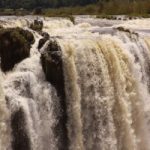
<p>Eventually an old steam locomotive showed up and slowly pulled the train at the typical speed of Africa through lots of pristine woodland up to the Zambian border and the spectacular Victoria Falls. The Zambezi River, on its way from the Congo basin to the Indian Ocean, takes a truly amazing plunge between the countries of Zimbabwe and Zambia and is considered as one of the great natural wonders of the world. Known locally as Mosi oa Tunya, which loosely translates as “The Smoke that Thunders”, the actual falls are 1700m (1.1 miles) wide and 110m (330 feet) high. In comparison, Niagara Falls is about 900m wide and 58m high. During the rain season, it is the most voluminous falls in the world; so much water plunges over the cataract that a huge water spray cloud rises over the Falls. Hence the native name. Nestled in a dense forest full of monkeys, we found it impossible to find a spot to take in the entire view of the falls, but had to contend ourselves with walking along water drenched paths to see the massive display of violent current churned to white foam. The collective roar of the falls not only pounded my ear drums, but also made itself felt all along the solar plexus, so powerful were the sound waves. From the Zambian side the view was more distant but gave us an opportunity to see the roaring rapids of the Zambezi hundreds of feet down into the black gorge. </p>

<p>More than satisfied with the splendor of Victoria Falls and more than fed up with corruption and excessive bureaucracy, we turned our attention back to the big game of the continent and made our way out of Zambia and Zimbabwe. By this time we still hadn’t see the “Big Five” animals up close, on their turf, and on their terms. We would have to travel to the poacher free game reserves of various other countries to meet up with all the beasts that we dreamed about at night. Even in game reserves, we realized that nothing would be guaranteed because it wasn’t a zoo but open range only protected from ranching, farming and other human encroachments. But more about that quest later.</p>]]>
</content>
</entry>
<entry>
<title>Why You Shouldn&apos;t Walk on Hippo Trails</title>
<link rel="alternate" type="text/html" href="http://www.davestravelcorner.com/blogs/solomon/archives/2005/04/why_you_shouldn.html" />
<modified>2005-06-11T22:53:31Z</modified>
<issued>2005-04-17T00:55:57Z</issued>
<id>tag:www.davestravelcorner.com,2005:/blogs/solomon//26.20</id>
<created>2005-04-17T00:55:57Z</created>
<summary type="text/plain">I remember looking out my window on the night flight from Europe to South Africa and seeing nothing but black below. No city lights for hours. Not until the next morning when the plane was over South Africa, were any...</summary>
<author>
<name>DaveDTC</name>
<url>www.davestravelcorner.com</url>
<email>dave@davestravelcorner.com</email>
</author>

<content type="text/html" mode="escaped" xml:lang="en" xml:base="http://www.davestravelcorner.com/blogs/solomon/">
<![CDATA[<p>I remember looking out my window on the night flight from Europe to South Africa and seeing nothing but black below. No city lights for hours. Not until the next morning when the plane was over South Africa, were any signs of civilization present.</p>]]>
<![CDATA[<p>On that flight I tried to imagine what it would be like to actually be in one of those areas that seemed so dark from above. Well, we finally entered this part of Africa when we crossed the “veterinary cordon” in Namibia’s Caprivi Strip. This fence separates the large, white owned commercial cattle ranches of the southern three quarters of the country from the communal and subsistence cattle herds of the north. Its purpose is to keep rinderpest and foot-and-mouth disease away from the southern cattle ranches, but it also effectively marks the boundary between the first world of South Africa and southern Namibia and the third world of the rest of Africa. The flat landscape became noticeably greener and densely wooded. The termite mounds became taller, larger, and sometimes surrounded and virtually consumed whole trees from the ground up. The European colonial influences on towns disappeared as well and we started seeing more and more “rondavels”, traditional round huts made of mudbrick and thatch roofs. The air was thick with smoke from individual cooking fires in front of each home and from slash-and-burn agricultural practices. Land cleared by fire can be planted with maize, cassava and vegetables to provide the villagers with food. We constantly observed women doing all the chores from cooking and washing clothes to tilling the fields and harvesting crops. They carried water from the local pump with children tied to their backs. All this intense physical labor endowed the women with burly muscles and the many pregnancies endowed them with rich bosoms. This was contrary to what I expected to see in such a manual lifestyle. I imagined to everyone in these conditions to be very lean. The men, on the other hand, fit my preconceived notion of leanness. Quite a few were downright skinny and it looked almost comical when they walked next to their massive women. Does that come from the fact that most men have the relatively easy cattle herding duties where they usually just hang out near their animals and catch naps? Or, more likely, are genetic factors involved? Bottom line was that women seemed to bear the brunt of the daily duties. </p>

<p>This picture remained with us as we left the Caprivi and entered Botswana. At the border crossing, our milk got taken away from us and dumped into a burning fire pit. We received no explanation, so we assumed that it must have something to do with the cattle diseases. Then our entire bus had to drive through a pit presumably filled with some sort of disinfectant, while all passengers had to get out and walk through a mini pit also filled with the disinfectant. I still felt sweaty and hot but my feet were squeaky clean. Our initial impressions of the country were lush forests and tropically humid weather and many, many donkeys and other farm animals grazing right along the roads. In fact, the roads seemed to be the center of all activity, as children played, people walked, women cooked, men socialized, and animals just blocked them. As expected, the driving was very slow but accepted by everyone as a fact of life. We finally started seeing the true speed at which Africa moved. I didn’t mind at all because the tropical weather had a similar effect on me and all movements slowed down, especially during the heat of the day. We spent some time in a game lodge right on the confluence of the Chobe and Zambezi Rivers not too far from town. Both were slow moving beasts that wound their way lazily through the dense brush and trees. We set our camp up near the Chobe River and slowly a fuzzy feeling of impending animal encounters crept up. But the first animals crept up rather suddenly, as I noticed the white furred, black faced vervet monkeys swarming in the trees above and following my every move in the hopes of scoring something to eat. The first visitors to come after food were not the vervet monkeys, but some warthogs with fearsome tusks and big heads that took up half their body lengths. They sniffed and grunted their way around our camp but showed no interest in me at all. I was happy about that; the last thing I needed was a big dirty tusk up my….uhh….behymen. Crocodiles were another matter and a very serious consideration because the camp was right along the river side. The warning signs were simple and effective: the jaws and teeth of a croc spray painted on a piece of wood and posted all along the shore. Frightfully aware of this danger, I stayed well away from the water’s edge but still managed to stumble upon a smaller croc hiding among the roots of a tree. At only 2m (7 feet), this beast got scared itself and bolted for the river, while I bolted into the next tree. That literally scared the living daylights out of me. Thankfully I walked away from this potential disaster with just a bruised nose. </p>

<p>With this area being so river laced, Abdul and I decided to hire a pontoon boat and guide in the hopes of seeing some of the wild life of the nearby Chobe National Park. It cost a bloody fortune, but turned out to be worth the money, as we had unparalleled views and very knowledgeable guides. I forget the names of the myriad birds we saw, but will not forget the vast numbers of crocs floating around everywhere. One particularly primitive looking specimen with dinosaur like plates gracing its back and tail happened to be catching the fading sunlight on the shore when our boat floated past. At about 4-5m (12-15 feet) and a belly that could hold a zebra, it didn’t react at all to our presence, but continued to keep its jaws open into the sun. Those were some of the most evil looking slit eyes I have ever gazed on. Further down the river we came upon literally hundreds of elephants grazing and wandering around slowly and gracefully. As big as these beasts are, they moved about in complete silence, even underfoot nothing snapped or rustled. We noticed groups separated according to sex and age; large matriarchs led other, lower ranking females and calves, while young bulls congregated in bachelor herds in the reeds along the river and conducted playful mock fights. Older bulls usually lead solitary lives. Of course, where there is water in this part of Africa, one can be sure to eventually come across the eyes of a hippo floating serenely in the calmer spots. But submerged in water and underneath those two eyes, hide over 2 tons of thick skinned flesh and bone. During those rare occasions, when one of these hippos actually leaves the water in day light, it’s possible to witness the massive rounded features of its body. It seems lazy and slow, but on land these pachyderms can outrun any human and are credited with killing more people than any other animal each year. Such a brutal trampling death usually occurs at night because some hapless person walks into the path the animals use to retreat into the water after coming out on land to feed. Fortunately, we were in the safety of the boat and in the water the hippos didn’t pay us much attention at all. They would just submerge completely if we came too close and stay underwater for quite a few minutes before coming up to breathe. The last major animal other than herds of impala and individual kudus, was the huge monitor lizard. Fast as rockets and almost 2m long, they looked just like their more normal sized brethren, only a lot bigger. And they were as skittish, dashing for the dense undergrowth as soon as we came near. </p>

<p>Satisfied with our fill of animals along the Chobe River, we decided to head for the Okavango Delta in the heart of Botswana. To get there we had to opt for the notorious minibuses that we had so desperately tried to avoid in the past. No choice here, though. We were able to flag one overloaded, low riding, tire bulging vehicle down and the driver squeezed us in somewhere in the back row. Unable to move any body part except my eyes, I counted about twenty to twenty two people inside a vehicle the size of a large minivan. Inside, however, everyone seemed happy and the music thumped, as we careened down the highway, swerving around loose donkeys and large potholes. With the vertical noon sun beating down on the roof, the un-airconditioned interior heated up quite a bit and sweating didn’t help much, it just lubricated our skin as everyone tried to move their limbs around to prevent them from falling asleep in their wedged positions. Besides staying in a small village, a minibus trip with the locals is actually a very African experience that gives a foreigner a very good picture of the life of an average African. We were completely surrounded by the sights, sounds, smells, and textures of African villagers at an African distance: inches from our faces and stuck on our skins. That’s how we got to the Okavango Delta.</p>

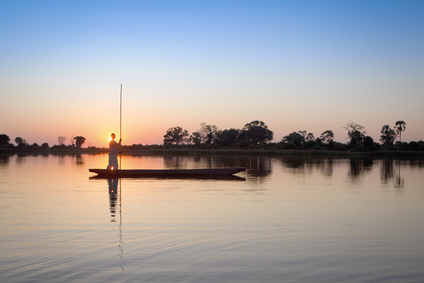
<p>The 1400 km long Okavango River originates in the Angolan Highlands and, unlike most other rivers of the world, flows inland to sprawl in a huge delta and eventually drain into the Kalahari sands or evaporate in the hot air. The delta is laced with a virtually infinite number of channels, lagoons, and islands. This wetland is one of the biggest tourist attractions in Botswana, and accordingly, we ran into plenty of them during our stay there. A highly recommended activity is a trip into the maze of streams in a long pole powered dugout canoe. Known as “mokoro”, these canoes are manned by a guide with a long pole, who pushes it slowly and silently through the reeds and papyrus. Due to outrageous prices that these guides demanded and knuckleheaded tourists willing to pay them, we couldn’t afford even a half day on a mokoro. Instead, Abdul and I teamed up with a couple of like minded Kiwis (traveler speak for a New Zealander) and hired some horses and guide for an unforgettable trip into the bush on horseback. To accentuate the possible dangers, my horse had huge scars on its rear end, inflicted by a crocodile. The guide told us that it ventured near the water’s edge a little too long and barely escaped the jaws of a 4m croc. Ay caramba!! We were able to ride through some remote delta villages accessible only by these means. No electricity, no running water, no gas, no mail delivery, no phones, and still around in the twenty first century. Amazing. </p>

<p>As much as we would have liked to stick around Botswana, we had to cut our stay short because of outrageously expensive prices for foreigners. Most of the bush lodges demanded sums that would make a first class weekend in Las Vegas seem like a trip to McDonald’s. It seems as though the Botswana government actively pursues the low volume, high budget kind of tourism. It was too bad, as the people themselves did not seem at all concerned with such issues and just pursued their simple subsistence life styles. So we mini-bussed it in African style and tortuously slow from town to town until we reached the border of Zimbabwe. Here, Abdul and I embarked on a trip through a different side of Africa, one of bureaucracy, corruption, instability, greedy strong-man presidents and utter nonsense. But we also saw one of the absolute top natural wonders of the world. More about that later.</p>]]>
</content>
</entry>

</feed>