Malta is a small island but it has probably the highest density of things to see and do per square kilometre of anywhere I’ve been. I know that sounds like a brochure. It’s not. You can drive across the main island in about 45 minutes. Most visitors give it a day or two, usually on a cruise ship stop — they walk around Valletta, take a photo of the harbour, and leave, which means they miss almost everything. Give Malta a week and you’ll see what I mean.
The Light and the Layers
It’s the light that hits you first. Malta sits further south than Tunis, and the limestone that everything is built from catches the sun in a way that turns the whole island golden in the late afternoon. The buildings, the fortifications, the churches, the cliffs — all the same honey-coloured stone, and photographers lose their minds here because the colour shifts by the hour.
The second thing is the density of history. There are temples on Malta older than the Egyptian pyramids — the Ġgantija temples on Gozo date to around 3600 BC. Then you layer on the Phoenicians, the Romans, the Arabs (who gave the Maltese language its Semitic backbone), the Normans, the Knights of St. John, Napoleon, the British, and two World Wars. All compressed into 316 square kilometres. You cannot walk five minutes without tripping over something that would be a national monument anywhere else.
Valletta
Most people rush through Valletta in a couple of hours, which is like speed-reading a novel and claiming you got it. The capital is a fortified grid built by the Knights after they survived the Great Siege of 1565, and nearly every street has something worth stopping for.>
The museums alone could fill two or three days. The National Museum of Archaeology houses the “Sleeping Lady” figurine from the Ħal Saflieni Hypogeum. The National War Museum in Fort St. Elmo covers Malta in World War II — the island was the most bombed place on earth during the war, and the George Cross awarded to the entire population still appears on the Maltese flag. St. John’s Co-Cathedral has Caravaggio’s largest painting hanging inside, and the interior is so over-the-top ornate that you stop trusting your eyes after a while. There’s also a tiny cinema museum on South Street that nobody goes to, which is a shame because the guy who runs it clearly loves what he does.
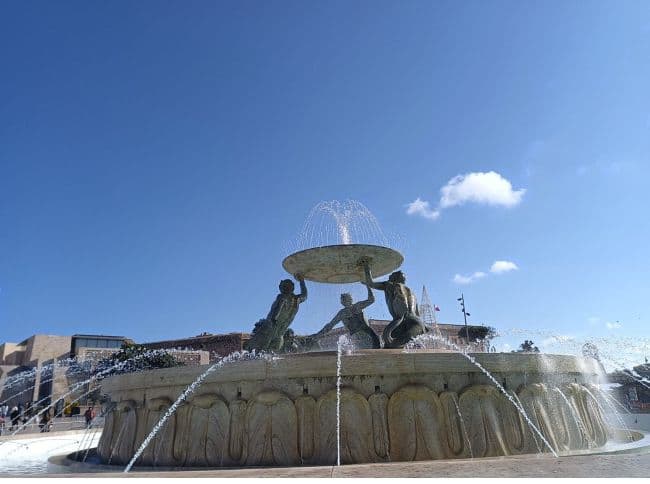
The triton fountain in Valletta
The Three Cities
Across the harbour from Valletta sit Birgu, Senglea, and Bormla — collectively the Three Cities. This is where the Knights first settled, where the Great Siege was fought, and where working-class Malta still lives. There are no tour buses here. The alleys are narrow, the washing hangs between balconies, and the fortifications are massive and mostly empty of tourists.
Senglea’s Gardjola Gardens, perched on the tip of the peninsula, offer the best harbour view in Malta. Better than the Upper Barrakka Gardens in Valletta, and you’ll probably have it to yourself. Take the traditional dgħajsa water taxi across — it costs almost nothing and you get to watch Valletta slide past from the water, which is the way it was meant to be seen.
The Coastline, Comino, and the Outdoor Stuff
Malta’s coastline is not really about sandy beaches — there are a few, but they’re not the main draw. It’s the swimming spots carved into the limestone that keep you coming back. Hidden coves, natural pools, flat rocks where you can lie around for hours, cliff jumping spots, and water so clear it looks photoshopped.
Comino, the tiny island between Malta and Gozo, is famous for the Blue Lagoon — which is genuinely that blue, though it gets crowded in peak summer and the trick is to go early morning or in shoulder season when you might actually find a spot to sit down. But Comino has more than the lagoon. There’s an abandoned police station up on the ridge that you can walk into (the door’s gone), a crumbling medieval tower called St. Mary’s, walking trails across scrubland where you won’t see another person for an hour, and a second smaller lagoon on the Cominotto side that most day-trippers never reach because it involves a bit of scrambling over rocks. I keep going back and it’s different every time depending on the season and the wind direction.
If you’re into anything active, Malta does well for its size. The diving is probably the best in the Mediterranean — warm, clear water, big caves, and several accessible shipwrecks including the Um El Faroud and the P29 patrol boat. Rock climbing is growing fast, particularly on the sea cliffs of Gozo. Mountain biking trails wind through the rural interior where the landscape looks more North African than European. And the wine — yes, Malta makes wine — is genuinely good and almost impossible to find outside the islands. The indigenous Girgentina and Gellewża grapes produce something you literally cannot drink anywhere else.
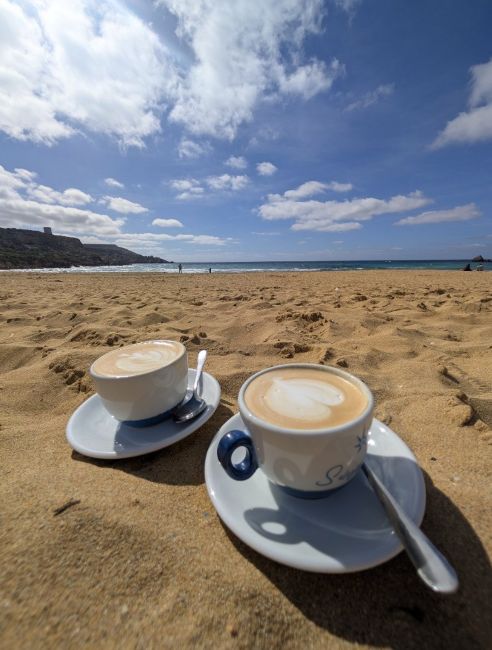
Coffee on the beach in Golden bay, Malta
Practical Bits
You’ll be fine here. Violent crime against tourists is essentially unheard of. The buses are cheap and go everywhere, though they run on what locals affectionately call “Maltese time.” English is an official language — everyone speaks it, often mixed with Maltese in the same sentence which takes some getting used to. The food is underrated: rabbit stew, pastizzi (flaky pastry stuffed with ricotta or peas for about fifty cents), ftira which is a Gozitan flatbread that’s recently gotten its own EU protection status, and some surprisingly good restaurants that have appeared in the last decade.
The summers are hot. Genuinely hot, 35°C and above with high humidity. If you have a choice, come in April, May, October, or November. The water is still warm enough to swim, the light is beautiful, and you won’t be fighting for space at the historic sites. I have written extensively on planning a trip to Malta.
Why a Week
A day gives you Valletta. Two days adds a beach and maybe Mdina, the old silent city. But a week lets you take a boat to Comino, explore the Three Cities properly, drive around Gozo (which deserves at least two days on its own), dive a wreck, eat at a village festa, watch the sunset from the Dingli Cliffs, and still have a slow morning with coffee on a harbour-front terrace.



Leave a Reply