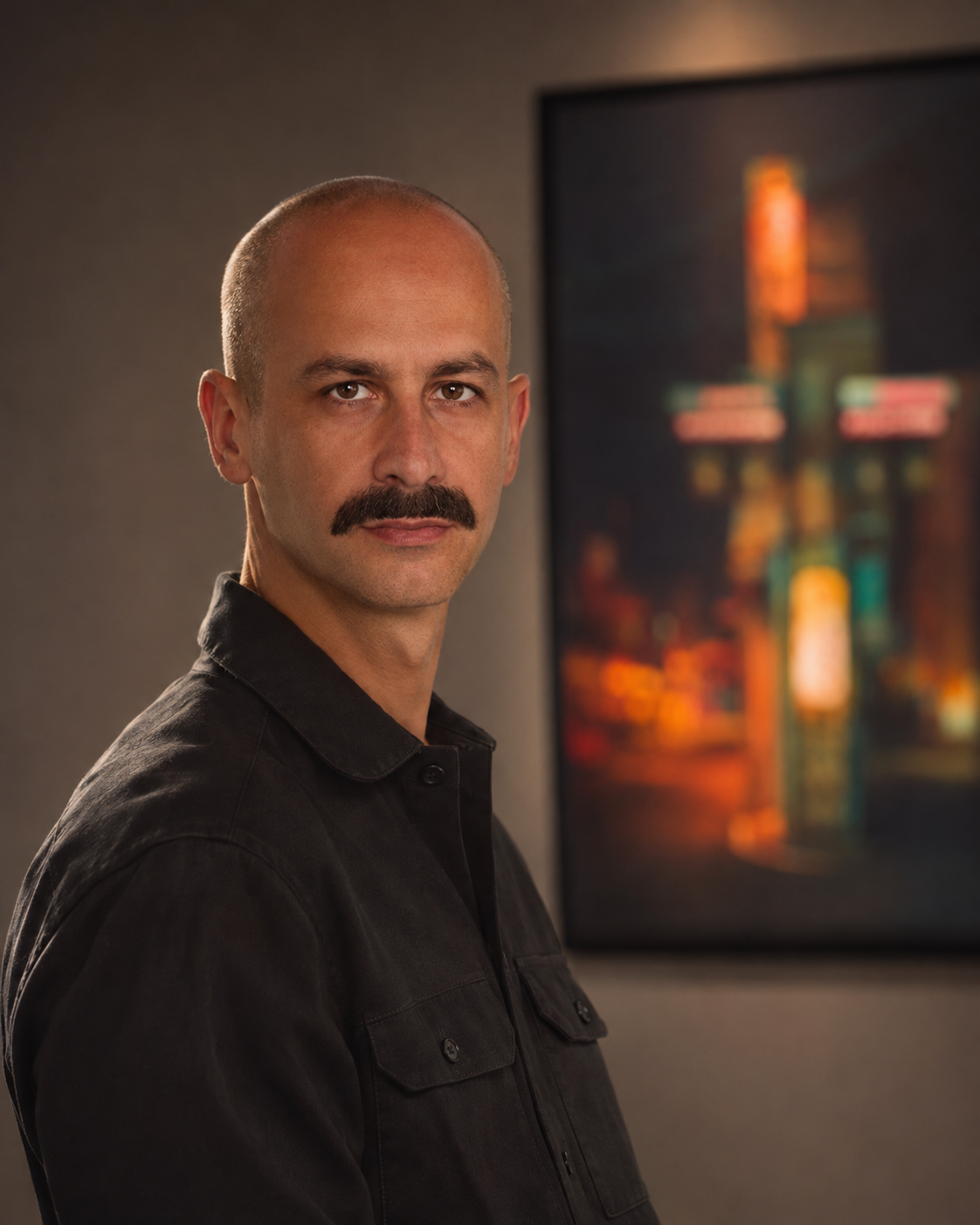
 Etienne Perrone is a French photographer and filmmaker. Trained in cinematography, he has worked as a director and director of photography for more than 25 years. His ongoing series, Dreams Happen After Dark, was born from years of walking alone at night through cities in Asia and the United States. It explores ordinary streets transformed by darkness and by colored light created in camera. His work has been recognized at the LensCulture Street Photography Awards and featured in The Guardian.
Q. You have a background in cinematography and have spent years working with moving images and music. How did you get into photography and eventually find your niche in exploring and documenting cities after dark?
I first got serious about photography in film school in the late ’90s, in the school’s black-and-white darkroom. For a long time, I photographed everything, day and night, without asking myself too many questions. Then, little by little, looking back at my images, I realized that the ones that really moved me were the night ones. I still love some of my daytime photographs, and sometimes I feel like going back to it. But at night, I experience something stronger. So I spend more time out there, and naturally, that’s where most of my images are born.
Cinema and music have always been ways for me to dive into other worlds. Music, especially, lets you travel without moving. But there’s one need it can’t fill: actually being somewhere else. Another language, other smells, other food, other sounds, a different light in the streets. Nothing replaces that moment when you find yourself abroad, suddenly immersed in another world. Night photography became my way of bringing it all together: traveling, walking, and bringing back something of what I felt.
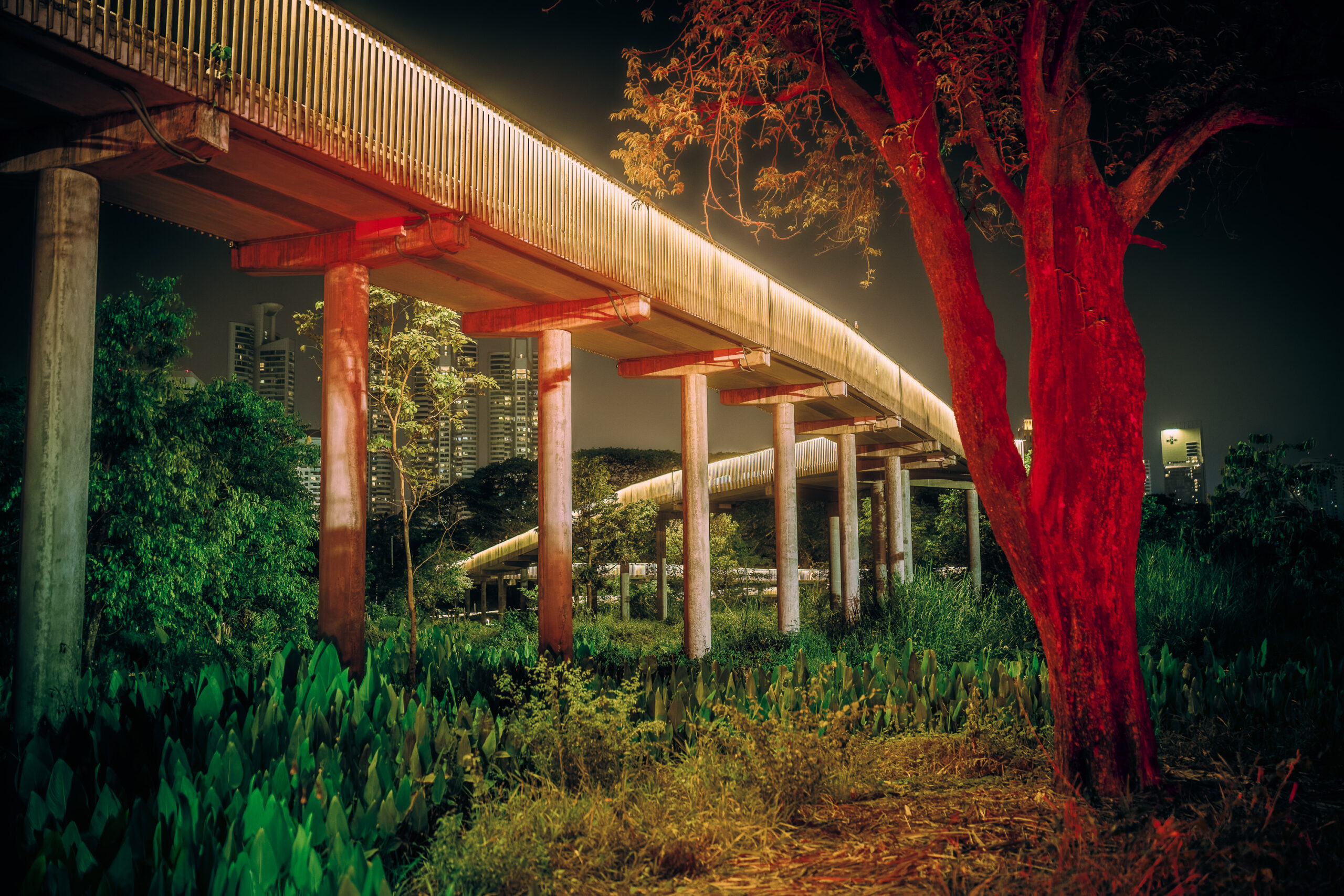
A tree lit blood red stands beside a long elevated walkway that curves through Benjakitti Forest Park in Bangkok. Residential towers rise beyond the wetland, half hidden by the night and the trees.
Q. Your ongoing photography project, Dreams Happen After Dark, even the name itself is intriguing. What does the title mean to you, and how does it reflect the way you see and experience cities at night?
There’s a paradox in this title. When I walk at night through a foreign city, I’m the exact opposite of someone who’s dreaming. All my senses are on alert: I look at everything, I listen to everything, I notice the smells. I’m one hundred percent in reality. And yet, that’s precisely when I feel like I’m entering a dream.
During the day, I love wandering around, visiting museums, discovering a city like any other traveler. But when night falls, something shifts in my head. The street in front of me is very real, but I see it differently, like a set from a parallel world. It’s a waking dream, and my photographs try to capture what I feel in that moment so I can share it.
The title also speaks to another kind of dream: the life I dream of. Back home in Marseille, I live a more conventional life, and I miss these journeys enormously. When I set off exploring again, I feel like I’m reconnecting with my true self, who has been waiting for me somewhere and says: “Ah, there you are at last. Now we’re not wasting our life. Now we’re living for real.”
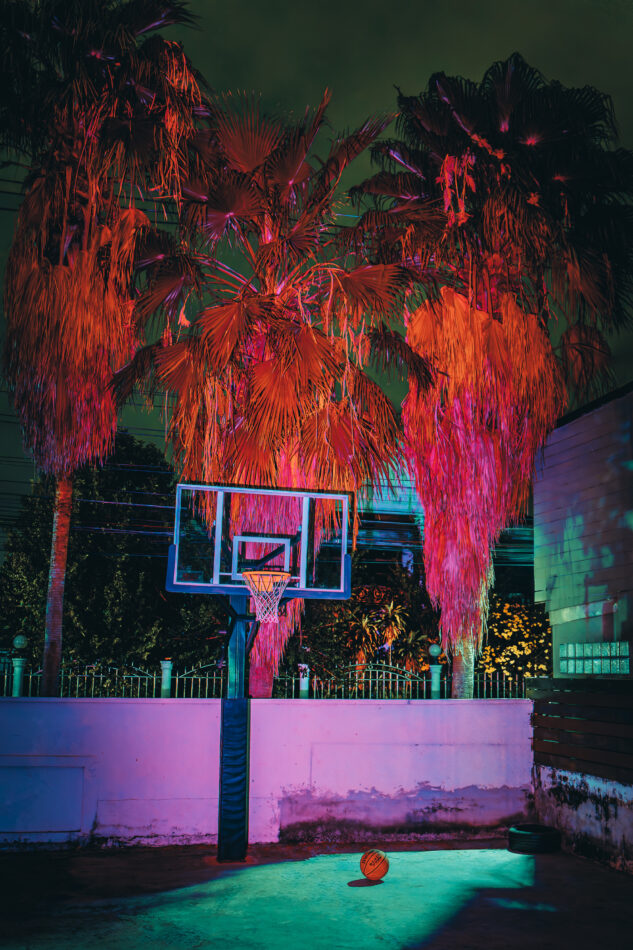
A basketball hoop stands in a small courtyard in Bangkok beneath shaggy fan palms lit orange and pink. A lone ball rests on the cyan-lit concrete, as if the game ended long ago.
Q. You have traveled extensively across the US, Europe and Asia. When you are at a new destination, how do you usually plan your days and evenings, and what do you particularly enjoy about the city after dark?
I have a ritual, almost always the same. Since I photograph late, I rarely go to bed before 1 a.m. I get up around 9:30 and head out right away: when I’m abroad, I hate lingering. A coffee outside, a short walk, then I do a bit of work on my laptop until lunch.
In the afternoon, I go out to discover the city with one goal in mind (a neighborhood, a museum, a gallery, a restaurant) and a lot left to chance. I go on foot, even if it takes two hours, because walking is how you really discover a city. Around 5 p.m., I take a one-hour nap. That’s sacred. When I wake up, night has fallen (in Asia, it falls early), and a second day begins, from 6 p.m. to 2 a.m. During the day, I wander like a tourist with a small compact camera. At night, I grab my bag, my camera, two or three lenses and my flashes, and I become an explorer.
What I love about the night is that the city transforms. It’s not the same people on the streets anymore. The darkness erases everything, and every light becomes a little island of reality: a lit window, people behind a shop window, a flickering neon sign. It’s as if the city were underlining certain places to tell you: “Look here.” And on a silent street, passing under a window, you hear a TV, a conversation, a child talking to their parents.
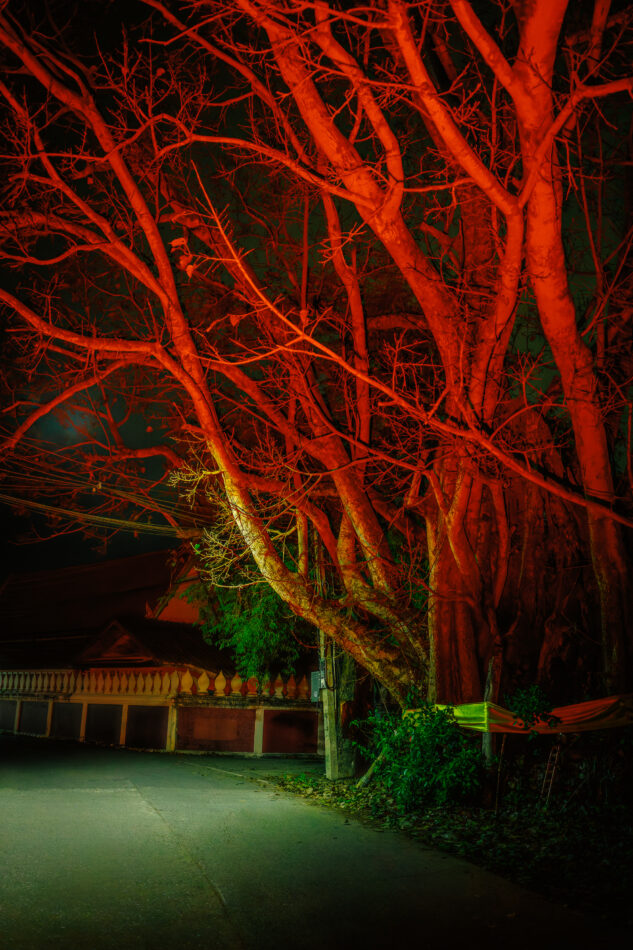
Huge old trees spread their branches over a quiet road near Chiang Mai, lit red against the night. Below them, a low ornamental wall and a small roof glow faintly — the trees seem to hold the light long after the day has gone.
Q. Nighttime exploration can sometimes get you off the usual tourist areas. Have you ever walked into an interesting or unique neighborhood, or some hidden corner, or seen some very interesting human interaction during your travels that you might not have discovered otherwise and what was the experience like?
Almost every night. I can’t remember ever coming home from a night of exploring and feeling like I hadn’t seen anything.
In Tokyo, I love Shibuya, Shinjuku and Golden Gai, but my favorite memories aren’t there. They are in residential neighborhoods where there isn’t a single tourist left: a narrow, winding street that climbs and then drops down the other side, silent houses, and an elementary school at night, with little decorations hanging up. Nobody ends up there by following a guidebook. And that’s where you feel you’re touching real life.
At night, I have another ritual too: Japan’s tiny bars. I have a drink, chat with strangers, go back out to shoot, then stop at another bar, sometimes three or four in one evening.
One night in Kyoto, I heard people laughing at the top of a staircase, so I went up. The welcome was incredible. And the bartender turned out to be a magician as well. Not a weekend amateur: a real one, at a very high level. For an hour, he did completely mind-blowing tricks. The bar was electric, we were all stunned, a group of strangers bonded by the same bursts of laughter. Then we said goodbye, it was almost moving, and everyone went back to their lives. It’s the kind of moment you know, while you’re living it, that you’ll never forget.
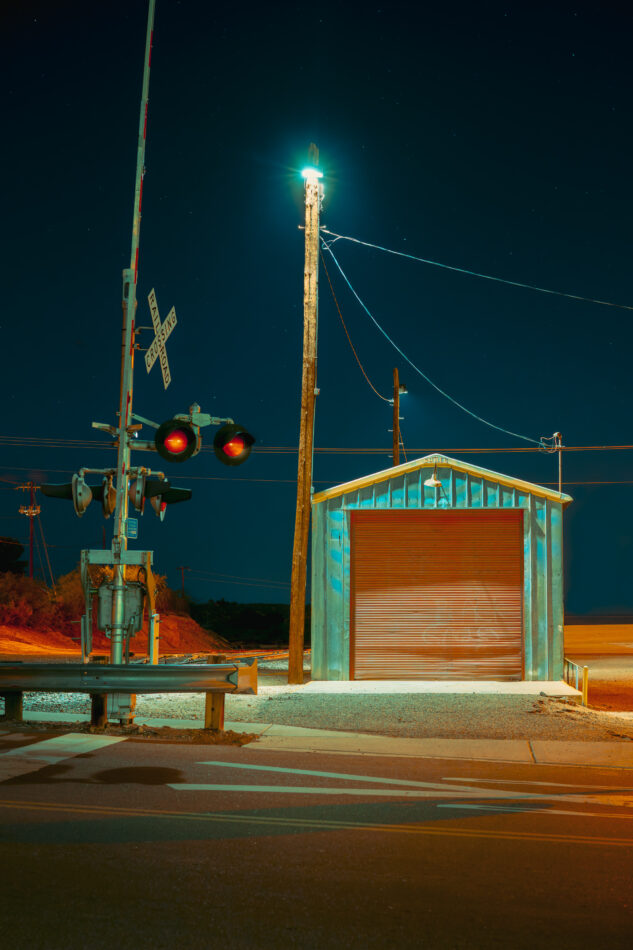
A railroad crossing with red warning lights stands beside a small metal shed with a closed roll-up door. A single bright lamp on a wooden pole lights the empty crossroads under a deep blue night sky — waiting for a train that may never come.
Q. How do you use your cinematography background when taking photographs to make them feel almost like scenes from a film?
To be honest, my work as a cinematographer and these photographs work almost in reverse. On a film set, I create light that serves a story and its characters. Here, the light no longer serves the subject: it becomes the subject. I take it for what it tells me and for the feeling it creates.
If my images remind people of film scenes, I think it’s because these places give off an unusual intensity. In cinema, everything is designed to carry intensity: either something powerful is happening between the characters, or the place itself is charged. My photos show ordinary places, but with something extra. It’s not a unicorn in a bright pink restaurant (there, you’d simply think it’s impossible). It’s more like: “I know this… but there’s something more.” Normality, with something extra that makes it strange and intense.
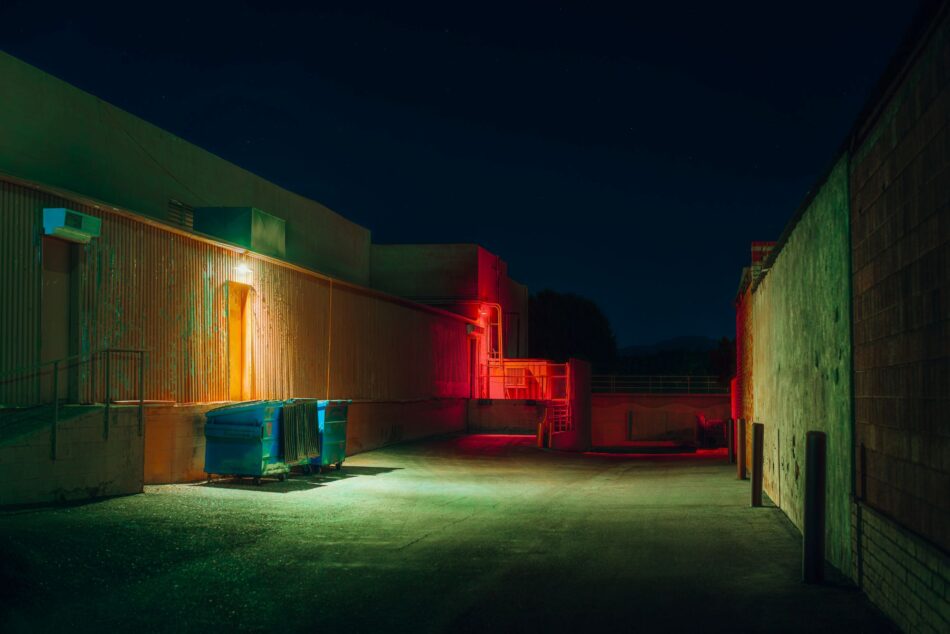
To create that extra something, I travel light, since I walk for miles: a speedlight, a set of colored gels and a stand for the flash. I place the light at a particular angle that adds depth, with a color chosen to create that shift. That’s often what tips an ordinary street into fiction.
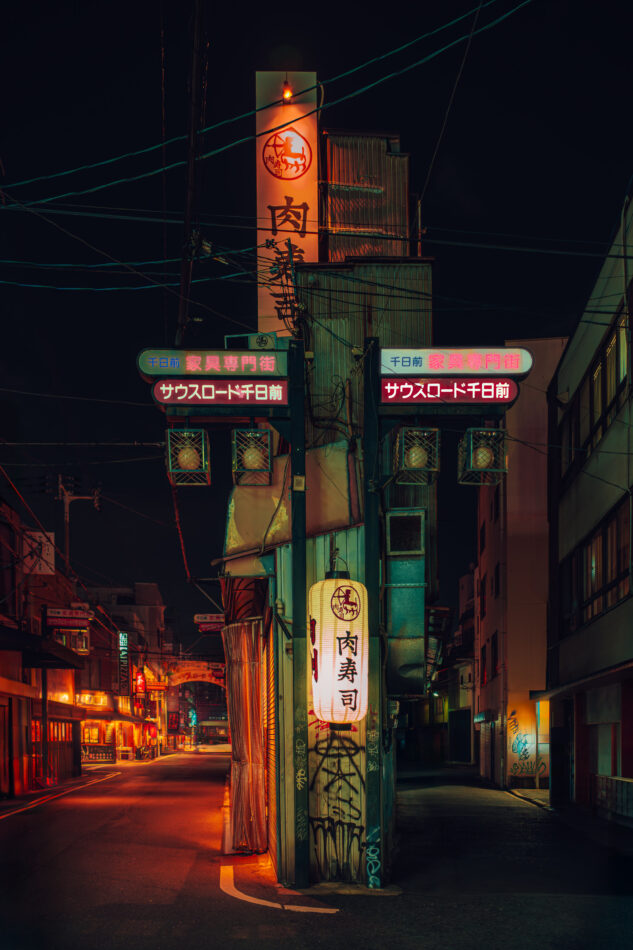
A street corner splits in two around a tall pole of signs and a lit paper lantern in Sennichimae, Osaka. Neon arches in Japanese mark two shopping streets, while a tangle of power lines crosses the dark sky.
Q. I know you often explore cities on your own, do you find that travelling solo gives you a different way of seeing and experiencing a place?
Yes, absolutely. Traveling with others is wonderful too. One of my first trips to the United States was with my best friend, and it’s one of the best trips of my life. You laugh more, go out more, share more. But you have to compromise all the time: when to eat, where to go, when to head back, when the other person has had enough of walking.
Alone, the freedom is total. I eat when I want, what I want, where I want. I walk twenty kilometers if I feel like it, I talk to whoever I want, I go to bed whenever I want. It’s very rare in life to be in that situation. I think we don’t travel alone enough, and I understand why: opportunities to travel are too rare to spend them away from the people we love. But on your own, you see differently. You’re more receptive, and you live moments of introspection and poetry you wouldn’t experience with others.
I often think of one night in Bang Krachao, the huge green lung in the middle of Bangkok. I’d gone there during the day and loved it. So I went back for my nap, returned that evening and rented an electric bike. I rode through the night for three hours. The sound of the jungle, the silence, and in the distance some Thai music from the ’60s, probably an open-air dance, which I searched for but never found. I felt like I’d been dropped into In the Mood for Love. Then, in the middle of nowhere, I came across a tiny open-air restaurant, empty, with a radio playing music. I was so happy I almost had tears in my eyes.
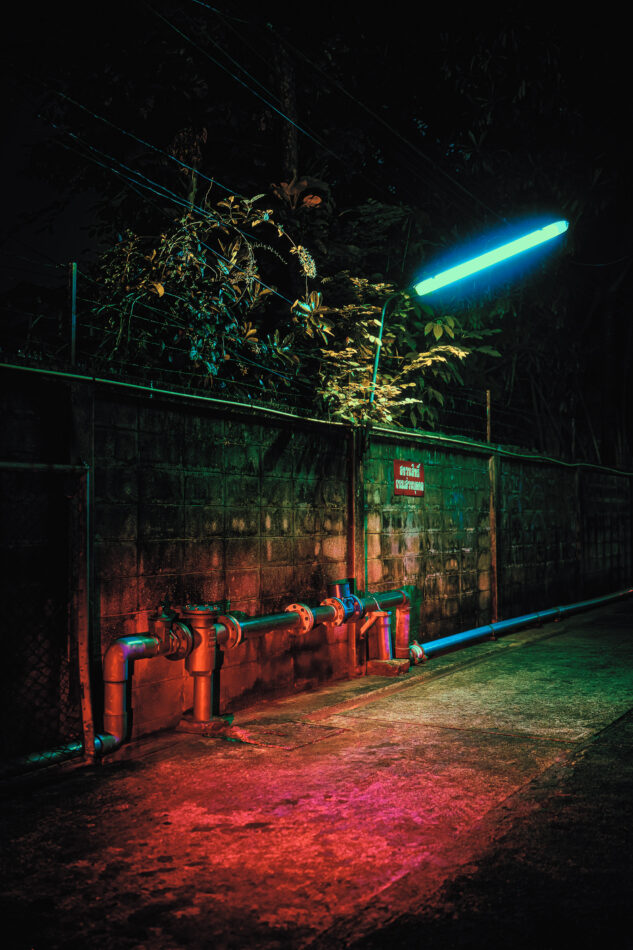
Pipes and valves run along a stained block wall in a narrow alley in Bangkok, under a single cyan tube light. A small red warning sign in Thai and a red glow on the ground give the scene a quiet tension.
Q. When you take your nighttime photographs, do you usually have a particular story or message you want to convey, or do you prefer to leave things open and let people use their own imagination when they look at your work?
I prefer to leave things open. In this series, an image doesn’t correspond to a specific story that people need to figure out. I never tell myself: “I’m photographing this street or this pile of tires to say exactly this, and if people don’t get it, they’ve missed my message.” It doesn’t work like that.
Each place has its own power, almost independent. They are fragments of my world. A single image can intrigue, but it’s by looking at all these fragments together that people begin to sense where I’m going. The rest is built by the viewer’s imagination: they step into the image and bring their own story to it.
Q. Many people spend their days sightseeing, but when evening comes, most of them head back to their hotels, go out for dinner or spend time in bars. What advice would you give to people who want to get out and explore more after dark and experience a different side of the places they visit?
I wouldn’t tell them to give up dinner or drinks: I go too! But pick a place a bit farther away, an hour’s walk, and walk back by a different route. You’ll get your drink, your dinner, and a whole city to discover along the way.
Above all, walk slowly. Not to get somewhere on time, but to look. Imagine you’ve just landed on another planet, like an anthropologist who observes, takes notes and tries to understand. A city is made of thousands of small details: street signs, lettering, the shape of sidewalks and streetlights, electrical cables, shop signs, restaurant windows, menus. They’re what remind you that you’re not at home.
Listen, too. In Japan or China, in two minutes you can go from a noisy avenue to an alley where all you hear are your own footsteps, and sometimes crickets.
Choose countries where you feel safe. In Japan, South Korea, Taiwan, Thailand or China, I walk at night without any worry, and that peace of mind changes everything: you can get lost on purpose. In the United States, I do it differently: I drive around and stop when a place draws me in.
Finally, don’t be afraid of the dull stretches. Sometimes you walk for forty minutes along a noisy road without seeing anything interesting. Then, around a corner, something appears. I sometimes walk twenty kilometers in a day, simply because you want to see what’s on the next street.
All photographs credit: Etienne Perrone




Leave a Reply