Museum Partnership Creates Cambodia’s First Metal Conservation Laboratory
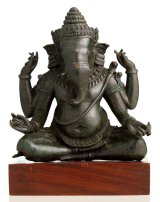 The enduring significance of bronze in Cambodian culture is the theme of “Gods of Angkor: Bronzes from the National Museum of Cambodia,” the first international exhibition to focus specifically on the skills and achievements of Khmer bronze casters. On view at the Arthur M. Sackler Gallery from May 15 through Jan. 23, 2011, the exhibition features magnificent bronze sculptures and ritual objects created within a Khmer cultural context that spanned some 1,600 years, from late prehistory through the Angkor period (9th-15th centuries).
Thirty-six masterworks from the National Museum of Cambodia’s unparalleled collection of some 7,000 bronzes make up the exhibition, co-curated by Freer and Sackler colleagues Louise Allison Cort, curator
of Ceramics, and Paul Jett, head of the Department of Conservation and Scientific Research. “This exhibition presents the stunning accomplishments of Khmer bronze casters,” said Cort. “These bronzes are among the most exquisite expressions of Khmer ideals of religious imagery and ritual implements.”
The exhibition, which grew out of a collaboration between the Freer and Sackler galleries and the National Museum of Cambodia to develop a conservation program at the National Museum, explores significant developments in bronze casting, as well as cultural and religious developments that coalesced during the Angkor period into a recognizable Khmer style of bronze form, finish and ornament.
The first of three linked galleries presents the two prehistoric bronze works in the exhibition: an urn with pictorial decoration and a bell, both examples of rare and highly valued items that were traded over long distances within Southeast Asia. The gallery also previews the Angkor period’s remarkable accomplishments in bronze casting with three sculptures: a crowned Buddha, an image of the elephant-headed Hindu deity Ganesha and a kneeling woman who may have represented an attendant in the royal palace or a temple.
In the second gallery, the exhibition delves more deeply into the evolution of bronze sculptural styles within Khmer culture. Buddhist sculptures from the pre-Angkor period (6th-8th centuries) reveal early Khmer adaptations of Indian prototypes. A highlight of this gallery is a group of seven diverse bronze figures unearthed together in 2006 that reveal the dynamic interaction of early bronze religious sculpture: they include not only images in local and regional styles but also two imported Chinese figures, both with gilding.
Bronzes from the 11th through 14th centuries in the third gallery project a distinctly Angkorian style. Objects include ritual paraphernalia and Buddhist and Hindu sculpture. A mirror that may have adorned a palace and a weighty bell for a court elephant suggest the wide importance of bronze objects among the Cambodian elite. Unlike bronze religious sculpture, these little-studied ritual and ornamental objects have rarely been exhibited.
A 160-page illustrated exhibition catalog, edited by Cort and Jett, includes essays by four senior scholars illuminating the significance and development of bronze sculpture and ritual objects in the Khmer world.
Over the past five years, with support from the Getty Foundation and other sources, Jett and colleagues at the Freer and Sackler and the National Museum have established Cambodia’s first metal conservation lab. The metal conservation program, the new laboratory for the treatment of ceramics and the National Museum’s long-standing stone restoration efforts, comprise one of the most advanced conservation facilities in Southeast Asia. When the exhibition objects travel from Cambodia to the Freer and Sackler, they will be accompanied by couriers from the National Museum, who will stay on for three weeks of training in museum practices, such as conservation and exhibition design and installation. The training is part of the two museums’ ongoing partnership to study and preserve the art of Cambodia.
The exhibition will coincide with the fifth Forbes Symposium, taking place at the Freer in October 2010. The symposium will focus on the topic of scientific research on ancient metallurgy in Asia. To complement the symposium, “Aspects of Angkor,” a series of lectures presented by museum staff and guest speakers during the summer and fall, will illuminate the themes of the exhibition.
Public education programs and the Freer and Sackler’s Southeast Asian Film Festival, scheduled to run from September through October 2010, will also focus on Cambodia.
The exhibition will travel to the J. Paul Getty Museum in Los Angeles in February 2011.
“Gods of Angkor: Bronzes from the National Museum of Cambodia” is organized by the Sackler Gallery in collaboration with the J. Paul Getty Museum and the National Museum of Cambodia. Major funding is provided by the Henry Luce Foundation and Leon Levy Foundation.
For more information about the Freer and Sackler galleries and their exhibitions, programs and other events, the public is welcome to visit www.asia.si.edu. For general Smithsonian information, the public may call (202) 633-1000 or TTY (202) 633-5285.
The Freer Gallery of Art, located at 12th Street and Independence Avenue S.W., and the adjacent Arthur M. Sackler Gallery, located at 1050 Independence Avenue S.W., are on the National Mall in Washington, D.C. Hours are 10 a.m. to 5:30 p.m. every day, except Dec. 25, and admission is free. The galleries are located near the Smithsonian Metrorail station on the Blue and Orange lines.


About Dave's Travel Corner
 Dave's Travel Corner is a travel content, resource provider and community (founded 1996) providing travel Guides written about Dave's personal travel experiences and Journals, pages that contain trip summaries and experiences written by fellow travelers. We spotlight locations and attractions with an article linked directly from our homepage including content across our blog, photo and video galleries. We use a combination of social media, written content, photography and videos to promote locations. Not only does the content appear on this site but we have direct partnerships with other well visited travel sites for placement of the content. Since 1996, we have also established hundreds of relevant link exchanges with other travel sites.
Visitors to Dave's Travel Corner will also find thousands of travel related links organized by categories on the Resources Page, a Photo Gallery containing International travel photos, Book Reviews, and Product Reviews focusing on products useful for travelers, fully automated Forums, Tour Bookings offering over 4400 unique tours around the globe, Interviews with those making news in the travel industry and Videos - specializing in International travel videos as well as home of the Dave & Jim Show.
Dave's own travel blog is Above the Clouds which focuses on International Travel & Lifestyle.
For information on advertising please choose from a variety of advertising options here.
Contributors are welcome
 Learn how you can contribute About www.davestravelcorner.com/about
Leave a Reply