 $737-Million LAX Tom Bradley International Terminal Renovation Completed in Time and Under Budget Terminal Upgrades Reduce Congestion, Improve Passenger Convenience and Safety
LOS ANGELES, May 26, 2010 (GLOBE NEWSWIRE) — Los Angeles Mayor Antonio R. Villaraigosa was joined today by City Councilmembers Bill Rosendahl, Janice Hahn and Tom LaBonge, airport commissioners, airlines and business leaders in a ceremony to commemorate the completion of the Tom Bradley International Terminal (TBIT) Renovation Project at Los Angeles International Airport (LAX). The $737-million project was designed to make traveling through the terminal safer, faster and more convenient to passengers, as well as provide a Southern California welcome to arriving international visitors. The significant changes are expected to help LAX retain its competitiveness as the premier West Coast international gateway, especially to the fast-growing Asia-Pacific Region. The 38-month project was completed on time and under its $755-million budget.
“The Tom Bradley International Terminal at Los Angeles International Airport is the first and last impression 10 million travelers have of Los Angeles every year,” said Mayor Villaraigosa. “This renovation project improves the travelers’ experience as they pass through LAX, while enhancing passenger safety by reducing congestion in the airline check-in lobbies and on the curbside. The upgrades also improve customer service so travelers’ experiences in our great city will be positive ones that will make them want to return.”
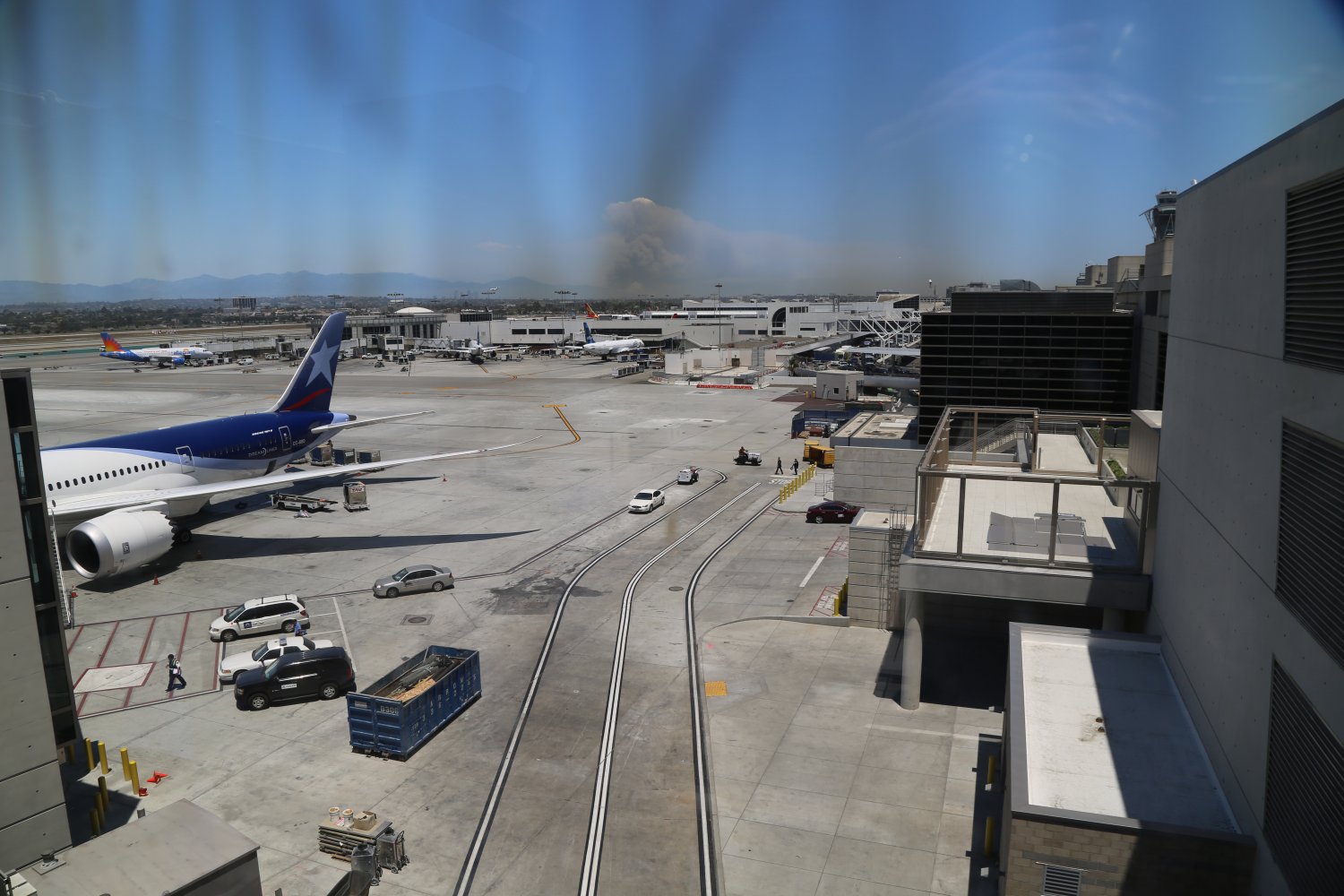 Councilmember Bill Rosendahl, whose 11th District includes LAX, said, “This is the first and only LEED Silver Certified airport project for an existing building in the country, and where the work was performed in a fully operational terminal. This is modernization at its greenest, and its best. I’m proud of our work here, and I challenge others to match it.”
“Tourism has become the number one industry in Los Angeles, but we must do everything we can to ensure that visitors continue to come here,” said Councilmember Janice Hahn (15th District), who chairs the City Council Committee that oversees the airport. “Revitalizing this terminal will help us attract airlines and travelers from all over the world, giving them the first-class airport experience they expect from a world-class city like L.A.”
“This terminal now extends a warm welcome to Los Angeles for the more than eight million international passengers who arrive at LAX each year,” said 4th District Councilmember Tom LaBonge, president of Los Angeles Sister Cities, Inc. “The late, great Mayor Tom Bradley will be smiling down on this ceremony from the friendly skies.”
Los Angeles Board of Airport Commissioners President Alan Rothenberg said, “LAX is the U.S. West Coast’s premier international gateway – especially to Asia-Pacific, the fastest growing commercial aviation region in the world. We greatly appreciate the Mayor’s support to LAWA in reaching today’s milestone. Major renovations to the Tom Bradley International Terminal greatly improve passenger comfort, convenience and safety and will help LAX retain its global competitiveness.”
Los Angeles World Airports Executive Director Gina Marie Lindsey said, “Passenger-friendly terminals and conveniences, airplane-friendly taxiways and gates are all ‘must-haves’ as airports around the world compete for the economic vitality that world-class airports create. Our goal is to modernize LAX to ensure it retains its vital role as the cornerstone of Southern California’s air transportation system.”
Project Scope
The three year project, which began construction in February 2007, included major interior renovations to airline check-in and passenger arrival (meet-and-greet) lobbies; customs and immigration arrivals hall with larger, high-capacity baggage carousels; arrivals corridors; restrooms; in-line baggage screening system, public art displays, and boarding gates (including two aircraft gates to accommodate new-generation aircraft such as the Airbus A380 super jumbo jet and the Boeing 787 Dreamliner. Along with a much more contemporary look, the terminal also incorporated improved accessibility for passengers with disabilities; upgraded utilities, energy-efficient lighting, and fire-and-life safety systems; new restrooms, elevators and escalators; climate control/ventilation systems; new paging system and clearer signage (including dynamic video panels and digital signage that automatically updates flight information). New Information Technology components to support the upgrades and promote better passenger flow also were installed.
The largest single component of the project added 45,000 square feet of space to house a new $140-million (included in project total) in-line, checked-baggage security screening facility located behind-the-scenes. The new facility reduces congestion in the airline check-in lobby by eliminating the need for passengers to wait in line for their checked luggage to be screened. The airport installed many van-sized, explosive detection systems in the airline check-in lobby following passage of a federal law requiring all checked luggage be screened using electronic measures by 2002.
A $22.9-million (included in project total) TBIT Enhanced Passenger Experience Project is another aspect of the terminal’s revitalization that focused on the aesthetic, rather than on utilitarian aspects. Large, high-definition, flat-screen monitors and entertainment display audio zones in baggage claim provide passengers with a warm “Welcome to Los Angeles!” as well as information about what to see and do in Los Angeles. In the Arrivals Lobby (meet-and-greet area), walls of flat-screen displays and glass panels of changing light, and a circular LED (light-emitting diode) element provide a vibrant, colorful introduction to the city.
The Enhanced Passenger Experience Project also included public art installations in keeping with the City of Los Angeles’ Public Percent-for-Art Program, whereby one percent of construction costs be designated for public art. Los Angeles World Airports (LAWA) and the Los Angeles Department of Cultural Affairs collaborated to create a permanent video art program comprised of 17 artists/artist teams commissioned to produce original video artworks that can be viewed at two venues within the Arrivals Lobby. One is a linear strip of 29 back-to-back, 46-inch liquid crystal display screens for a total of 58 screens suspended from the ceiling in a serpentine shape with an overall length of 90 feet – the longest video project at a U.S. airport. The other is a media wall composed of 25 46-inch screens in a 5-screen-by-5-screen matrix.
The airlines at TBIT also separately funded over $20 million to build out new, larger first- and business-class lounges. Four airline lounges replaced 16 individual lounges and expanded the terminal’s overall lounge space to 47,000 square feet – an increase of 72 percent over previous space. Three of the new lounges serve airline alliances, and the fourth is for customers of airlines not affiliated with an alliance. Amenities incorporated into the lounges include: Wi-Fi access, individual work stations, business center services and showers.
Cost and Funding
The overall Tom Bradley International Terminal Renovation Program completion cost is $737 million. Cost for construction work was $567 million and another $170 million was allocated for architectural and engineering designs; purchase of new passenger loading bridges; and construction of the first boarding gate for new-generation aircraft, lounges and terminal offices. The total budgeted amount was $755.3 million.
The project was funded by a combination of sources, including passenger facility charges, revenue bonds, airline reimbursements and airport revenues. The U.S. Transportation Security Administration provided partial reimbursement of $105 million for the $140-million in-line baggage screening system. No monies from the City’s general funds were used.
LEED Certification
Upon completion of the project, the U.S. Green Building Council awarded the revitalized Tom Bradley International Terminal its prestigious Silver LEED-EB (Leadership in Energy and Environmental Design-Existing Building) Certification, the first-ever for a renovation project at a U.S. airport. The Silver certification recognizes the project’s efforts at maximizing operational efficiency while minimizing environmental impacts. The project was the first at LAX to incorporate LEED standards. It achieved 20 percent energy savings and 24 percent water conservation with hundreds of thousands of dollars in annual savings expected in the future. For electricity use alone, future reductions of 5,381,903 kilowatt hours are expected for annual savings of $570,872. In addition, more than 75 percent of construction and demolition waste was recycled or salvaged.
Other “green” initiatives included:
* Efficient lighting fixtures and controls with occupancy sensors throughout the terminal to reduce lighting and save energy during off-peak periods
* Upgraded heating, ventilation, and air conditioning (HVAC) controls that reset temperatures to maximize efficiency without sacrificing passenger comfort
* More than 20 percent of the interior finishes included materials with recycled content
* Low-emitting paints, adhesives, carpets and sealants used in the interior
* Low-flow plumbing fixtures in the restrooms
Awards
The renovation project also has garnered two other awards from construction and engineering professional associations. The Association for the Advancement of Cost Engineering International recognized the TBIT Project Management Team for “Project Controls – Project of the Year,” based upon the size, complexity and success of the project. The project team faced significant challenges related to performing the construction while the terminal was fully operational, and still completed the project on time and under budget with over a million hours of work performed safely and with zero claims.
Associated General Contractors presented the project its 2010 Constructor Award for “Meeting the Challenge of the Difficult Job – Builder Classification,” given to projects faced with a restricted working space or where a structure has to be preserved intact, and for efforts to mitigate environmental impacts of construction.
Construction
Construction management was provided by Parsons Transportation Group in Pasadena, Calif. Leo A Daly in Los Angeles developed the architectural and engineering designs. Construction was performed by Clark/McCarthy Joint Venture, which is comprised of Clark Construction Group based in Bethesda, MD, and McCarthy Building Companies of St. Louis, MO.
Because construction work was performed while the terminal was fully operational, the project was considered one of the most complex among airport construction projects in the U.S.
This was the first major upgrade to LAX terminals since 1984, when the one-million-square-foot terminal was originally built, along with the double-deck roadway and concourses that connected airline ticketing counters to satellite boarding gates that were detached from the terminals.
About LAX
The more than 30 airlines at the Tom Bradley International Terminal served over eight million international travelers in 2009 or 57 percent of LAX’s overall 15.1 million international passenger volume. Total passenger volume at LAX last year was 56,520,843.
Los Angeles International Airport (LAX) is the third busiest airport in the U.S. and seventh in the world, offering more than 565 daily flights to 81 destinations in the U.S. and over 1,000 weekly nonstop flights to 65 international destinations on 75 air carriers. LAX is the busiest origin-and-destination airport in the U.S., whereby passengers who begin or end their trips at the airport (rather than connect to other flights) have a higher, positive impact on the local economy in terms of business, tourism and consumer spending. LAX is part of a system of three Southern California airports – along with LA/Ontario International (ONT) and Van Nuys (VNY) general aviation – that are owned and operated by Los Angeles World Airports, a department of the City of Los Angeles.


About Dave's Travel Corner
 Dave's Travel Corner is a travel content, resource provider and community (founded 1996) providing travel Guides written about Dave's personal travel experiences and Journals, pages that contain trip summaries and experiences written by fellow travelers. We spotlight locations and attractions with an article linked directly from our homepage including content across our blog, photo and video galleries. We use a combination of social media, written content, photography and videos to promote locations. Not only does the content appear on this site but we have direct partnerships with other well visited travel sites for placement of the content. Since 1996, we have also established hundreds of relevant link exchanges with other travel sites.
Visitors to Dave's Travel Corner will also find thousands of travel related links organized by categories on the Resources Page, a Photo Gallery containing International travel photos, Book Reviews, and Product Reviews focusing on products useful for travelers, fully automated Forums, Tour Bookings offering over 4400 unique tours around the globe, Interviews with those making news in the travel industry and Videos - specializing in International travel videos as well as home of the Dave & Jim Show.
Dave's own travel blog is Above the Clouds which focuses on International Travel & Lifestyle.
For information on advertising please choose from a variety of advertising options here.
Contributors are welcome
 Learn how you can contribute About www.davestravelcorner.com/about
Leave a Reply